
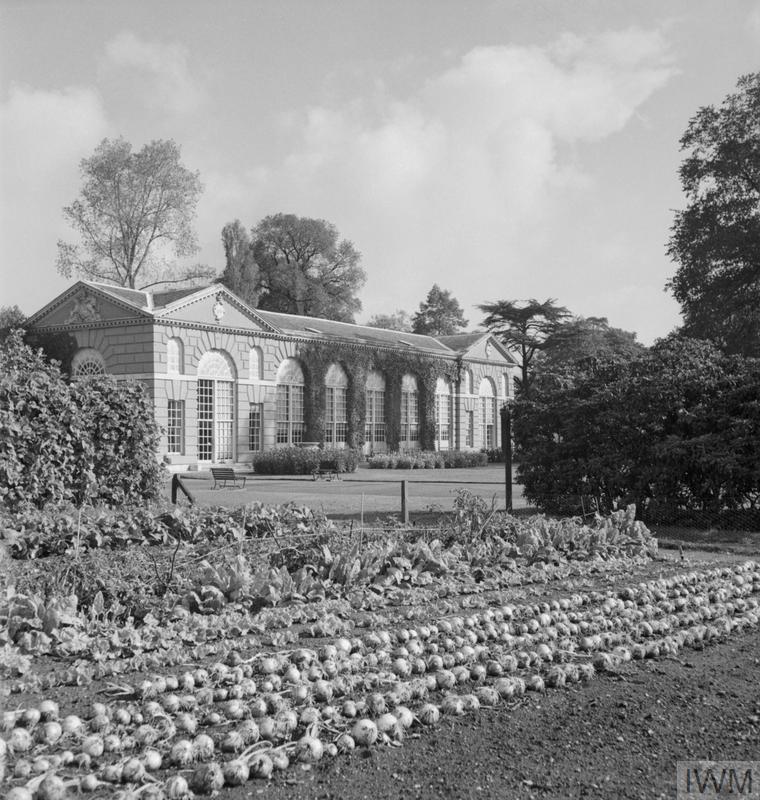
From a series of Ministry of Information photographs: The Work of Kew Gardens in Wartime (1943). With the impressive old orangery as a backdrop, vegetables grow in neat rows in the sunshine on the model allotment at Kew Gardens. The orangery belonged to the royal garden in 1761 and is now a museum. Copyright: © IWM.
There’s something so incongruous about long lines of freshly harvested onions laid out to dry in front of the famous orangery in Kew Gardens, where ordinarily we might expect to see well kept lawns or decorative beds of flowers. But in 1943, when these photographs documenting the work of Kew Gardens were taken for the Ministry of Information, England was at war.
Images from an unnamed photographer detail Kew’s contribution to the war effort, when research activities were re-focused onto the production of food, medicines and materials, which were in short supply. The National Archives records,
‘Staff concentrated on finding local alternatives for no longer importable goods, such as medicinal plants and vitamin rich foods. From 1940 the cultivation of pharmaceutical plants not of interest to commercial growers, but necessary for the war, became a new feature in the Gardens. Botanists were also involved in the research of rubber yielding plants and the use of nettle fabric for reinforcing plastic in aircraft construction.’
Keeping the iconic gates of Kew Gardens open during World War 2 was another priority, providing a place for the public to visit during the uncertainties of war. This ‘business as usual’ stance from the Gardens was a boost to morale, and there’s something reassuring and calmly defiant about the fragile glasshouse structures standing firm, despite occasional bomb damage.
After the outbreak of World War II in 1939, Kew Gardens closed to the public briefly to reorganise staff, relocate its invaluable collections of books and specimens to safer locations away from the capital and make preparations for possible air raids. Kew then remained open throughout the war, and according to the National Archives, attendance at Kew Gardens grew during the war years, surpassing the numbers of visitors in peace time.
An evocative colour film from 1941, likely shot by amateur filmmaker Rosie Newman, shows the Gardens teeming with people admiring the flowers and enjoying a moment of relaxation in the sunshine. (link below)
The activities of Kew’s employees are placed at the centre of these photographs, underlining the equal importance of everyone’s contribution to the huge task of running the Gardens in difficult circumstances. The tasks of ordinary workers like R Halsey, seen in a long tunnel fetching coal and stoking the furnaces beneath the Palm House, are especially striking, as is an image of refugee J A Simon from Alderney in the Channel Islands pictured building a traditional Channel Island hay rick. The hay was used to feed five working horses in the Gardens.
As part of the government’s Dig for Victory campaign, a ‘model’ allotment was constructed in the Gardens to Ministry of Agriculture specifications, and used to demonstrate the cultivation of vegetables to visitors. Some of the large lawns were provided to local residents to use as allotments.
As well as educating the public about how to grow their own produce, the challenge of food shortages was addressed by Kew via the development of new methods of crop cultivation methods. William Campbell, curator of Kew, pioneered a new process for growing potatoes more economically.
Traditionally, whole seed potatoes were planted into the ground to produce a crop, but Campbell’s new system divided a whole seed potato into slices. Sections containing an ‘eye’ were placed into a large tray to grow on, demonstrated by a female employee in one of the photographs. Each of these slices grew into a separate plant, increasing the number of potato plants available to grow on, and plants raised in this way were said to produce a heavier crop than those produced by the usual method, increasing yields. Campbell is pictured with one of the gardeners, inspecting the trial potato crop cultivated by use of his system.
As staff at Kew Gardens were called up for national service, their numbers were supplemented by women gardeners during the war years. According to Kew’s records,
‘Fourteen women were enrolled onto the staff in 1940, joined by a further thirteen in 1941. Most had previously trained as gardeners while others arrived at Kew via the Auxilliary territorial Services and the Women’s land Army. The women referred to their uniform of apron and clogs as battledress.’
At the end of the war in 1945, operations at Kew Gardens slowly began to return to normal, as damage sustained to the site was repaired, and items which had been moved for safekeeping were returned.
Kew Gardens remains an important symbol of the UK’s cultural and horticultural heritage, and these images of its gardeners, technicians, and management give us a better understanding of the challenges they faced in wartime, embraced with stoicism and creativity.
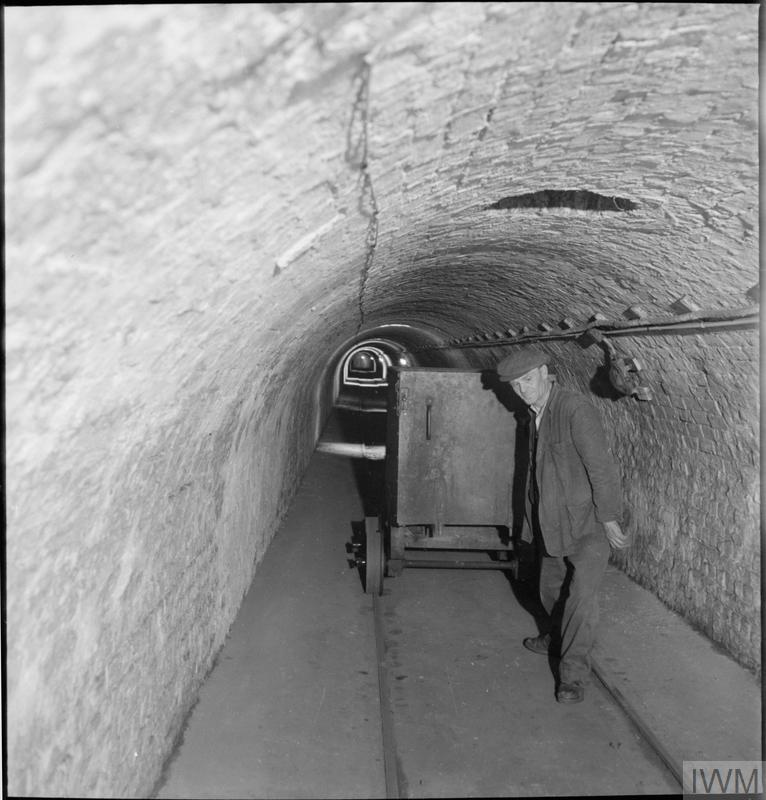
Deep beneath the Palm House at Kew Gardens, R Halsey pulls a truckful of coke along a tunnel, which stretches for a quarter of a mile, to the furnace which supplies the House with heat. According to the original caption, the ‘House was originally heated by draught from a furnace through the tunnel which runs the length of the building’. Copyright: © IWM.
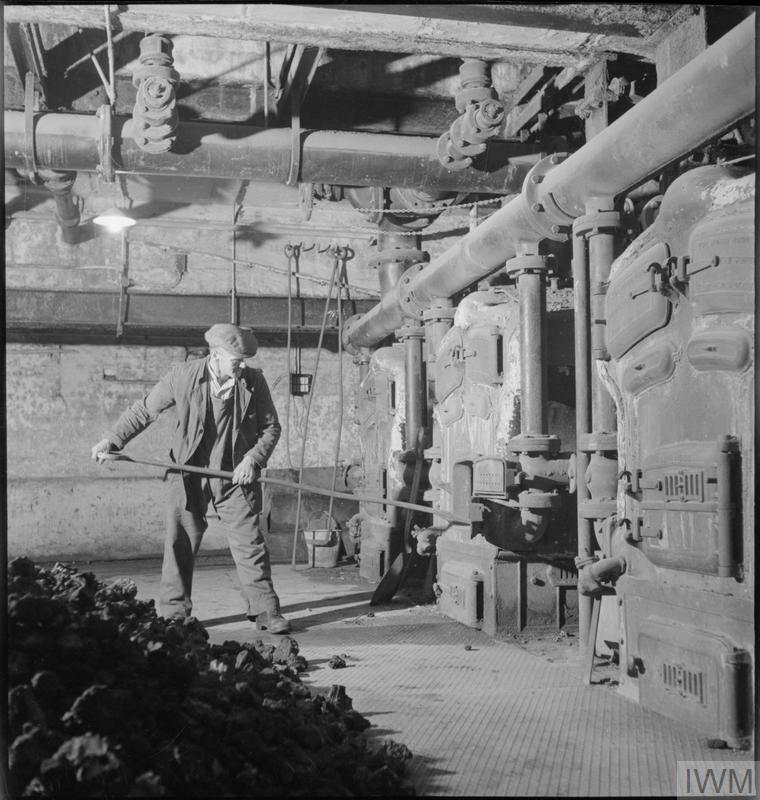
R Halsey stokes a furnace beneath the large Palm House at Kew Gardens. According to the original caption, these furnaces (there are two stokeholds under the Palm House) supply heat to approximately eight miles of hot water piping and burn about 800 tons of coke a year. Copyright: © IWM.
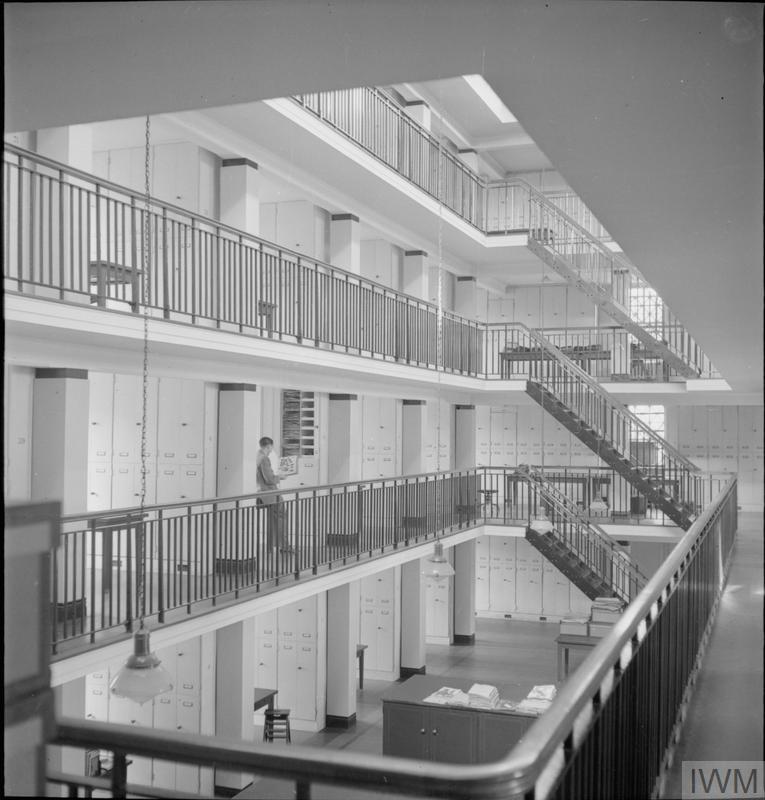
A view of the interior of the Herbarium at Kew Gardens, showing the scale of operations. The research centre covers four stories and includes dried plant specimens as well as books and journals. Copyright: © IWM.
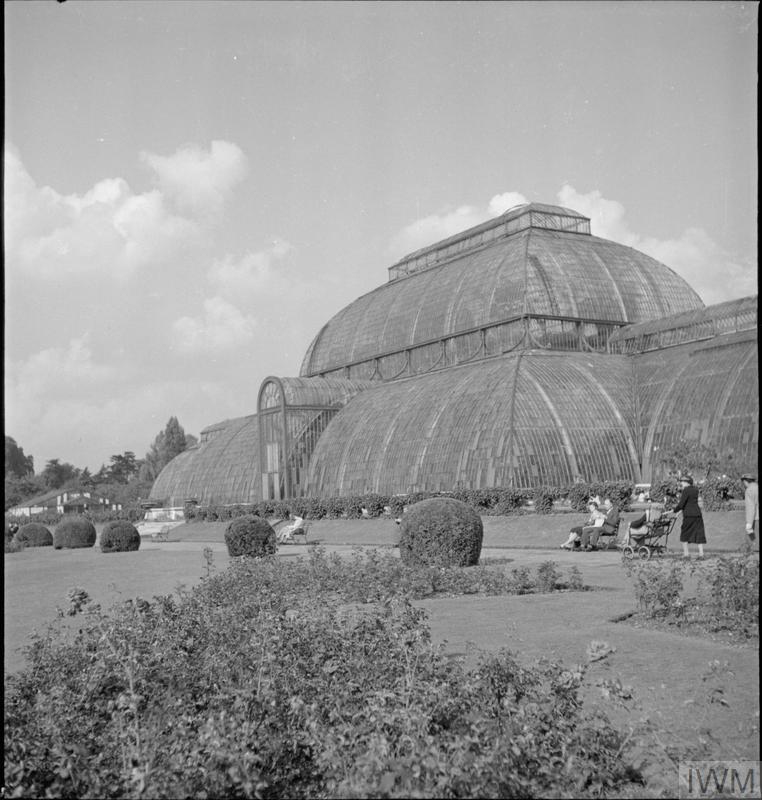
Visitors pass the impressive glass Palm House as they enjoy a relaxing stroll in the sunshine through the rose garden at Kew Gardens. There are between eight and ten thousand rose trees at Kew, and the rose garden has over 100 modern varieties. The dark panes of glass visible on the Palm House to the right of the photograph indicate where damage was sustained during an air raid. Copyright: © IWM.
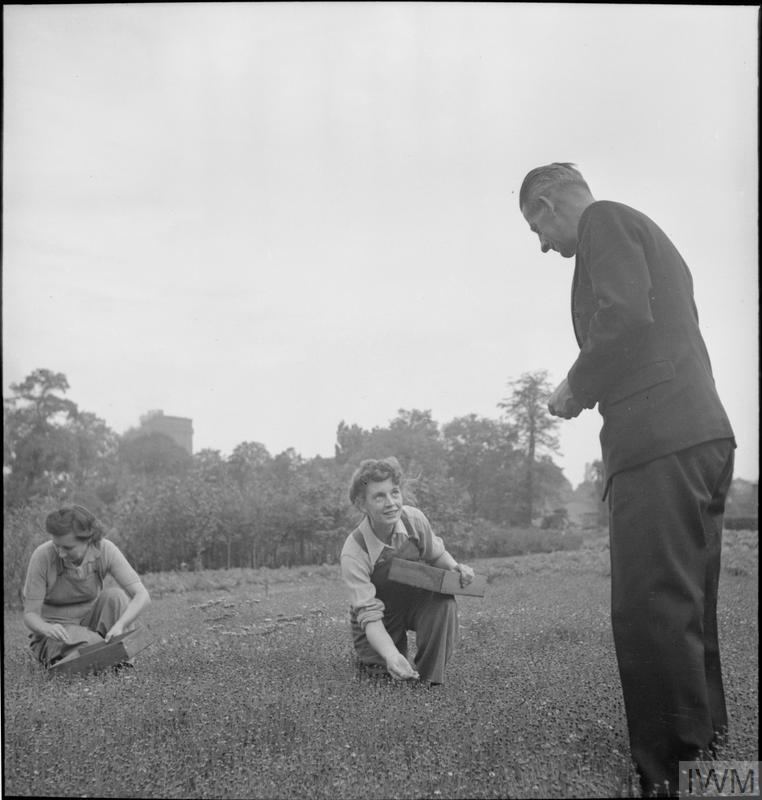
Curator of Kew Gardens, Mr Campbell, oversees the harvesting of seeds from the camomile lawn by members of the Women’s Land Army. The camomile was planted at the request of the Ministry of Home Security to be used as a quick-growing, wiry camouflage for new airfields. Copyright: © IWM.
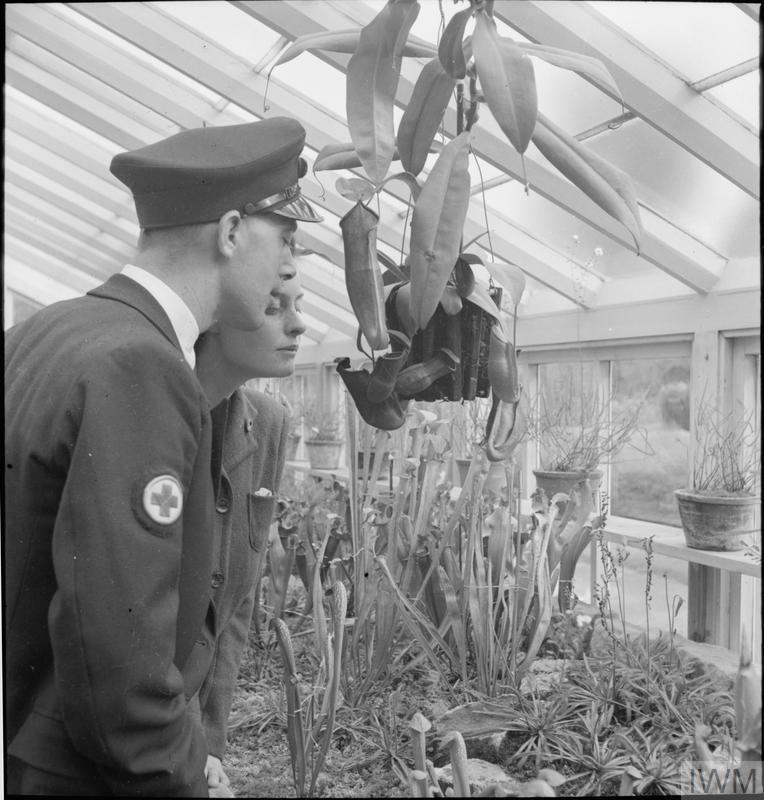
A member of the British Red Cross and his female companion inspect carnivorous pitcher plants from Malaya and Borneo in the tropical department at Kew Gardens. More insectivorous plants, such as the South African sundew and the American pitcher plant, can also be seen on the shelves of the greenhouse. Copyright: © IWM.
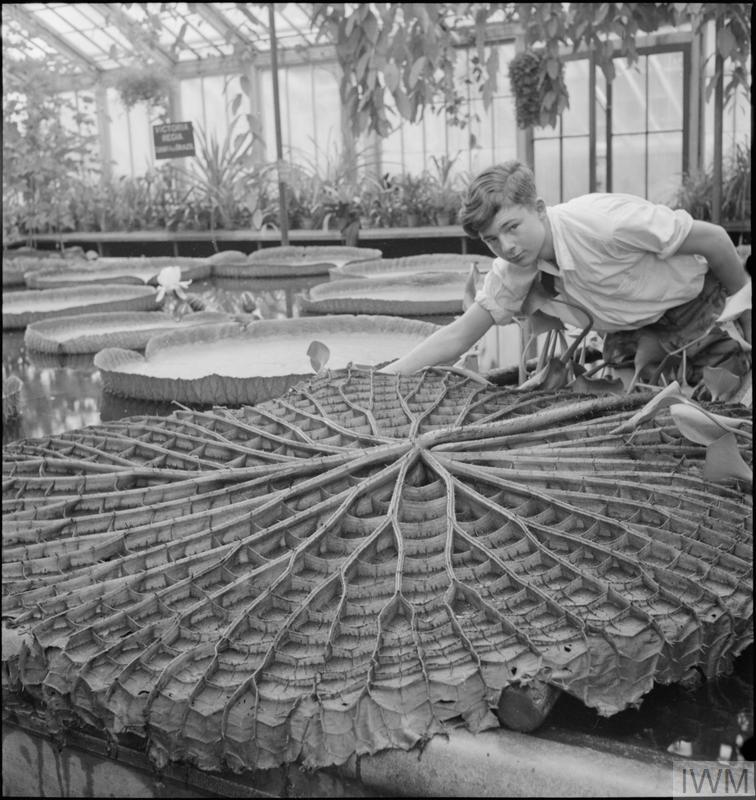
A young member of staff tends the ‘Victoria Regia’, a giant water lily from Guiana, in the tropical house at Kew Gardens. According to the original caption, the lily is very popular with visitors: ‘Grown from a seed the size of a pea in February, it develops leaves up to seven foot six in diameter by July. Underside of leaf is ribbed to help it float, and covered with prickles to keep off fish. Copyright: © IWM.
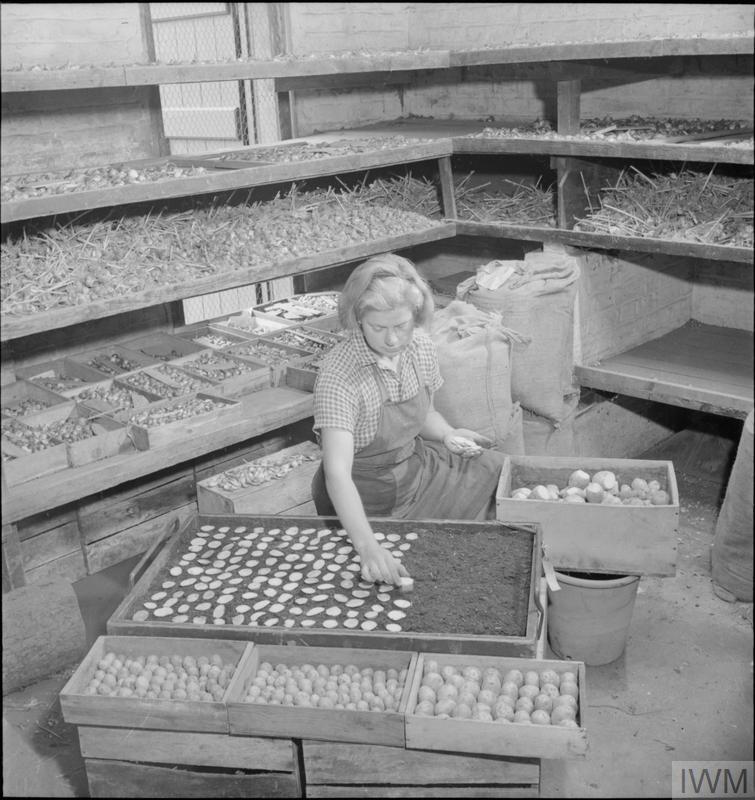
As part of an experiment requested by the Ministry of Food, an employee at Kew Gardens sows chips or slices of potato instead of full seed potatoes. According to the original caption, crops using this method were better than those grown in the normal way. Copyright: © IWM.
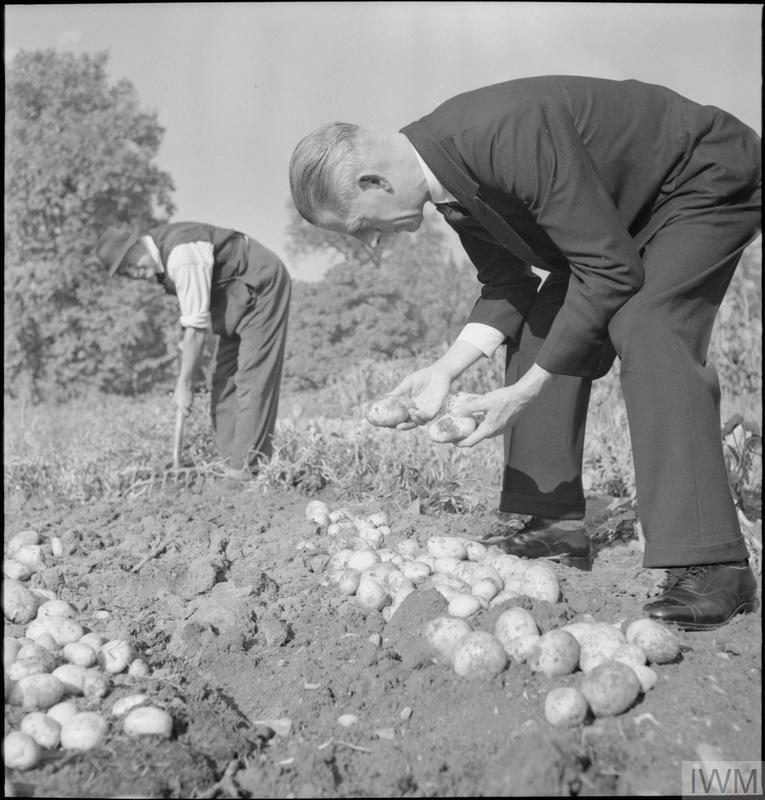
Mr Campbell (right), Curator of the Gardens, examines potato crops as they are lifted by a gardener. These potatoes have been grown experimentally, at the behest of the Ministry of Food, using a chip from a seed potato, rather than the whole thing. According to the original caption, crops using this method were better than those grown normally and ‘seed prepared at Kew is flown to Malta, Cyprus and Palestine to replace supplies cut off by war”. Copyright: © IWM.
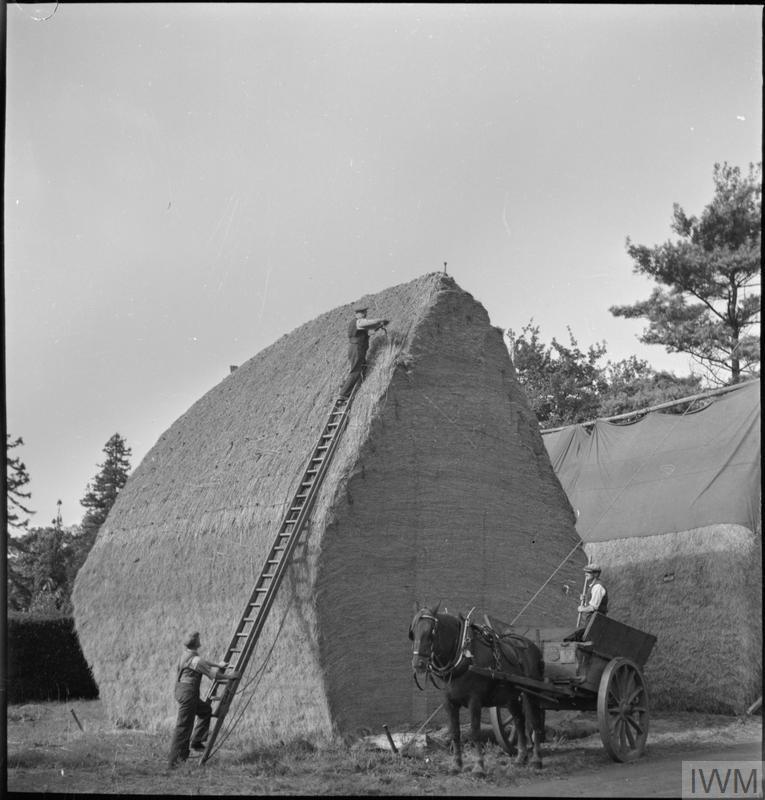
J A Simon, a refugee from Alderney in the Channel Islands, and his colleagues build a hay rick in the sunshine at Kew Gardens. Kew cuts its own hay for the five Suffolk Punch horses which are used in the garden. They are building a traditional Channel Island rick, using a very large ladder. A horse and cart can be seen to the right of the photograph. Copyright: © IWM.
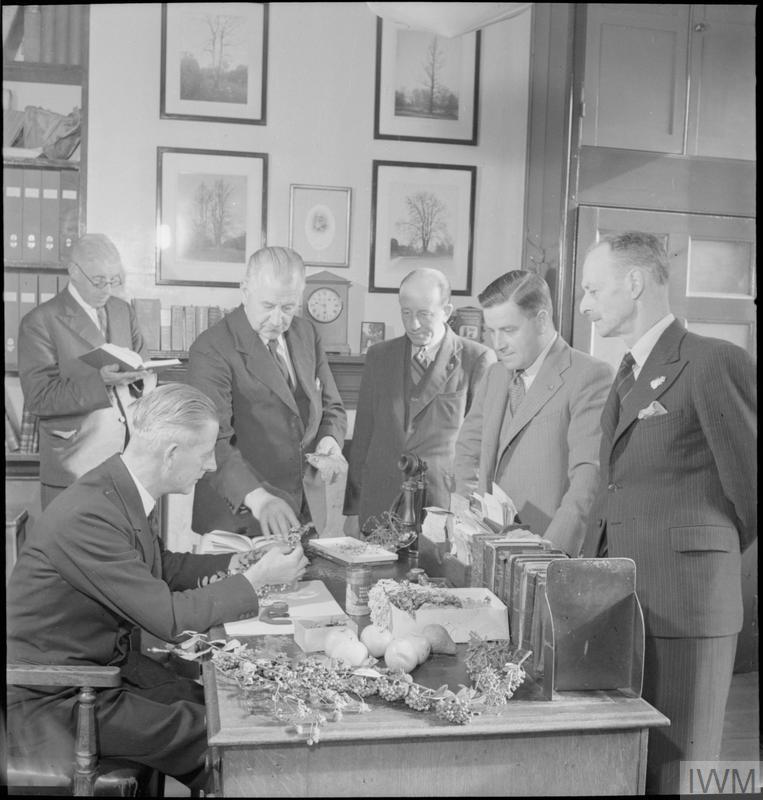
Curator of the Botanic Gardens, Mr Campbell (seated left) holds a daily meeting with his staff to discuss daily routine and to hand out specimens sent in for identification by the public. Left to right, the staff are: A Osborne (Arboretum), C P Raffil (Temperate House), L Stenning (Tropical House), S A Pearce (Decorative Department) and R Holder (Herbaceous and Alpine Department). Copyright: © IWM.
Further reading:
The Work of Kew Gardens in Wartime, Imperial War Museum online collection here
Papers of the Royal Botanic Gardens, Kew, during the Second World War National Archives here
Kew Gardens During the War – short film British Film Institute here
 Planting Diaries