Robert Furber’s January Flowers

January from Twelve Months of Flowers produced by Robert Furber 1730. The Morgan Library & Museum

Perhaps it’s during the short days and dark nights of January that we experience most a longing for fresh flowers.  Especially welcome are the first of the snowdrops and winter aconites; flowers so small they might be lost in the profusion of summer.  But now, emerging from the cold soil in this dormant season, they bring delight as they anticipate the coming of spring.

In a month where flowers are generally scarce, gardener Robert Furber’s astonishing bouquet representing January has apparently conquered the seasons with a super-abundance of blooms.  Alongside snowdrops and winter aconites, long sprays of fragrant citrus blossom are accompanied by stems of hyacinth, cyclamen, and anemone, the arrangement centered by two spectacular aloe flowers in red and gold.

Twelve Months of the Flowers published in 1730 by Robert Furber (1674 – 1756) is a series of engravings for every month of the year, designed in the style of Dutch flower paintings and featuring upwards of thirty blooms in each arrangement.  To produce the series, Furber’s collaboration with artist Pieter Casteels (1684 – 1749) and engraver Henry Fletcher (active between 1710 – 1750) involved each party investing £500 into the venture.  Public subscriptions and further sales after publication soon pushed them into profit.  The plates were originally sold for £1 5s in uncoloured form, or £2 12s 6d for a coloured version.

All the plants featured in the engravings were sourced from Furber’s nursery in Kensington from which he and his colleague John Williamson supplied clients with an extensive stock of tender plants raised in greenhouses, sought after bulbs and a comprehensive range of fruit trees.

Furber was a master of marketing and understood the power of the image to drive sales.  By producing this set of twelve high quality engravings, desirable objects in themselves, he positioned himself both as an expert horticulturalist, and as a person of taste, from whom similarly discerning customers could buy the choicest blooms for their houses and gardens with the greatest confidence.  If Furber was around today, he would doubtless be across all the social media channels with thousands of followers on Instagram.

Furber’s Twelve Months of the Flowers also speaks of a desire to regulate nature to a human timetable, especially by use of the heated greenhouse to force plants and to extend the seasons.  This approach has become a way of life for us now, with so many of our flowers, soft fruit and salad crops produced in this way.

Helpfully, each flower in Furber’s engravings has been given a number corresponding to a list at the base of each engraving, identifying individual plants and providing an important visual record of the range plants available in the UK in the early 18th century.  Here follow some observations about the flowers that brightened January days in the 1730s.  Links below:
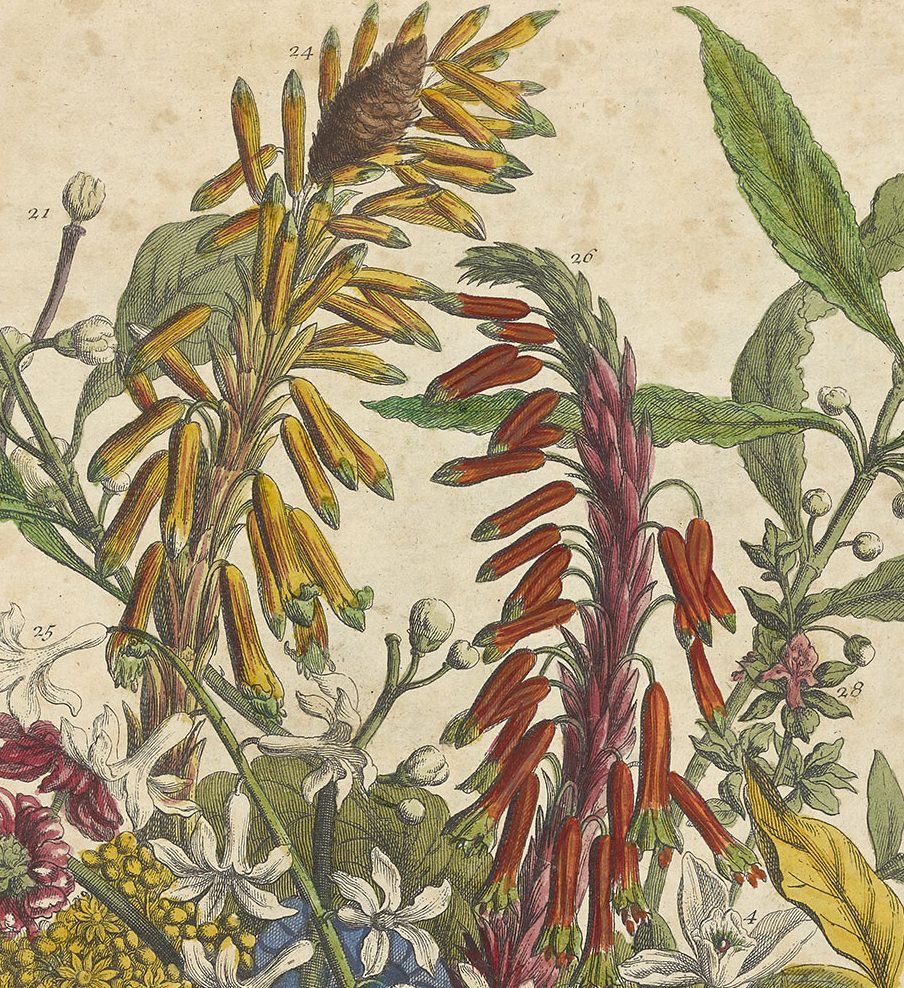
Grey Aloe (24) and Spotted Aloe (26)  Aloes from South Africa and the Canary Islands were popular greenhouse plants in the 18th century, recorded by artist Mary Delany and recommended by author and East London nursery owner Thomas Fairchild.
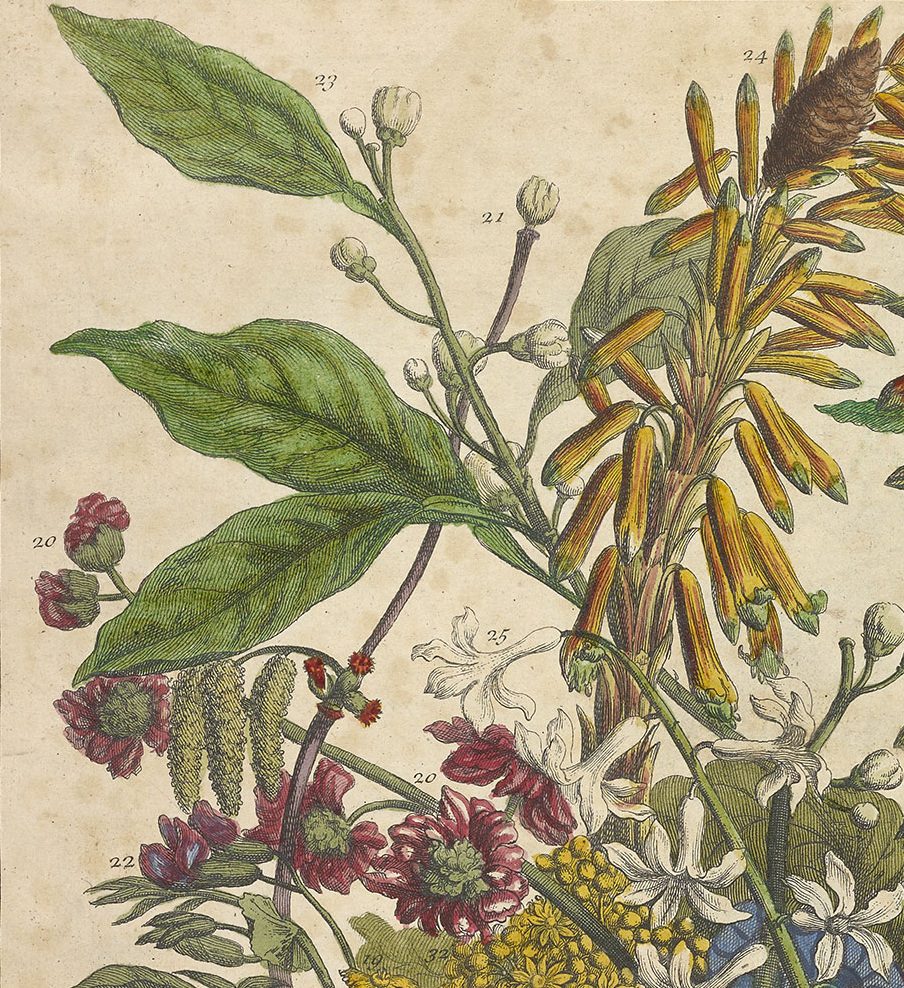
(23) Blossom of the Seville orange, whose fruits are used to make marmalade and (21)  Filberd tree in flower.  Amongst the exotic blooms, this branch of common hazel shows the beauty of both the catkins and bright red female flowers.
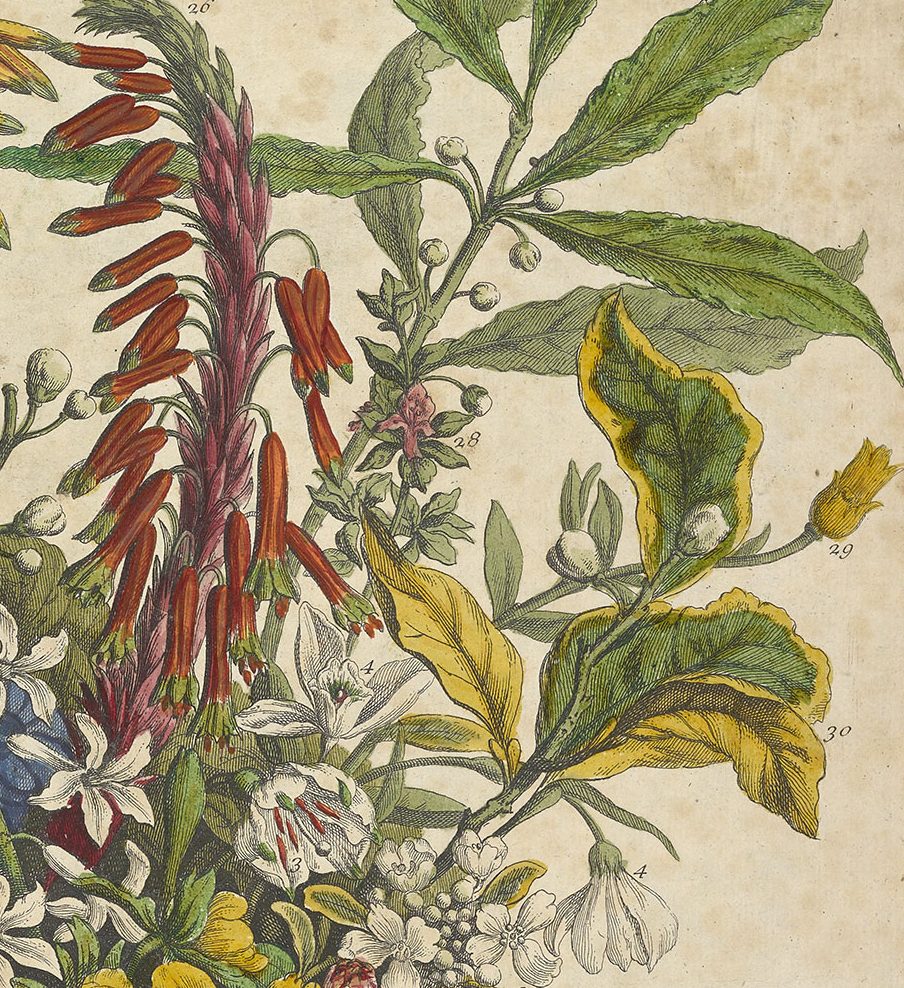
(30) The Strip’d Orange just coming into flower has green leaves bordered with yellow.  (3) Great early Snow drop (4) Single Snow drop, (28) Tree Savory.
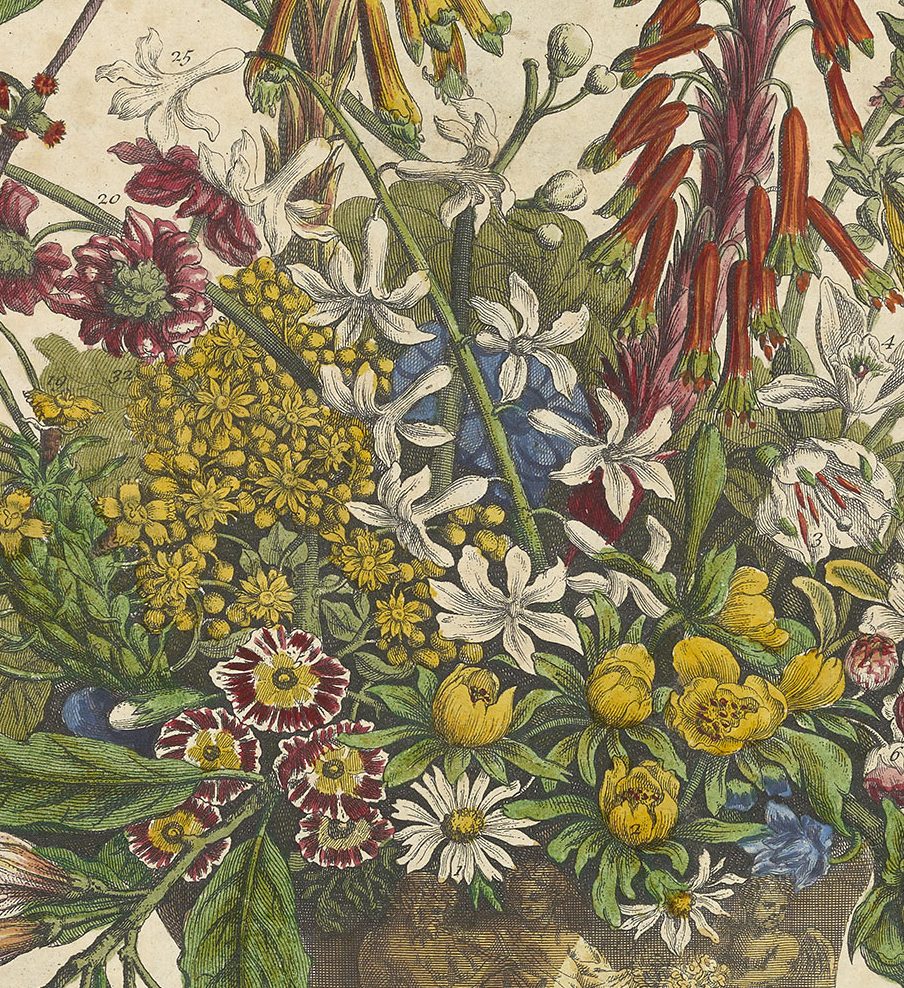
(25) Winter white Hyacinth.  This long, elegant stem with widely spaced flowers looks quite different to modern hyacinths where the flowers are bunched much closer together in the familiar cylindrical shape.  (20) Double stock, (32) Tree Sedum, (5) White edged Polyanthus, (2) Winter Aconite, (1) Pellitory with daisy flowers, possibly Anacyclus pyrethrum or Spanish chamomile.
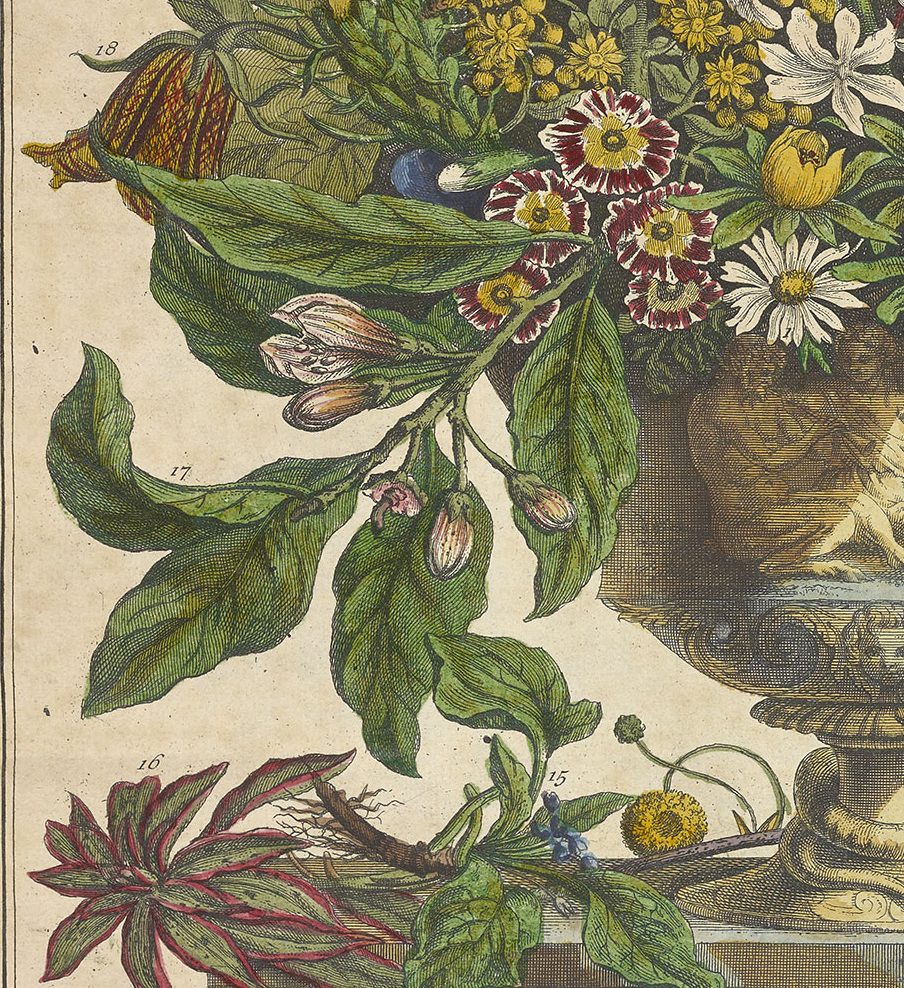
(18) Canary Campanula, most likely Canarina Canariensis the Canary Island Bellflower a fast growing climbing plant, grown from a tuber.  (17) Lisbon Lemon Tree, (16) Strip’d Spurge.  We know striped flowers like tulips and pinks were still immensely popular in this period and it would appear plants with multicoloured leaves were also valued as ornamentals in the garden.  (15) Creeping Borage or Bugloss.
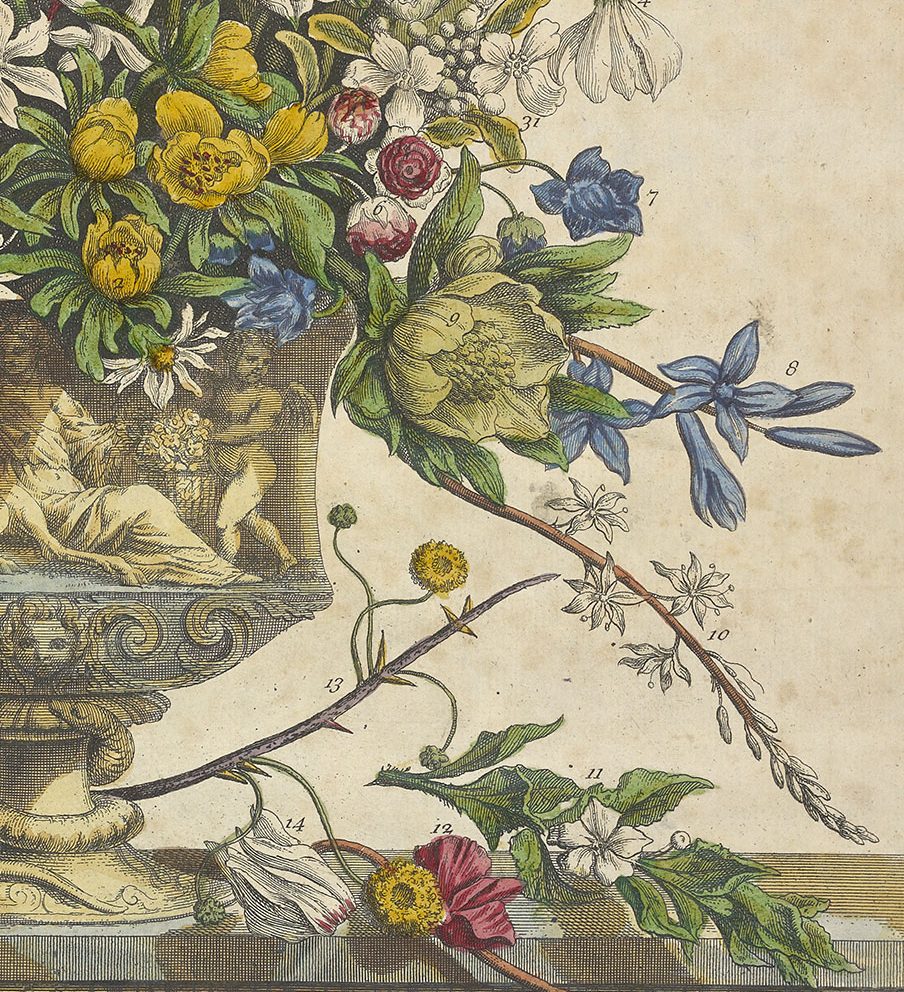
(31) Strip’d Candy tuft shown here with white flowers and variegated leaves, (6) Double Peach Coloured Hepatica, (7) Double blew Violet, (8) Winter blew Hyacinth, (9) Lesser black Hellebore, (10) Dwarf white King Spear, possibly a species of Asphodelus, common in the Mediterranean growing in stony ground.  (13) Acacia, or sweet button tree, possibly Acacia farnesiana, a plant with a wide distribution in the Americas, (11) Ilex leav’d Jasmine, (12) Red Spring Cyclamen, (14) White Cyclamen.
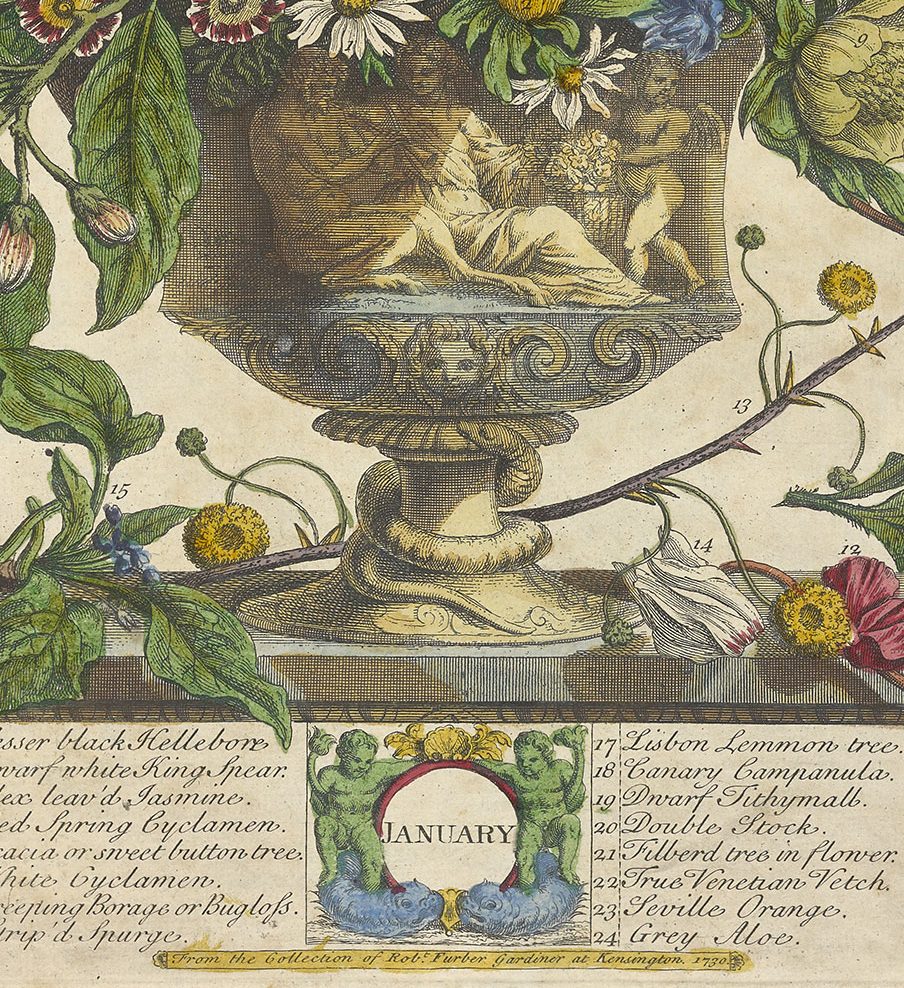
Beneath the cartouche for the month of January the legend says, ‘from the Collection of Robt Furber Gardiner at Kensington.  1730
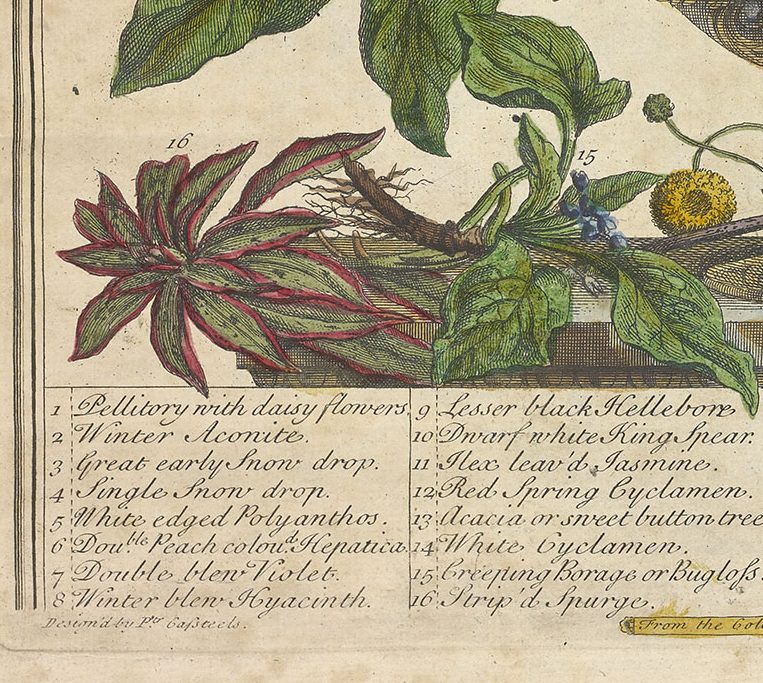
Design’d by Ptr Cassteels
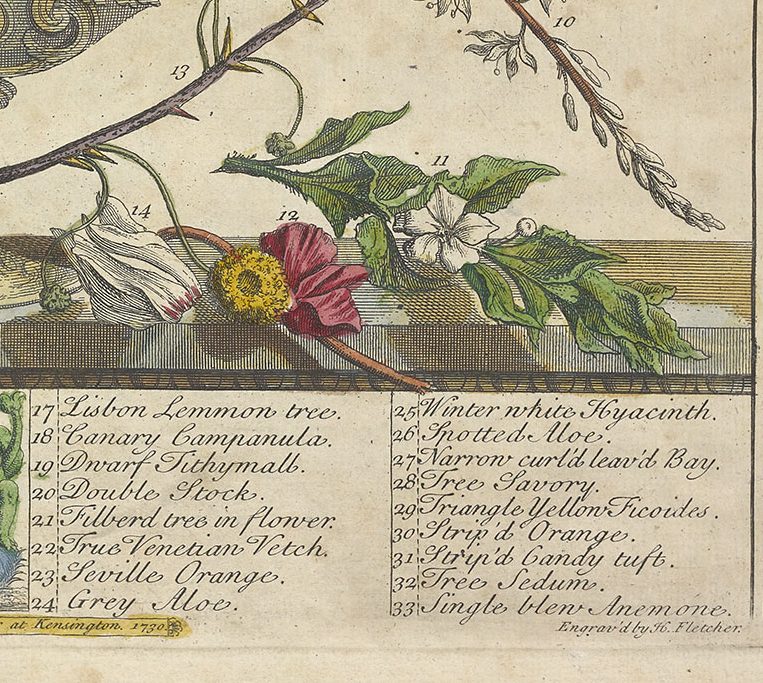
Engrav’d by H Fletcher

Further reading:

Twelve Months of Flowers at The Morgan Library & Museum here

Robert Furber Wikipedia here

The Catalogues of Robert Furber, The Garden History Blog here

Pieter Casteels Wikipedia here

Henry Fletcher, Wikisource here
Cecilia Glaisher’s Ferns

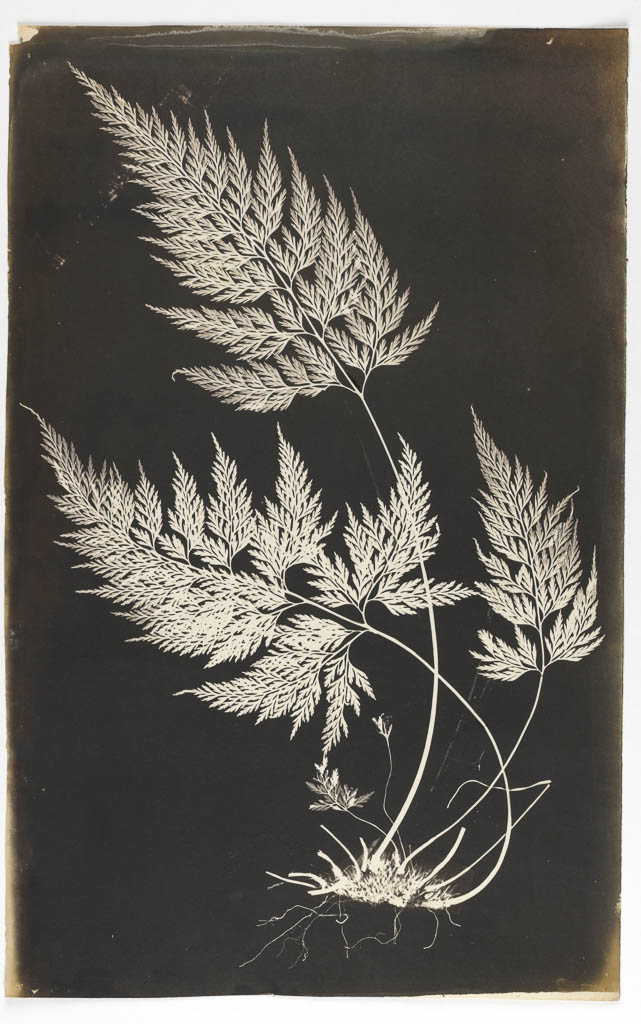
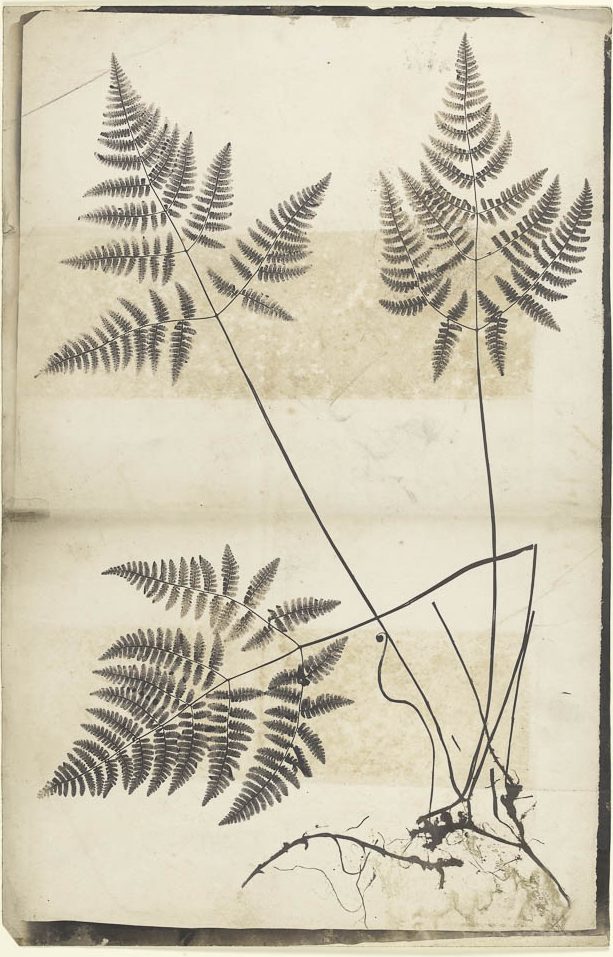
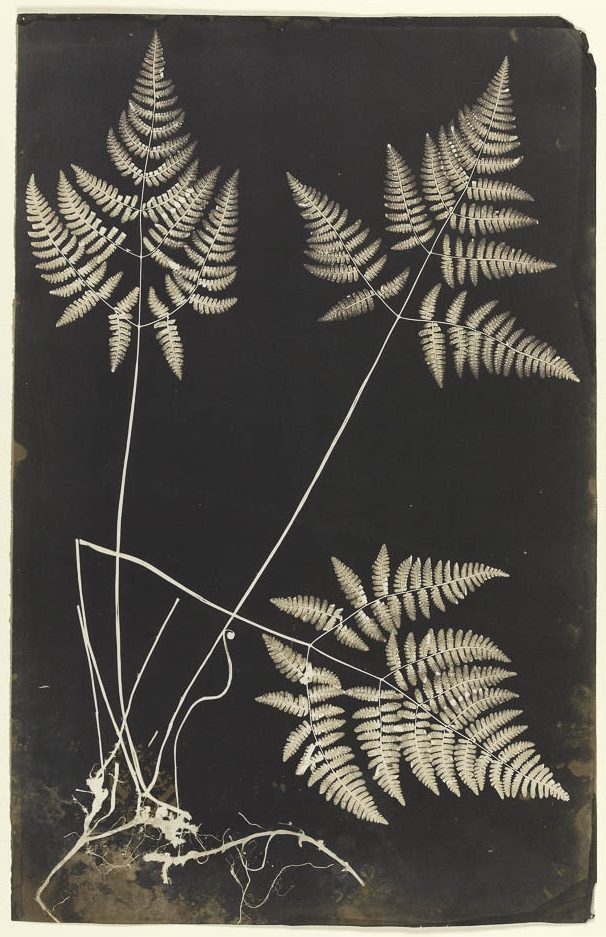
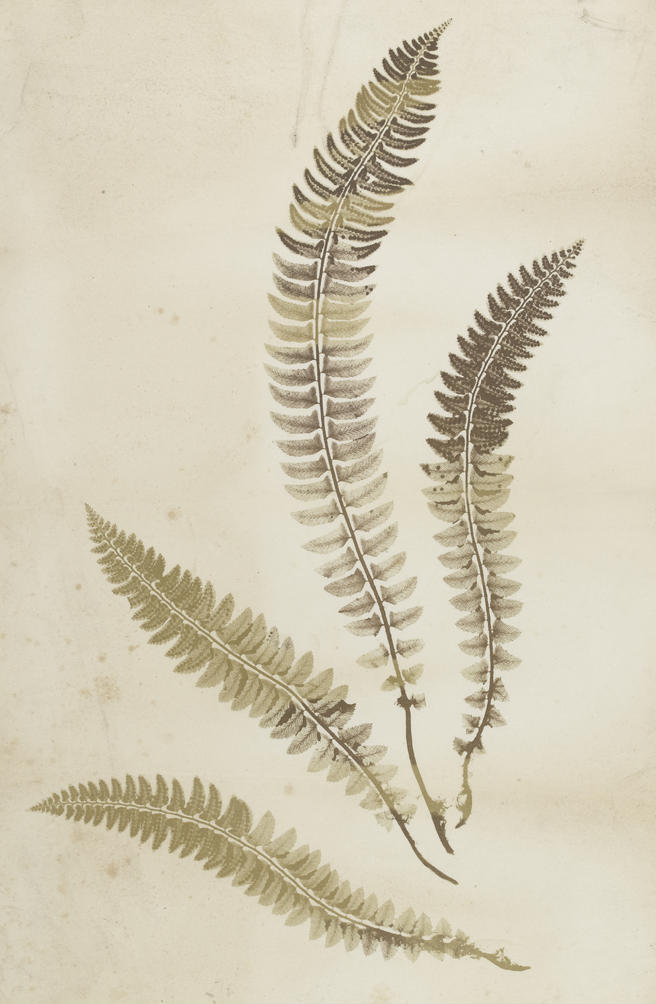
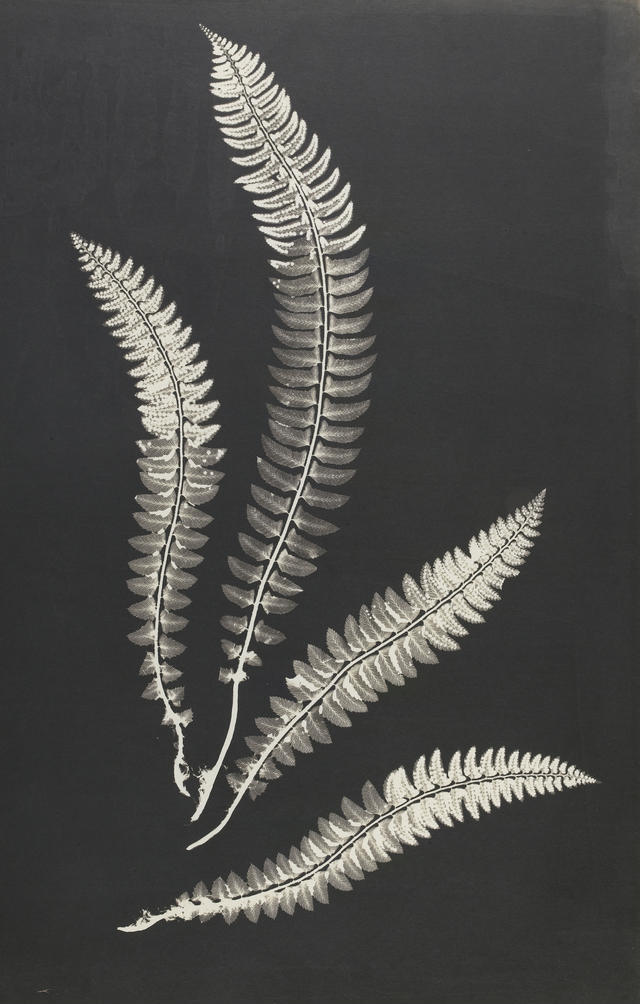
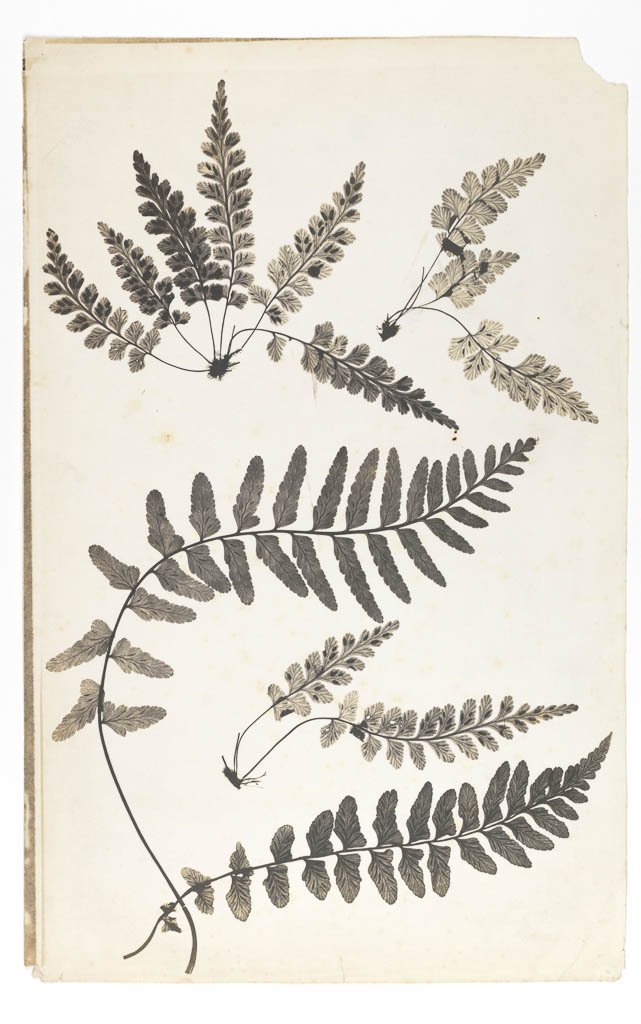
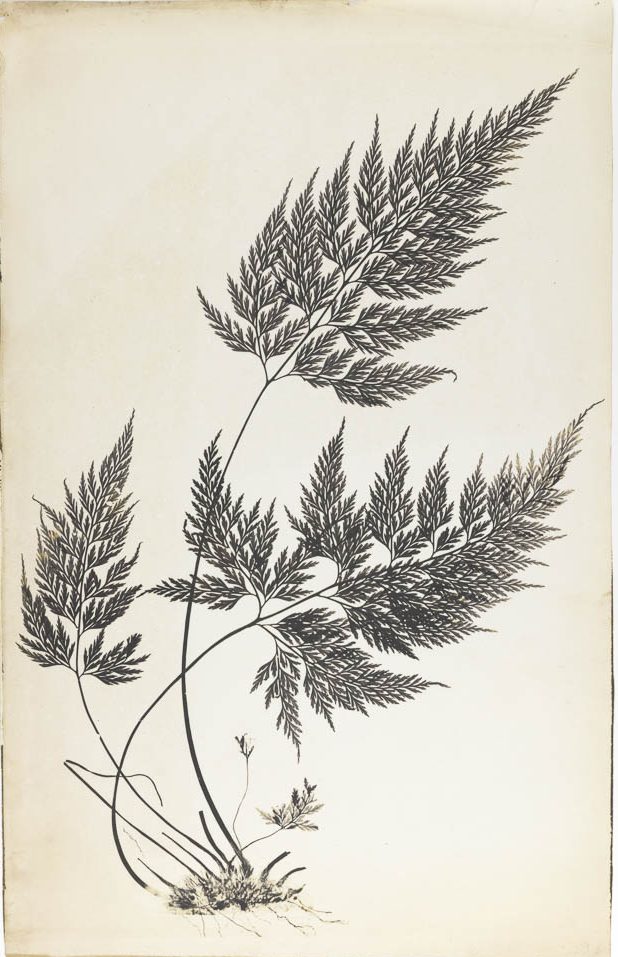
Irish Spleenwort fern. Salted paper print from a photogenic drawing contact negative Salt prints. The British Ferns – Photographed from Nature. Cecilia Glaisher (British, 1828-1892 ). All images courtesy The Fitzwilliam Museum, unless otherwise stated.

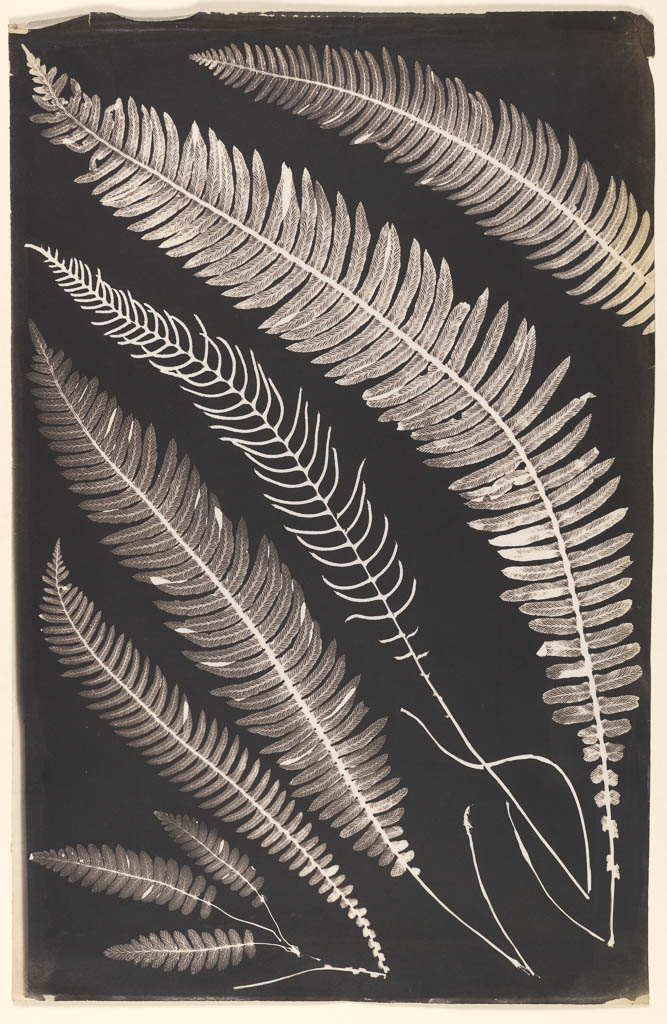
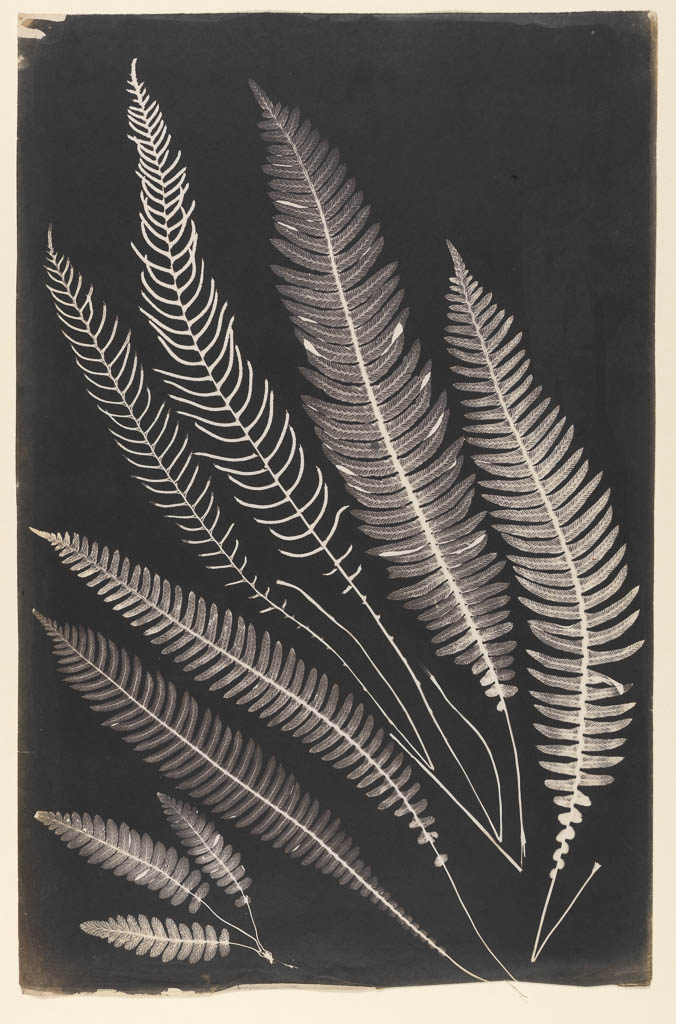
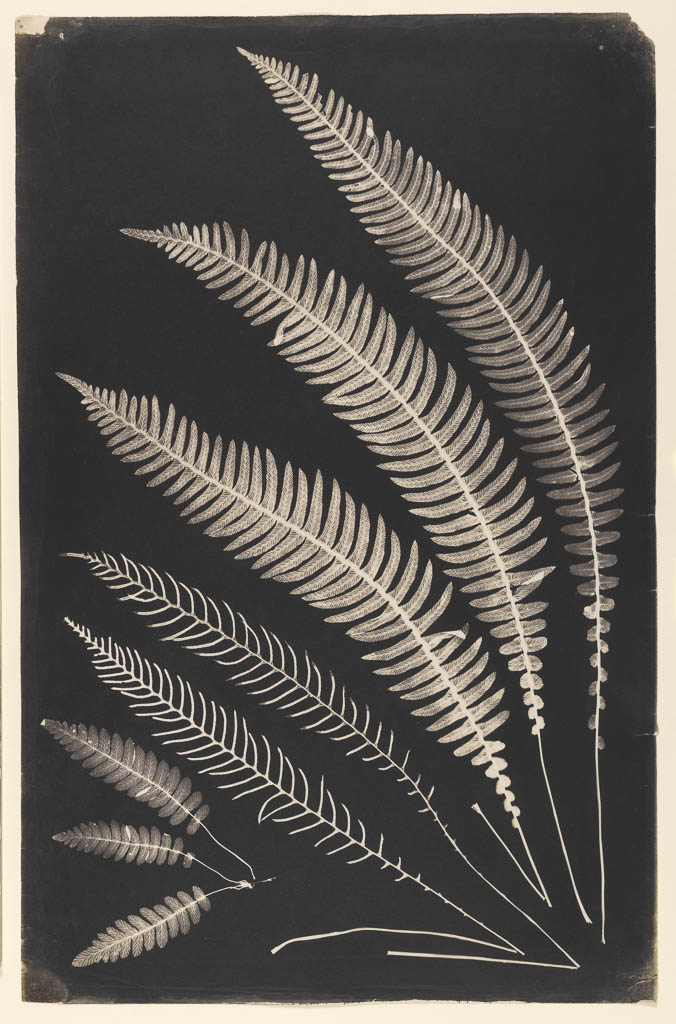
The British Ferns: Represented in a Series of Photographs from Nature by Mrs Glaisher was the title of a book project with promising beginnings, but for unknown reasons was never published.  It was planned in the early 1850s as a series of volumes of salt print photographs, a collaboration between artist and photographer Cecilia Glaisher (1828 – 1892) and Edward Newman (1801 – 1876), a natural history writer and author of A History of British Ferns (1840), a handbook aimed at amateur growers.  Newman’s text was popular, running to four editions by the 1860s and establishing him as an expert in the field.

Cecilia Glaisher was born in Greenwich, where her father John Henry Belville was an astronomical assistant at the Royal Observatory.  In 1843 she married James Glaisher (1809 – 1903) who was also employed at the Royal Observatory as Superintendent of the newly created Meteorological and Magnetic Department.  It seems likely that Cecilia started to experiment with photogenic drawing, the process pioneered in the UK by William Henry Fox Talbot, with the encouragement of her husband in the early 1850s.

Ferns were very much on trend in Victorian Britain when the nation was gripped by fern fever, or pteridomania.  Fern enthusiasts, both professional and amateur, sourced specimens for their collections from nurseries and from the countryside, while imagery of ferns abounded in decorative prints, fabrics, and ceramics.

Dozens of books about ferns were published during this period, some purely academic, others packed with illustrations, seeking to delight readers and explain cultivation techniques.  There was also a rush to explore new ways to represent ferns and allied plants, like mosses, using the latest technology of photography.  Anna Atkins’ cyanotypes of algae which she self published in 1843 is a well known example.

Nature printing was a much older printing method that experienced some new development in the mid 19th century.  Flat leaves, such as ferns, were ideally suited to this process, which traditionally were inked and pressed onto paper.  Henry Bradbury (1829 – 1860) patented a process where plant specimens pressed into lead plates that could be electroplated to become printing plates.  These plates were hand coloured producing lifelike coloured illustrations, such as those published in Ferns of Great Britiain and Ireland Nature Printed (Moore / Bradbury 1855).

Nature printed fern from The Ferns of Great Britain and Ireland (Moore / Bradbury 1855) Biodiversity Heritage Library

An article in The Athenaeum Magazine from 1855 sheds light on the progress of Glaisher and Newman’s fern photography project.  By June of that year, Glaisher had produced a sequence of salt print photographs which were exhibited at the Royal Society where they were reviewed favourably:

‘There were exhibited a collection of British ferns by Mrs Glaisher, from specimens collected by Mr Newman.  These beautiful copies, the size of life, and perfect in all their details, promise to be of value to the botanist, to whose requirements they are better adapted than any that have yet been placed at his command.  Their effect is that of delicate sepia drawings, and at the same time that the venation of the leaves is displayed with the fidelity and delicacy of the original, it is, as in nature, only to be detected on near inspection.’

The forthcoming publication was also mentioned:

‘Our acquaintance with the natural history of the ferns, and their peculiar elegance of form, is likely to be much increased by this valuable and interesting series, which, we understand, is in course of publication by Mr Newman.’

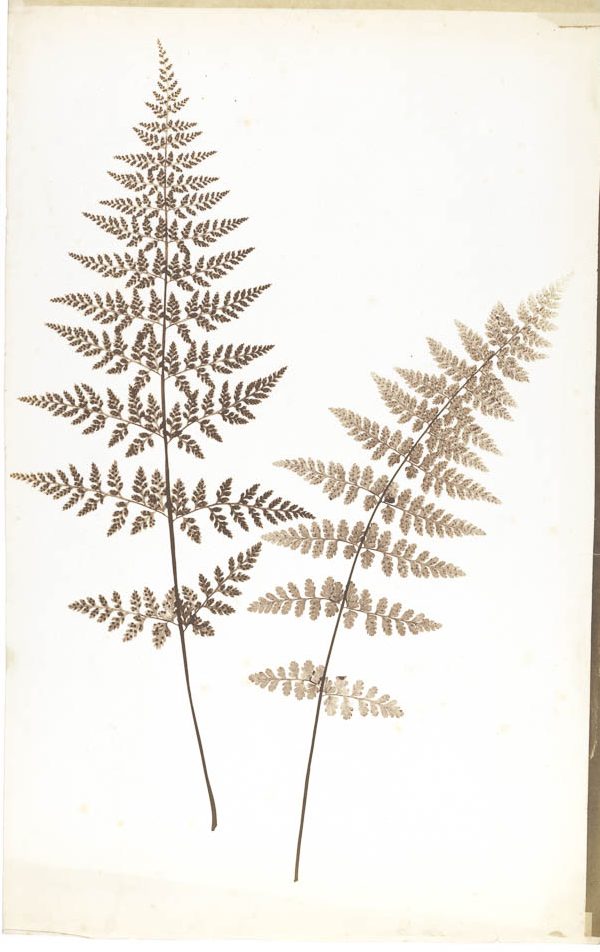
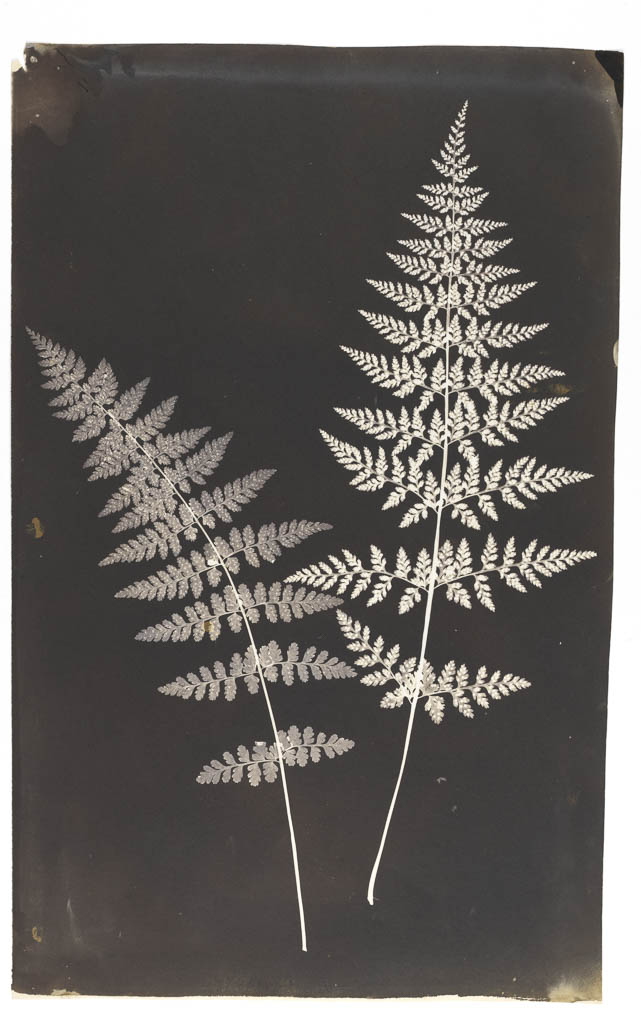
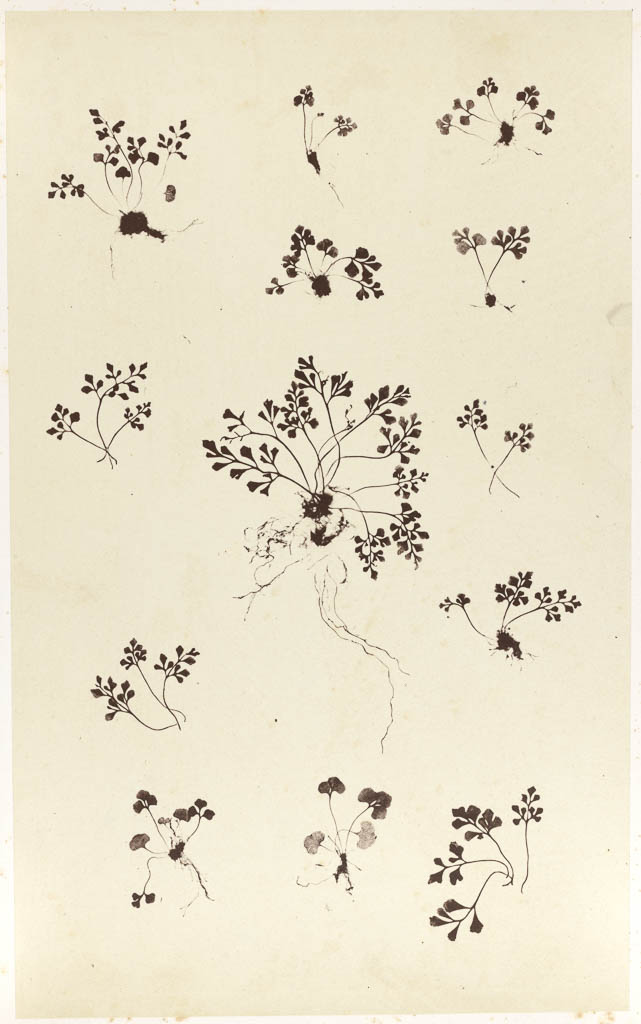
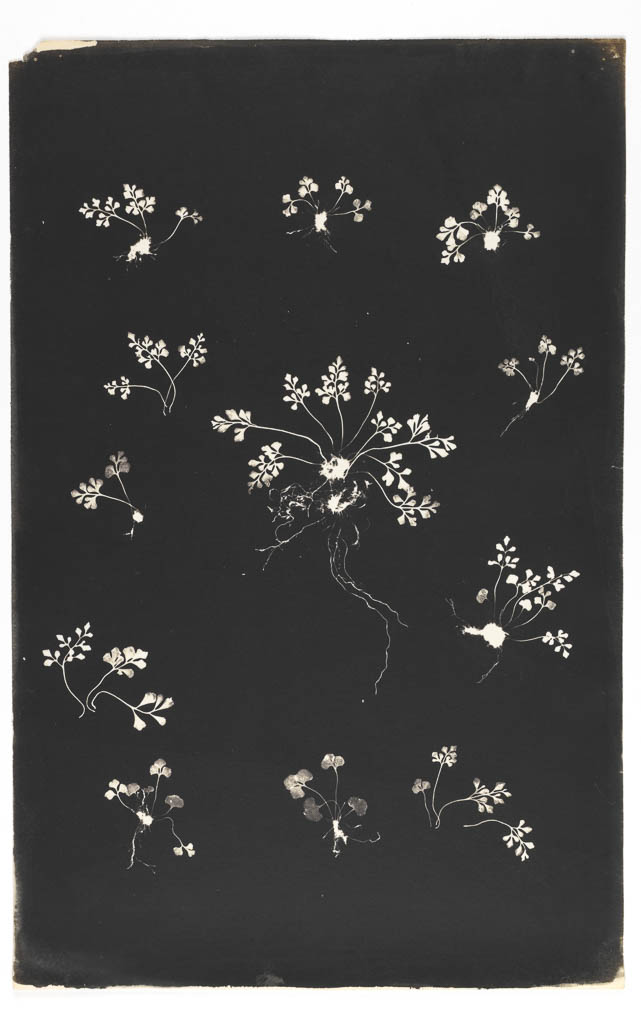
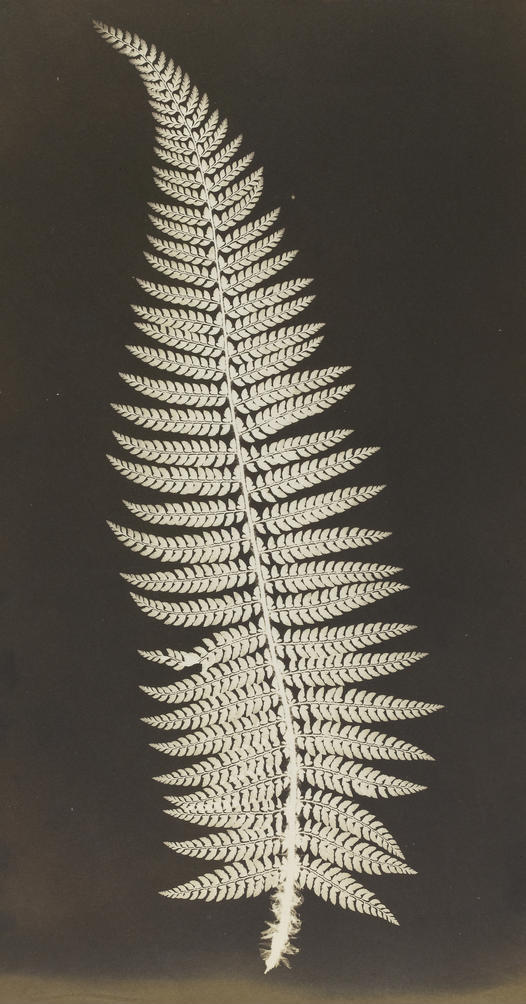
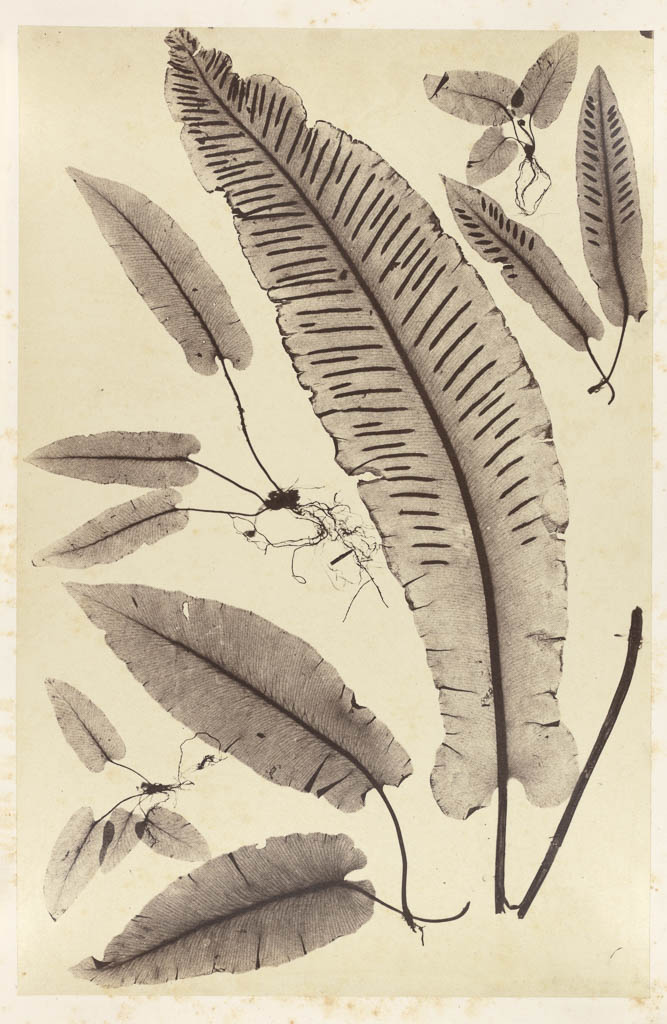
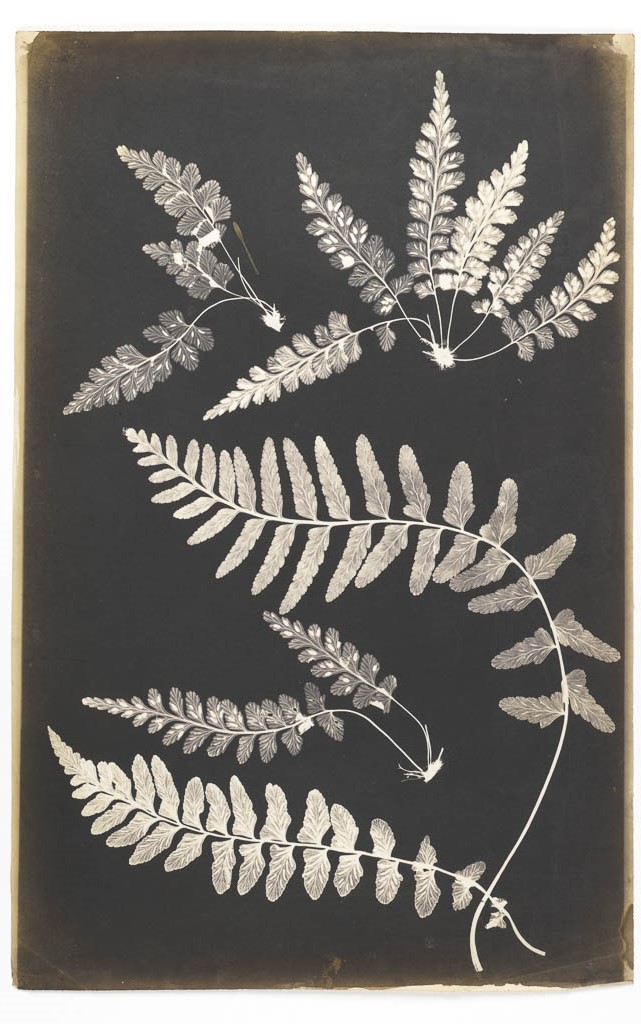
Glaisher’s elegant and accomplished photographs now held in The Fitzwilliam Museum’s collection show the ferns supplied by Newman in close botanical detail.  Multiple views of the same fern species demonstrate her experiments with composition.   Sometimes leaves are shown singly, or grouped together in varying numbers, while young plants are placed next to mature specimens for contrast.  Tiny wall-rue ferns are arranged together forming a complex pattern reminiscent of a Victorian dress fabric. Larger specimens have their stems bent to fit into the consistently sized rectangular space required for publication.

So, why did this project falter?  A number of possible reasons have been suggested including the complexities of printing the photographs in sufficient quantity to make publication financially viable.  Also, the appearance of Ferns of Great Britiain and Ireland in 1855, with its spectacular coloured nature prints, before Glaisher and Newman were ready to publish their work, might also have been a factor.

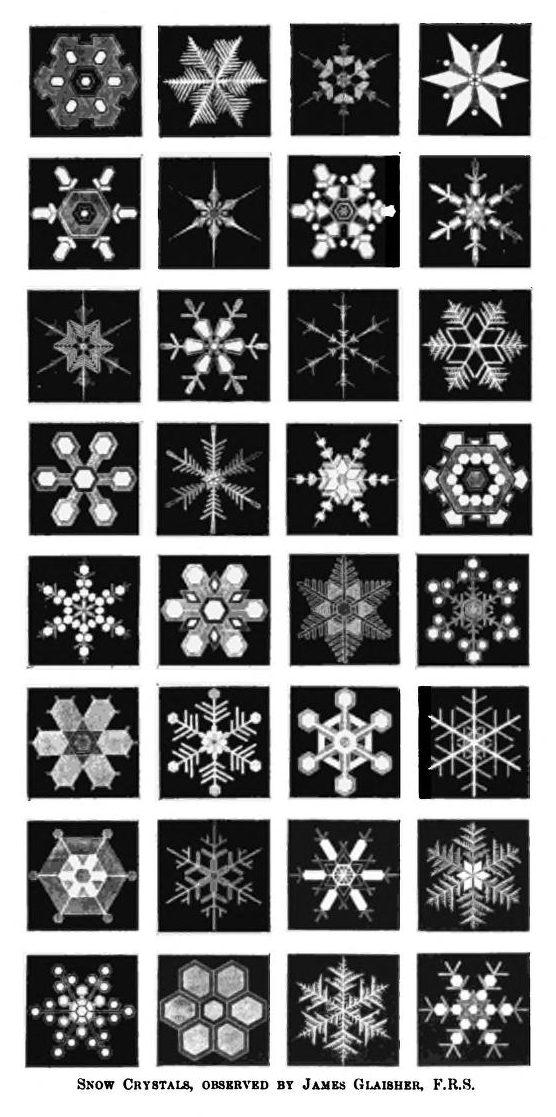
We can only think that the collapse of the fern project must have been a disappointment to Cecilia Glaisher, but fortunately there was another opportunity waiting for her.  Together, the Glaishers produced a series of one hundred and fifty illustrations of snowflakes for James Glaisher’s research paper for the Meterological Society, On the Severe Weather at the beginning of the year 1855: and on Snow and Snow Crystals.  James’s initial sketches of the individual snowflakes, observed through lenses from their house in Blackheath, were re-drawn and enlarged by Cecilia in a clear, diagrammatic style.  Cecilia also produced photographic copies of James’s snowflake drawings using salt prints.

Quarterly Journal of the Royal Meteorological Society

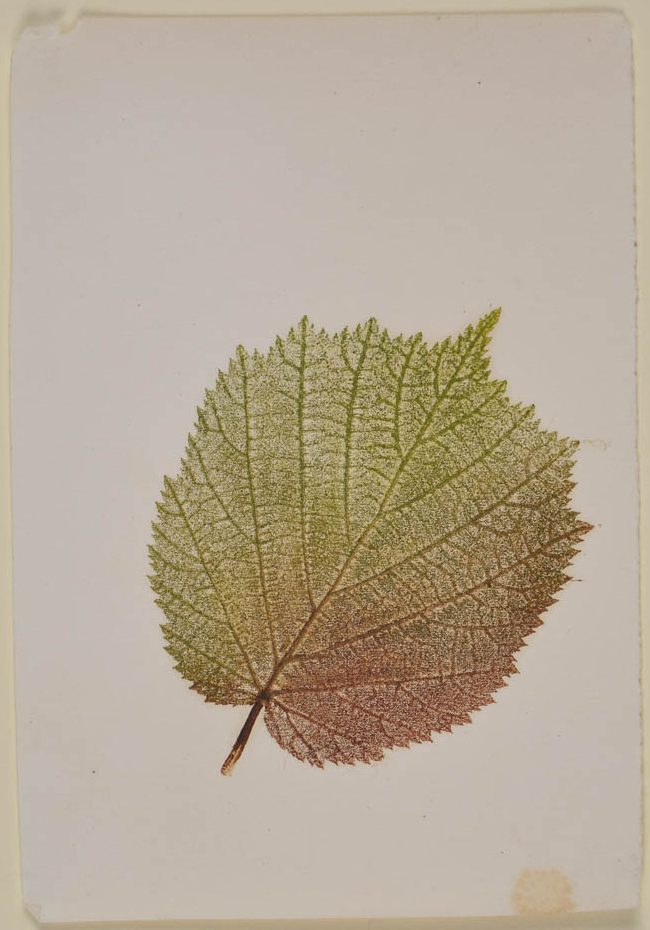
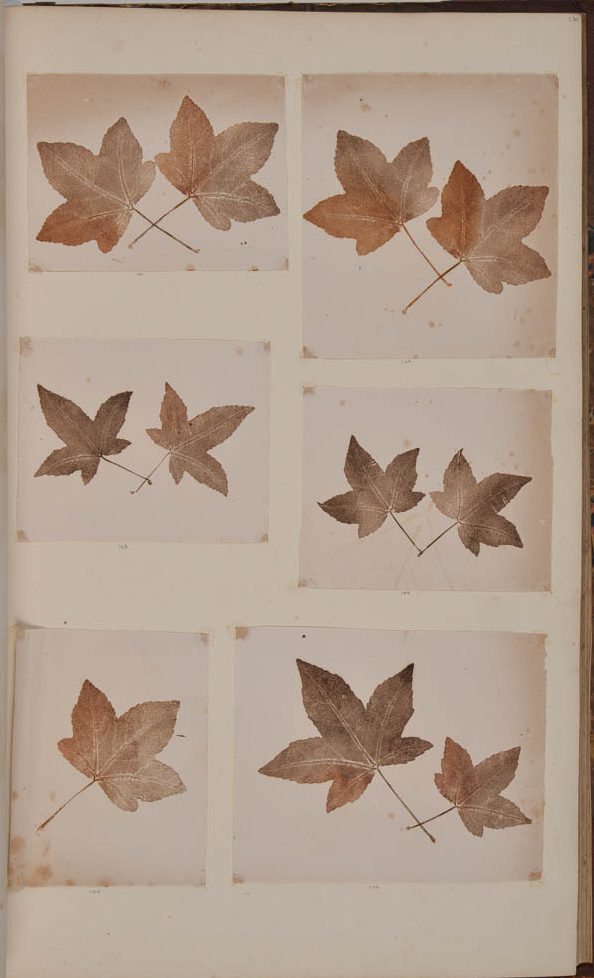
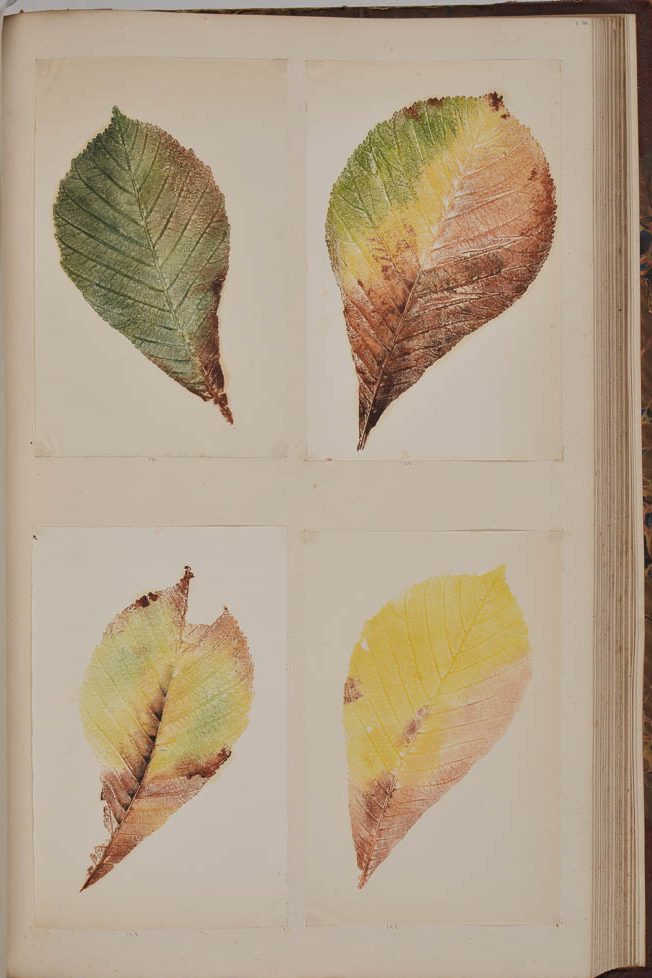
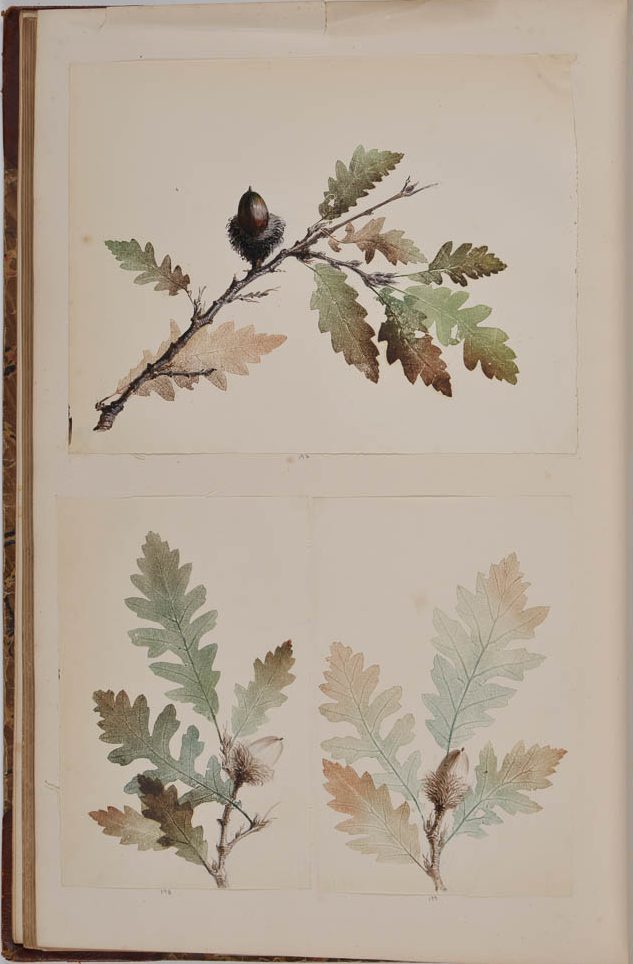
Although Cecilia Glaisher’s fern photographs weren’t published, they were preserved by her children and her son James presented them to The Fitzwilliam Museum in 1928 with some of her snowflake drawings and a series of highly accomplished nature prints depicting leaves and ferns.  One of the limitations of nature printing is that it works best with flat objects and in a series of images showing oak specimens Glaisher has addressed this by adding hand drawn details of branches and acorns.

Hazel leaf. Nature print in green and brown c. 1857

Maple leaves printed in brown. c. 1857

Horse chestnut leaf. Printed in green, brown and yellow. c. 1857

Turkey oak branch with leaves and acorn. Printed leaves in brown and green with hand drawn branch and acorn. c. 1857

Had The British Ferns: Represented in a Series of Photographs from Nature by Mrs Glaisher been published as planned, Cecilia Glaisher’s name would be much better known today as a photographer. Her ability to work with great precision and her systematic approach are skills that seem to lend themselves best to her still life photography.  While her snowflake drawings are undoubtedly accomplished, they are rather stiff and mechanical, with any flaws in the structures smoothed out.  But photography seems to release Glaisher from any tendency towards rigidity, her skills at arrangement and composition allowing the natural forms of plants, including their inevitable imperfections, to flow freely.

There’s lots more information about Cecilia Glaisher on the website dedicated to her work – see links below:

Irish Spleenwort fern. Photogenic drawing contact negative.


Narrow Buckler-fern, or Withering’s Fern. Salted paper print from a photogenic drawing contact negative.

Narrow Buckler-fern, or Withering’s Fern. Photogenic drawing contact negative.

Limestone (Oak) Fern, or Smith’s Fern. Salted paper print from a photogenic drawing contact negative.

Limestone (Oak) Fern, or Smith’s Fern. Photogenic drawing contact negative.

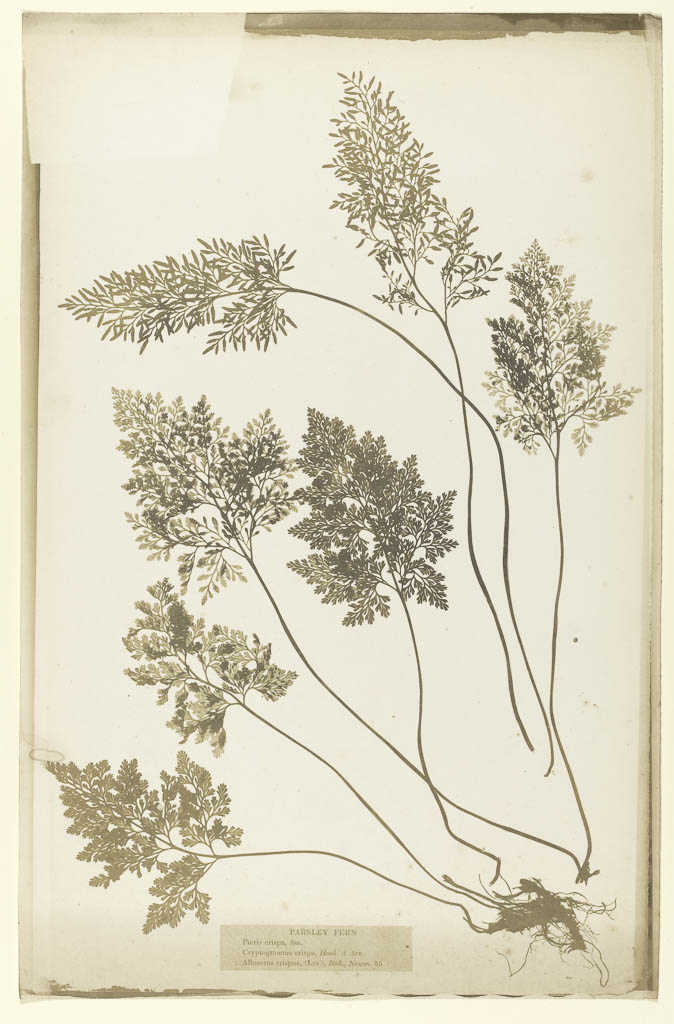
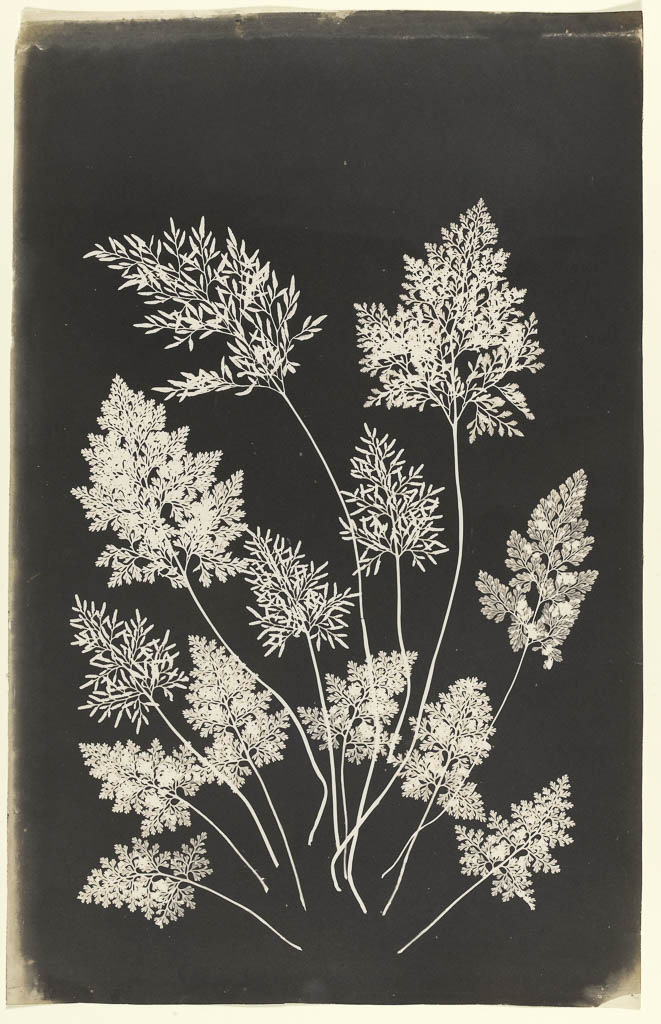
Parsley Fern, Rock brakes. Salted paper print from a photogenic drawing contact negative.

Parsley Fern, Rock brakes. Photogenic drawing contact negative. Thirteen frond composition.

Hard fern. Photogenic drawing contact negative. Sterile and fertile fronds.

Hard fern. Photogenic drawing contact negative. Sterile and fertile fronds.

Hard fern. Photogenic drawing contact negative. Sterile and fertile fronds.

Holly fern. Salted paper print from a photogenic drawing contact negative. Four specimens, ‘lantern composition’.

Holly fern. Photogenic drawing contact negative. Four specimens, ‘lantern composition’.

Wall-rue fern, or Rue-leaved Spleenwort. Albumen print from a photogenic drawing contact negative.

Wall-rue fern, or Rue-leaved Spleenwort. Photogenic drawing contact negative.

Soft Shield-fern, or Willdenow’s Fern. Photogenic drawing contact negative. Single frond.

Hart’s-tongue fern. Composition including sporelings, ‘enlarged’ composition. Albumen print from a photogenic drawing contact negative.

Sea Spleenwort fern. Salted paper print from a photogenic drawing contact negative.

Sea Spleenwort fern. Photogenic drawing contact negative. Composition with young plants, with water-drop mark.

Further reading:

Cecilia Glaisher’s work from The Fitzwilliam Museum: here

Cecilia Glaisher’s website: here

Cecilia Glaisher on Wikipedia: here

Edward Newman on Wikipedia: here

James Glaisher on Wikipedia: here

The Athenaeum Magazine, June 1855: here

Valerie Finnis: A Centenary Celebration

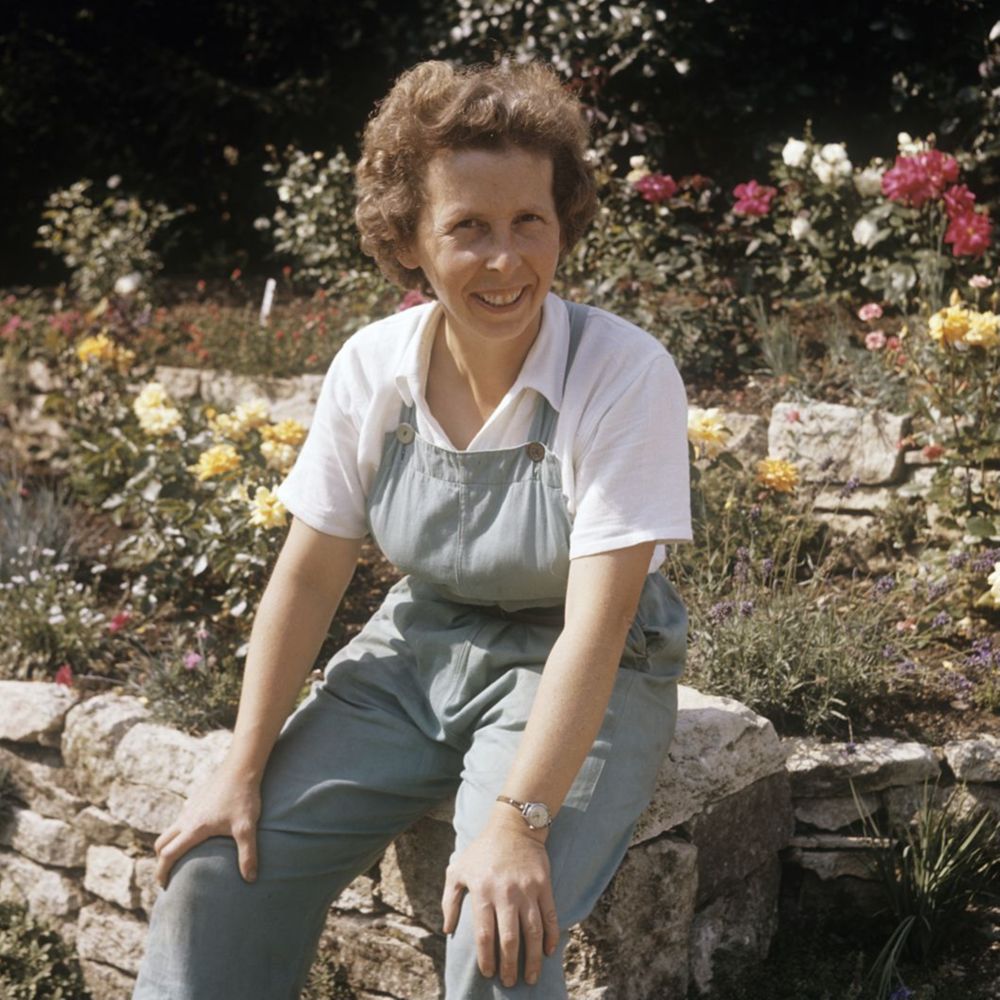
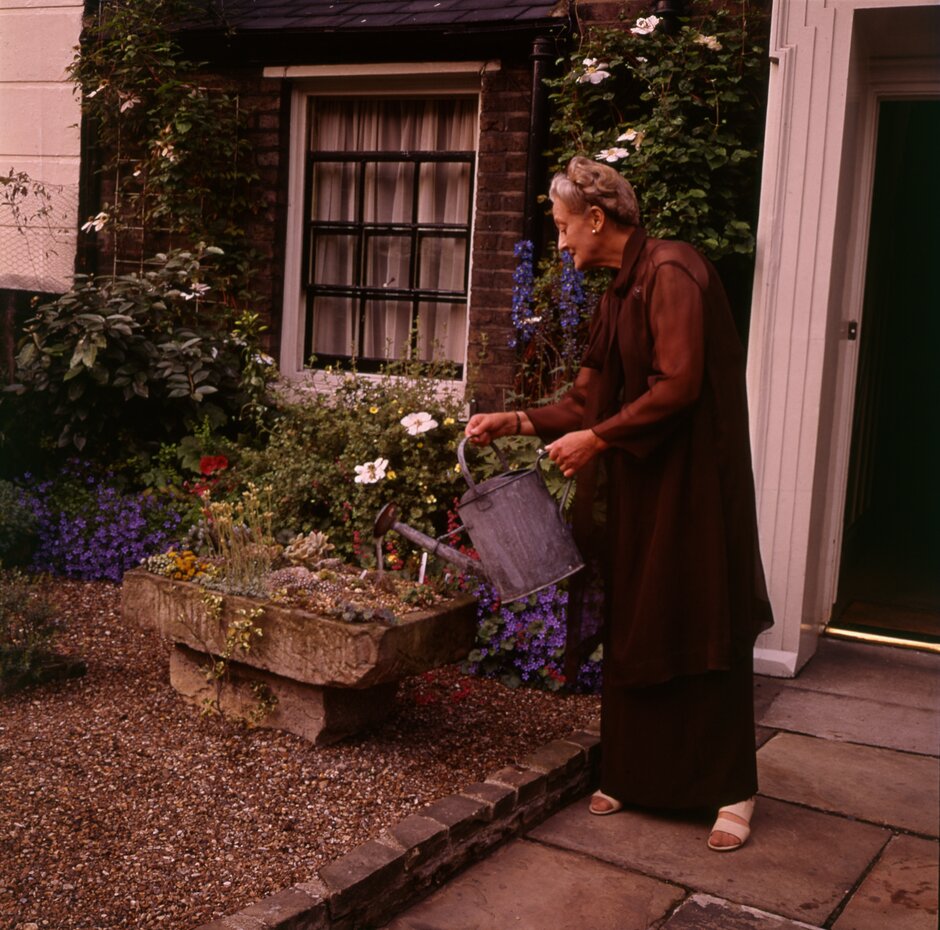
Photographer and alpine expert Valerie Finnis (1924-2006) sitting on a wall at the Waterperry Horticultural School. All images RHS Lindley Collections unless otherwise stated.

Valerie Finnis 31st October 1924 – 17th October 2006

The end of this month marks the centenary of Valerie Finnis’ birth, which seems like a perfect time to celebrate her life and photography.  A professional gardener, alpine specialist and prolific photographer, Finnis produced still life images of plants and portraits of gardeners from her wide acquaintance in the world of horticulture, where she was exceptionally well connected.

Finnis trained at Waterperry Horticultural School for Women in the early 1940s, continuing at the Oxfordshire based school as a tutor.  Following her marriage to retired diplomat Sir David Scott in 1970 she left Waterperry and continued to pursue her interests in gardening, photography and activities with the Alpine Garden Society and the Royal Horticultural Society from their home, at the Dower House of Boughton House, in Northamptonshire.

After her death in 2006, friends of Finnis took steps to preserve her extensive photographic archive, which was eventually housed by the RHS and a biography of Finnis by Ursula Buchan, Garden People (Thames & Hudson 2007), brought details of her life and her extraordinary images to a wider audience.

Valerie Finnis’ centenary happily coincides with the recent online publication of her photographic archive by the RHS.  With around five hundred images released to date, including some previously unpublished work, this provides an ideal opportunity to revisit her photographic legacy, in particular her portraits of gardeners.

Finnis was taught how to use a camera and photograph alpine plants by Wilhelm Schacht, curator of Munich Botanic Gardens, and who gave Finnis the Rolleiflex camera she continued to use throughout her career.  Other than this, Finnis had no formal photographic training, which raises some questions.  How did she develop her distinctive portrait style, with people at work in their gardens, bending, stretching, kneeling and using tools? And who were the photographers she whose work she admired, from whom she drew inspiration?

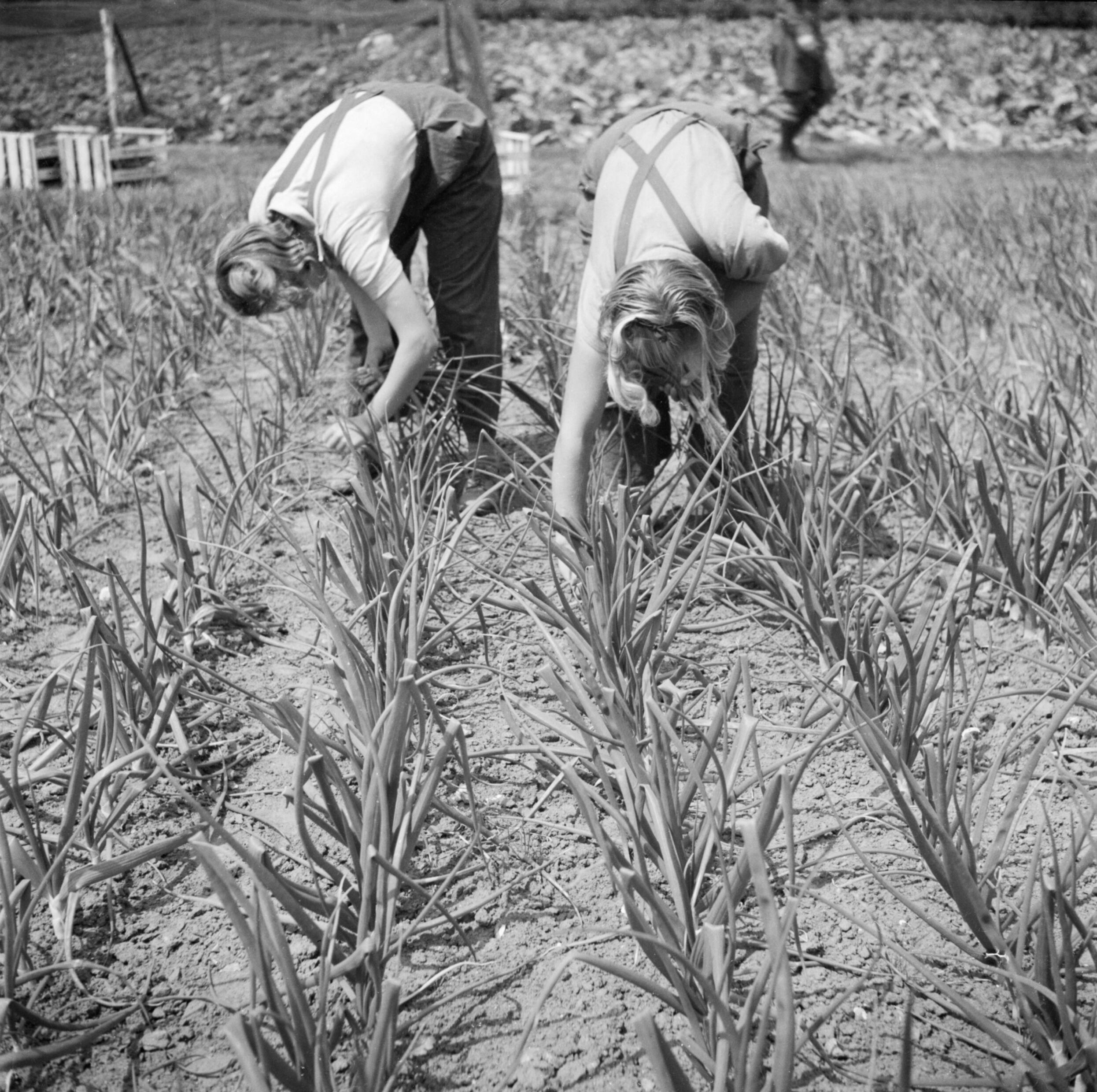
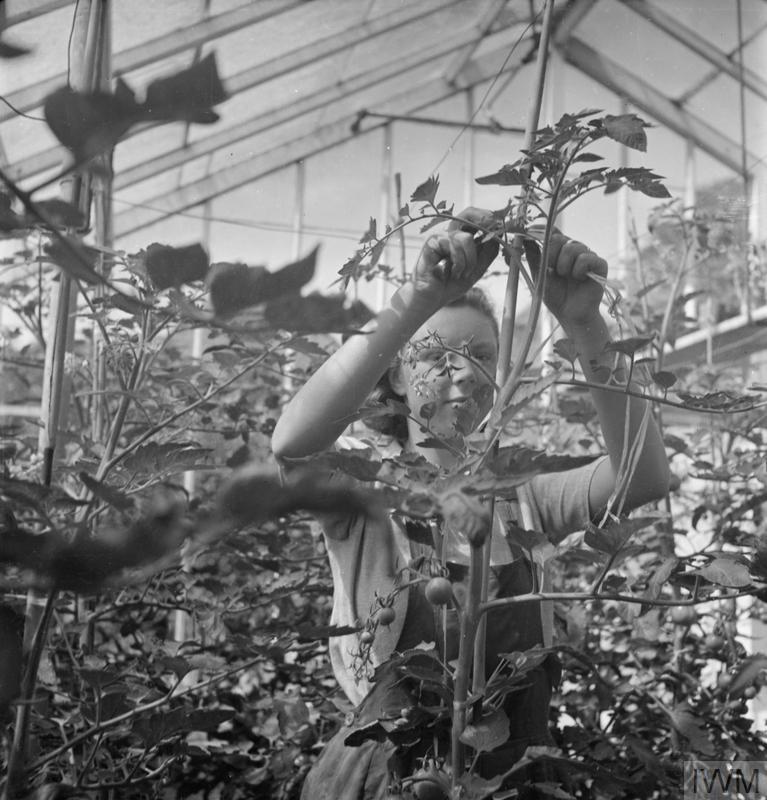
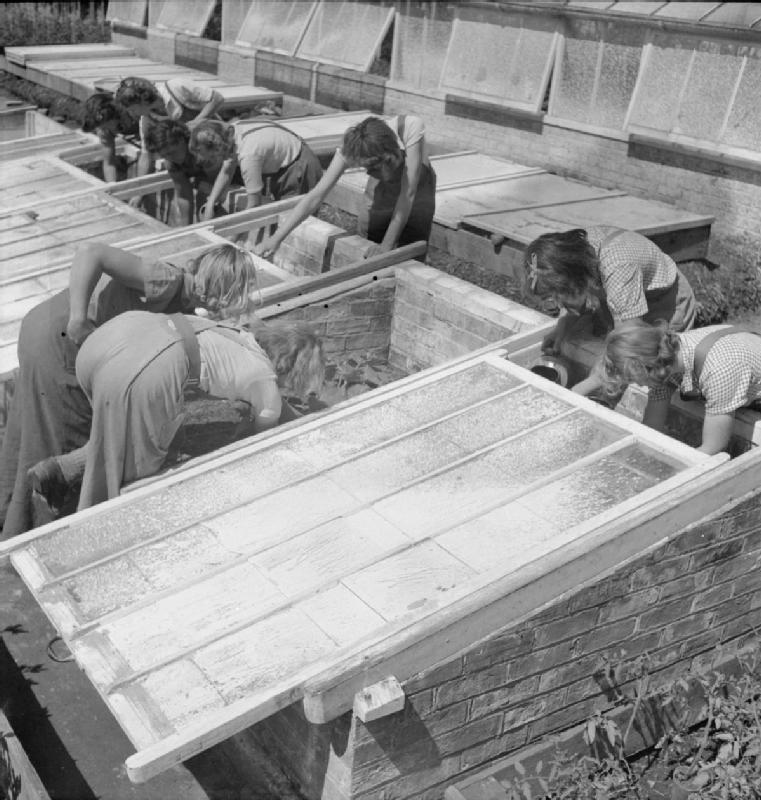
As far as I know, these questions weren’t ever put to Finnis, but a visit to Waterperry in 1943 by photographer Cecil Beaton supplies some interesting clues.  In his capacity as an official war photographer, Beaton’s assignment was to record crop production at the school, and his photographs show students, staff and land girls planting, pruning, harvesting and using agricultural machinery.  This style of photograph, showing workers doing their jobs, was used extensively by the Ministry of Information to elevate ordinary people and their tasks, transforming them into heroic and inspirational figures, intended to boost public morale and encourage participation in the war effort.

‘Thinning onions and assuring a good crop and no more onion shortages for the housewives of Britain.’ DB264  CECIL BEATON PHOTOGRAPHS: WOMEN’S HORTICULTURAL COLLEGE, WATERPERRY HOUSE, OXFORDSHIRE, 1943. Copyright: © IWM.

‘In the tomato houses trimming and training plants takes neat fingers, work for which women are especially suited.’ DB249  CECIL BEATON PHOTOGRAPHS: WOMEN’S HORTICULTURAL COLLEGE, WATERPERRY HOUSE, OXFORDSHIRE, 1943. Copyright: © IWM.

‘Watering time in the frames for the cucumbers and marrows.’ DB247  CECIL BEATON PHOTOGRAPHS: WOMEN’S HORTICULTURAL COLLEGE, WATERPERRY HOUSE, OXFORDSHIRE, 1943. Copyright: © IWM.

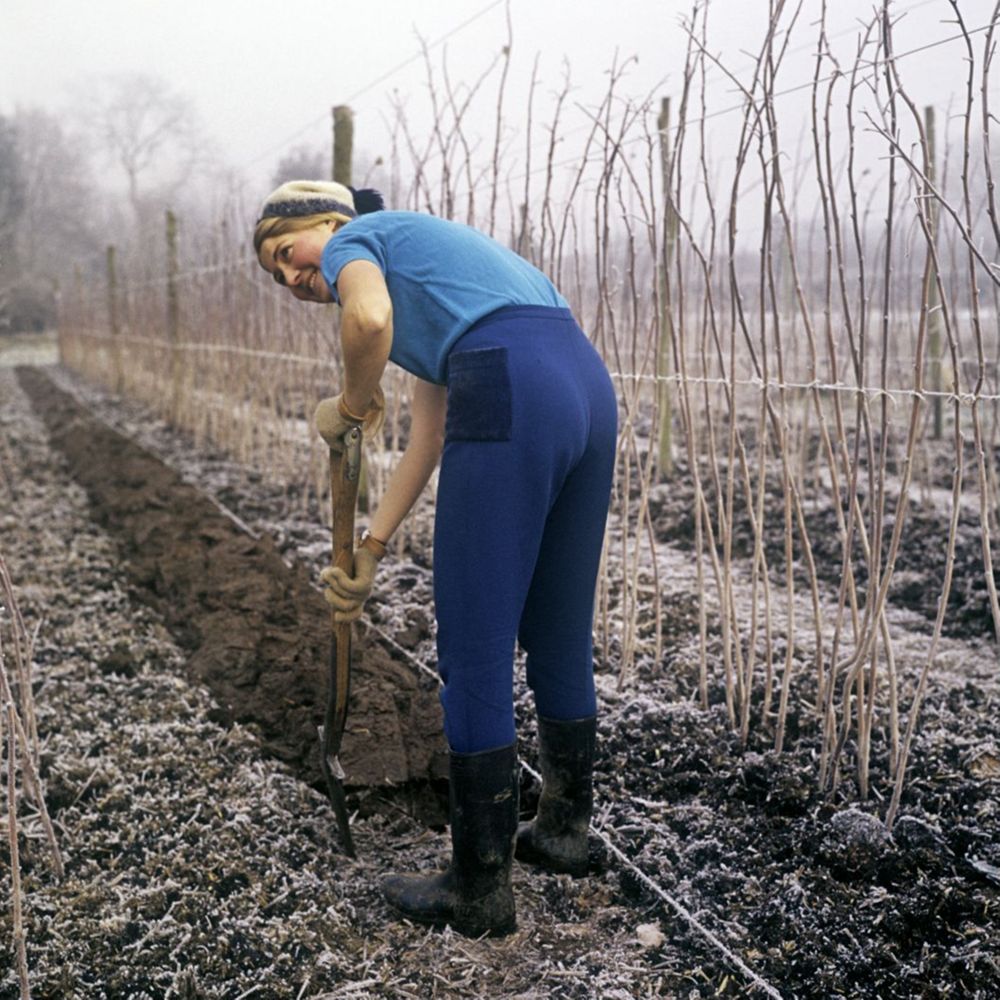
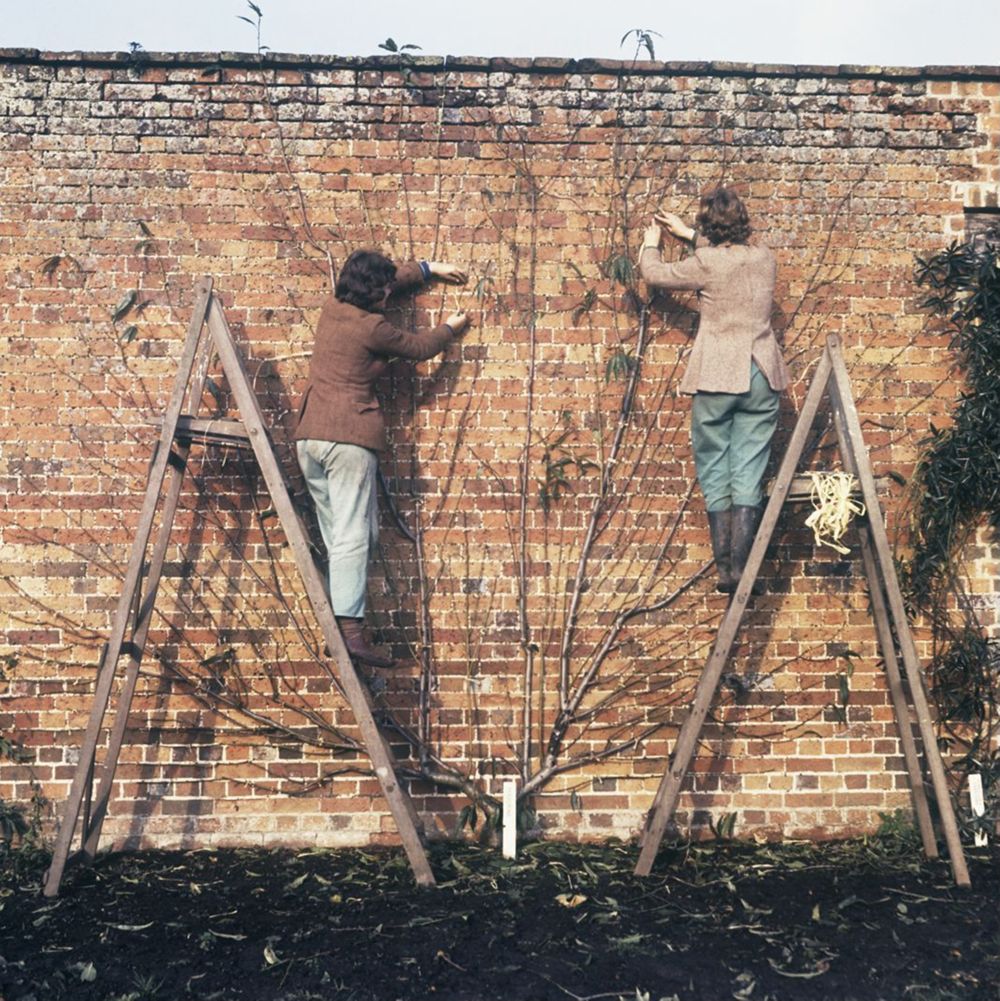
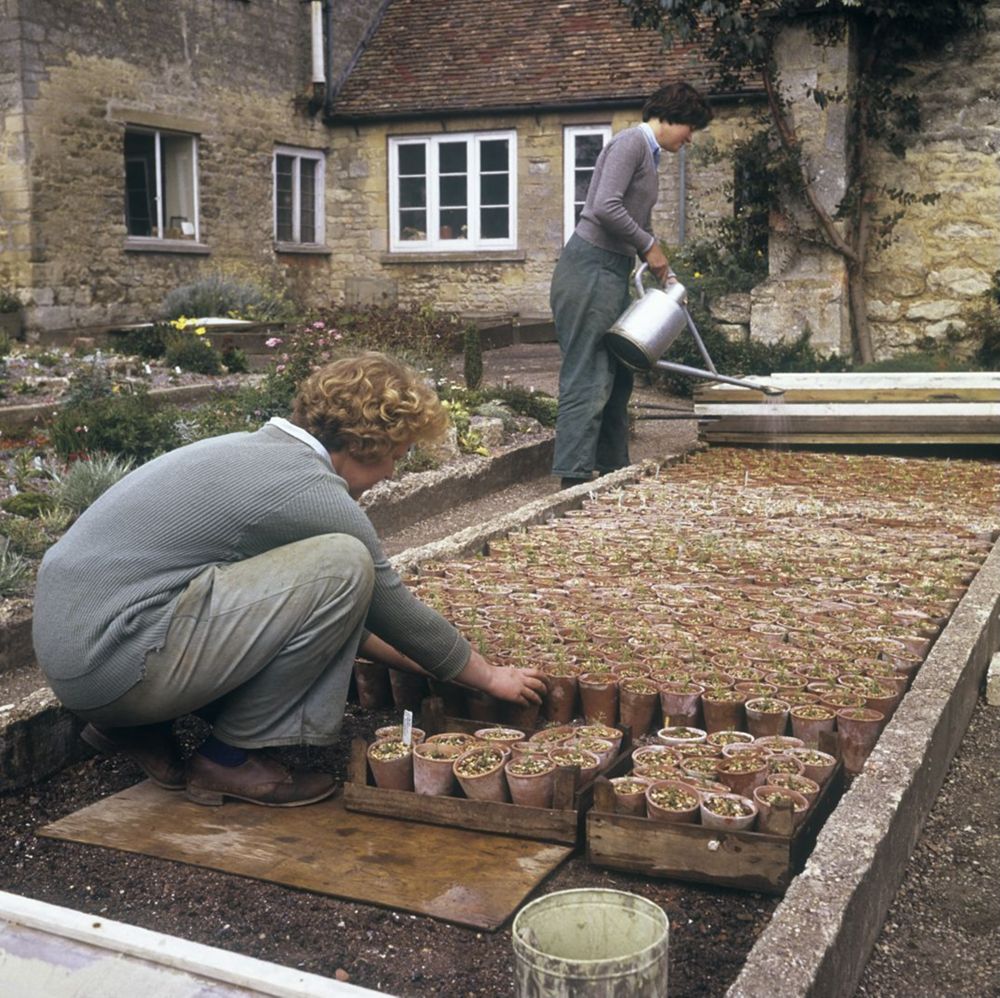
Finnis was a student at Waterperry at the time of Beaton’s visit and could even be one of the young women in his photographs.  We also know that Waterperry kept a set of these images in their archive, which would likely have been available to staff and students.  Finnis’ early portraits of Waterperry students, taken in the 1950s, look very much like a re-working of Beaton’s wartime photographs.  Two students on ladders pruning a wall trained peach tree have a wonderful symmetry, and all her subjects possess a quiet dignity as they go about their gardening tasks.

Student from Waterperry Horticultural School digging frosty ground.

Students training a peach tree on a wall at Waterperry Horticultural School.

Two students watering pots in Valerie Finnis’ Alpine Nursery at Waterperry Horticultural School.

As Finnis became interested in alpine plants and established her network of friends in the Alpine Garden Society, she began to photograph them tending their plants, using her own version of Beaton’s ‘Ministry of Information’ style.  Finnis also recorded interviews with these experts, intending to publish the material as a book, but this project wasn’t realised.

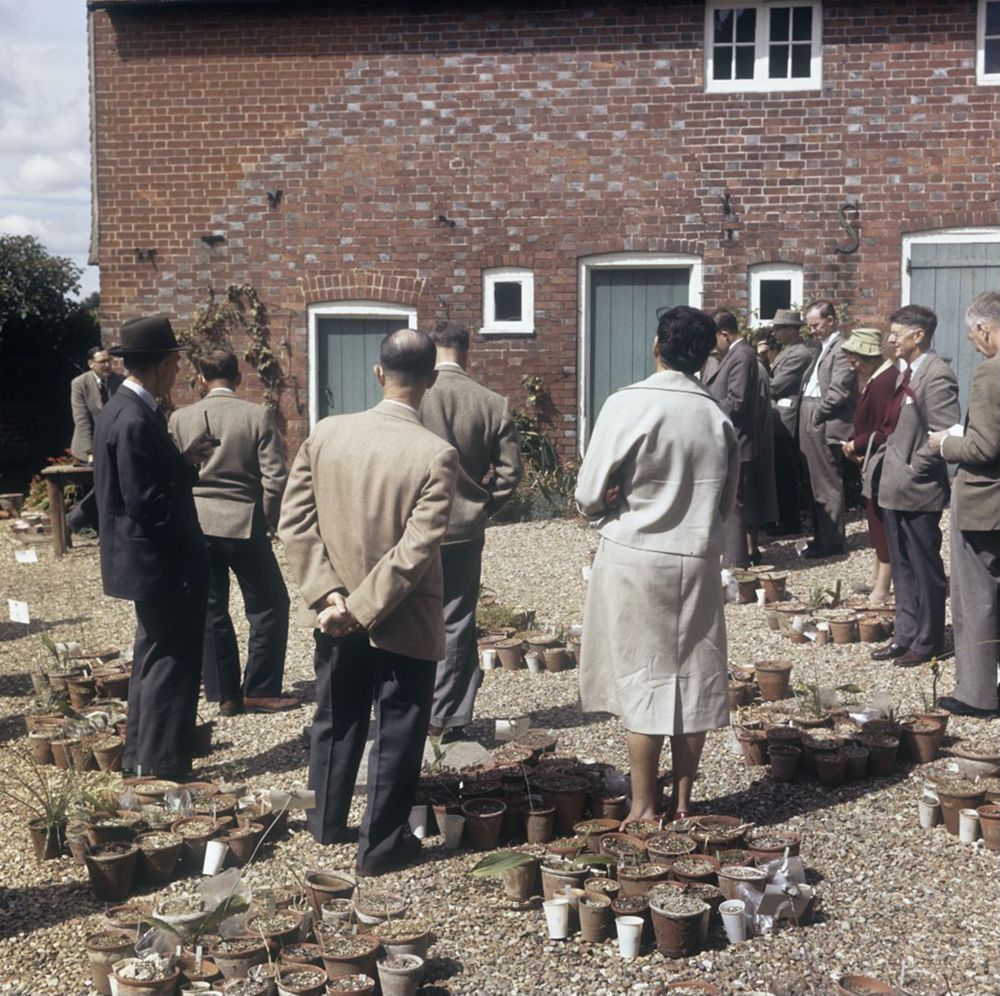
Viewed together, the intense concentration of Finnis’ alpine enthusiasts on their tiny plants is an intimate and involving record of this community in UK gardening history, but also has the effect of making them and their activities look quite nerdy.  An image of an alpine plant sale in Kent, where experts are listening intently to a speaker, with their tiny terracotta plants at their feet, ready for the sale, has an slightly absurd and surreal quality.

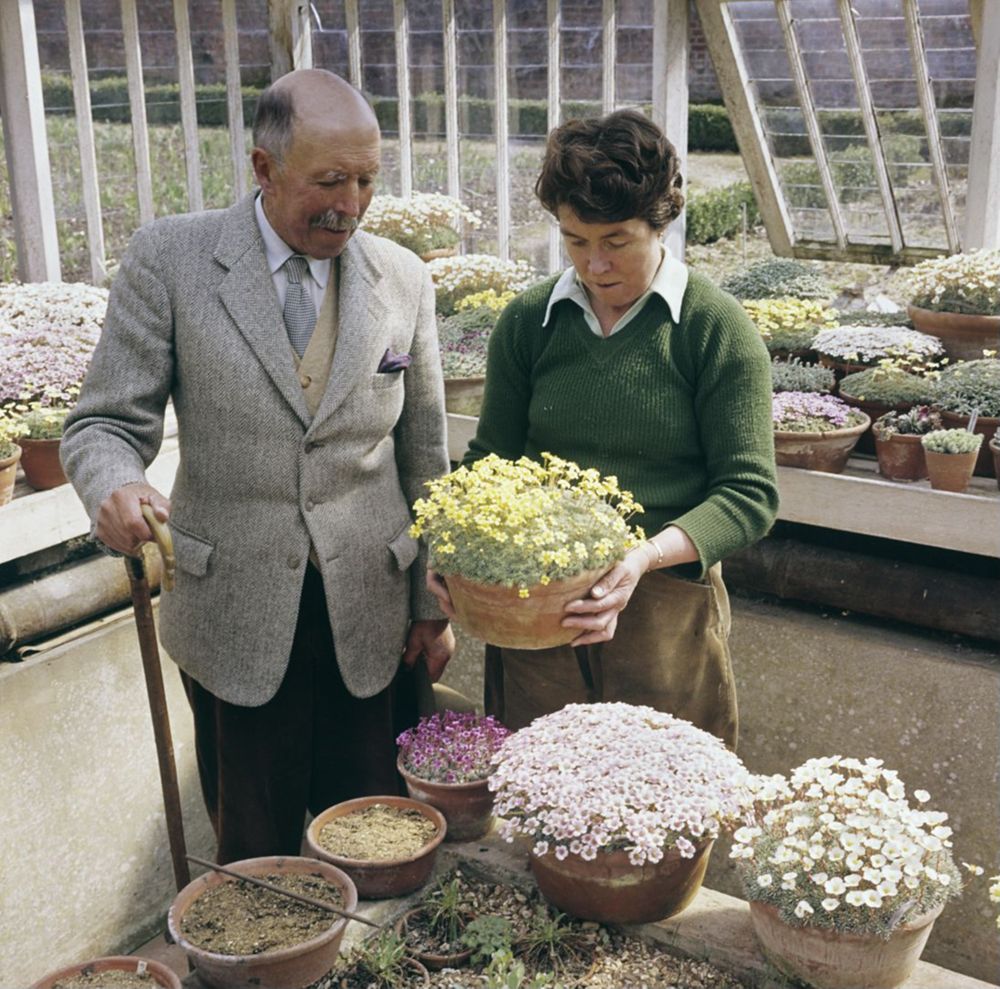
Cecilia Christie-Miller and her father admiring alpine plants in the alpine house. Undated. Valerie Finnis / RHS Lindley Collections

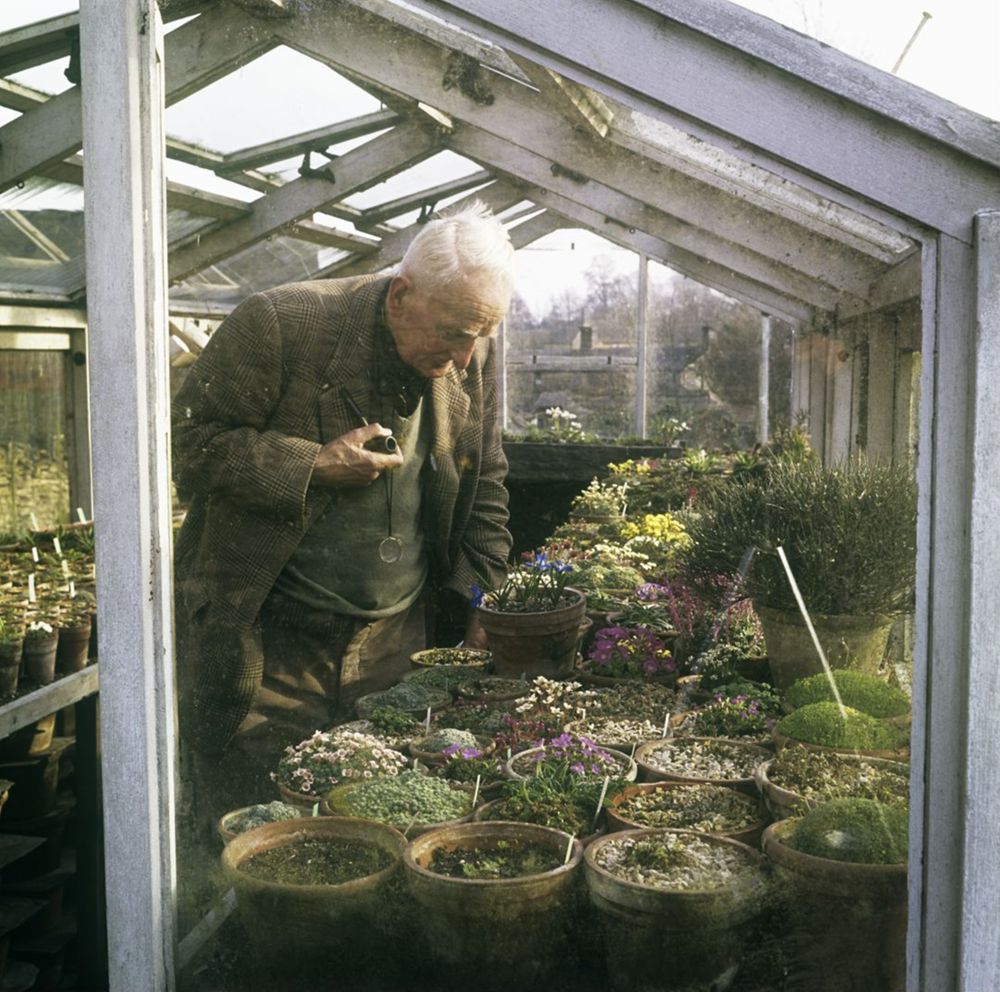
Plant collector Clarence Elliott (1881-1969) in his glasshouse at Broadwell, Gloucestershire. Elliott is wearing a magnifying glass round his neck.

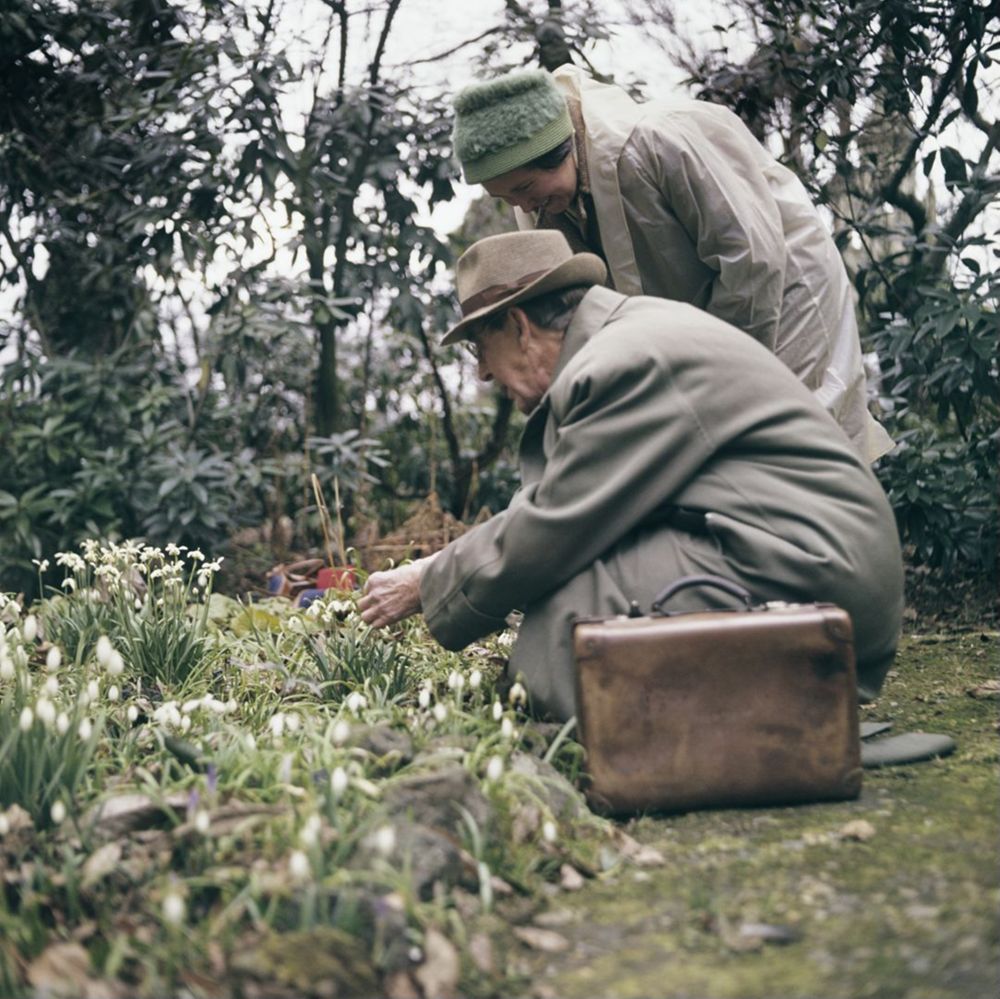
snowdrop enthusiasts Gerard Parker (1891-1977) and his wife Dora Parker (nee Scott), crouched over a snowdrop border at Myddelton House

An Alpine Garden Society plant sale in Kent.

According to writer Anna Pavord, Valerie Finnis was something of a complicated character.  In her obituary for Finnis from The Independent (21st October 2006), she says that alongside her enthusiasm for practical horticulture, ‘there existed a completely different Finnis, actressy, mischievous, a woman who adored gossip and outrageous hats.’  Pavord goes on to say, ‘She had a knack for engineering spectacular fallings-out with people, a process she thoroughly enjoyed.’

These observations are worth mentioning as they provide valuable context for Finnis’ portraits.  Some of her images irreverent and opportunistic, catching people off their guard, with the feeling of humour at someone else’s expense.  There’s perhaps a sense of the photographer’s enjoyment of her own power in these situations?

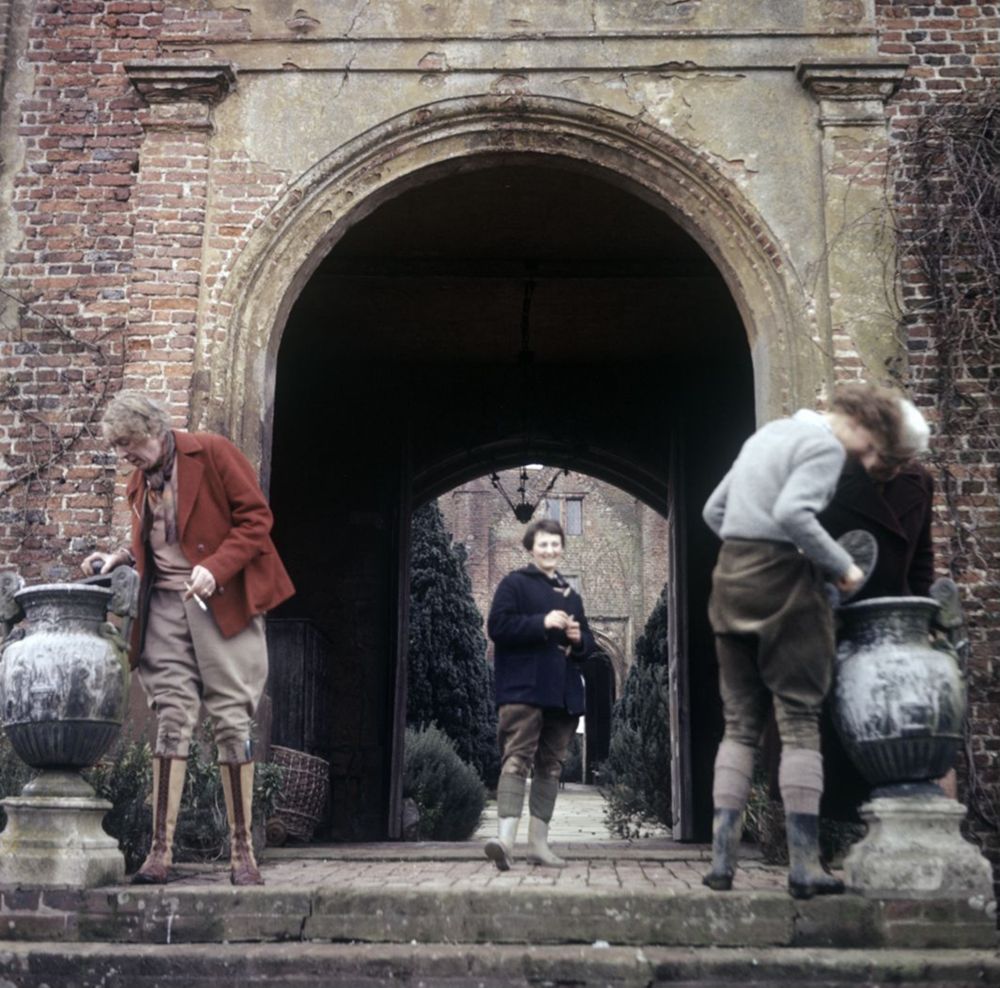
A photograph taken at Sissinghurst shows Vita Sackville West, cigarette in hand, peering into an urn alongside her new employees Pamela Schwerdt and Sibylle Kreutzberger is a good example of this tendency.  Schwerdt and Kreutzberger were both trained at Waterperry and it’s likely Finnis and Beatrix Havergal, principal at the school, were visiting Sissinghurst to offer support and settle the young gardeners into their roles.

Garden designer and author Vita Sackville-West (1892-1962), head gardeners Pamela Schwerdt (1931-2009) and Sybil Kreutzberger [Sibylle] (b. c.1931) with Beatrix Havergal (1901-1980) at Sissinghurst Castle garden.

Sir David Scott had a lifelong interest in plants, and after their marriage, Finnis had the opportunity to meet and photograph a new circle of his extremely grand gardening friends.  Following her now familiar format of photographing these subjects in their gardens, engaged in a gardening activity, these are some of her most successful portraits.

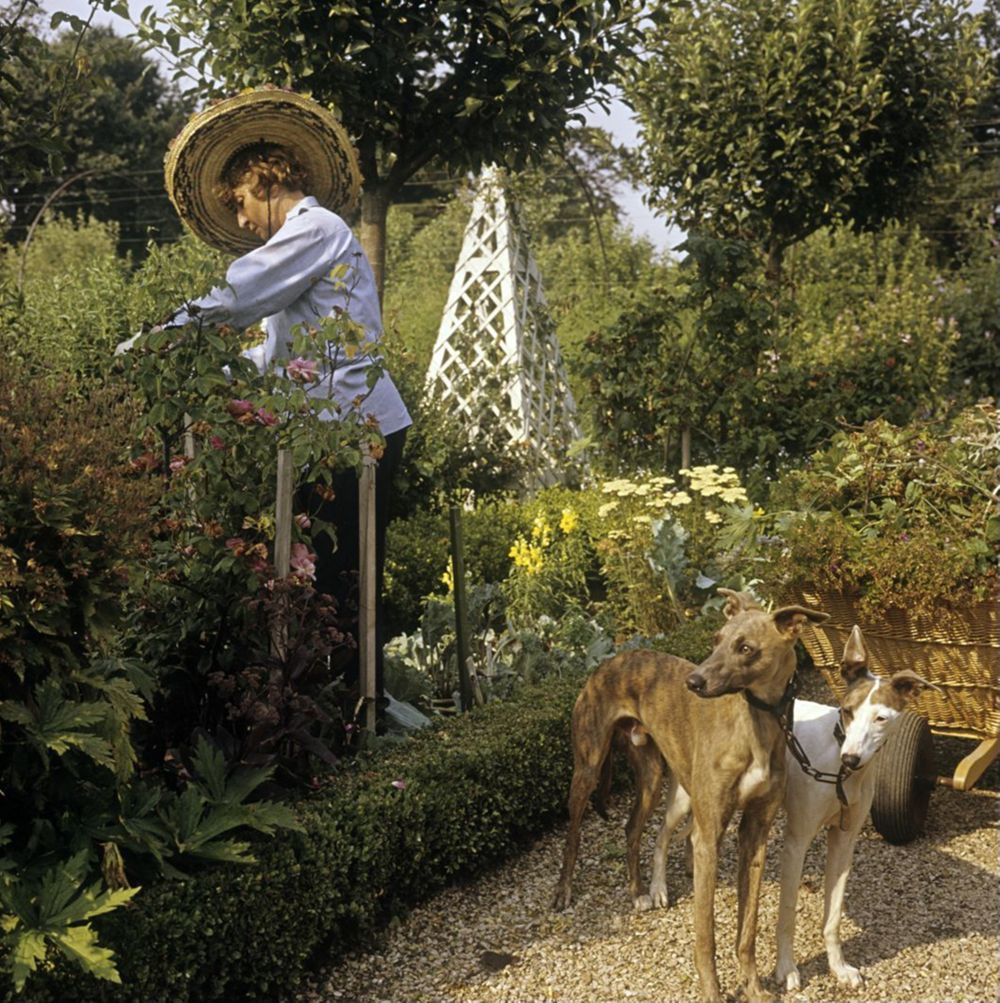
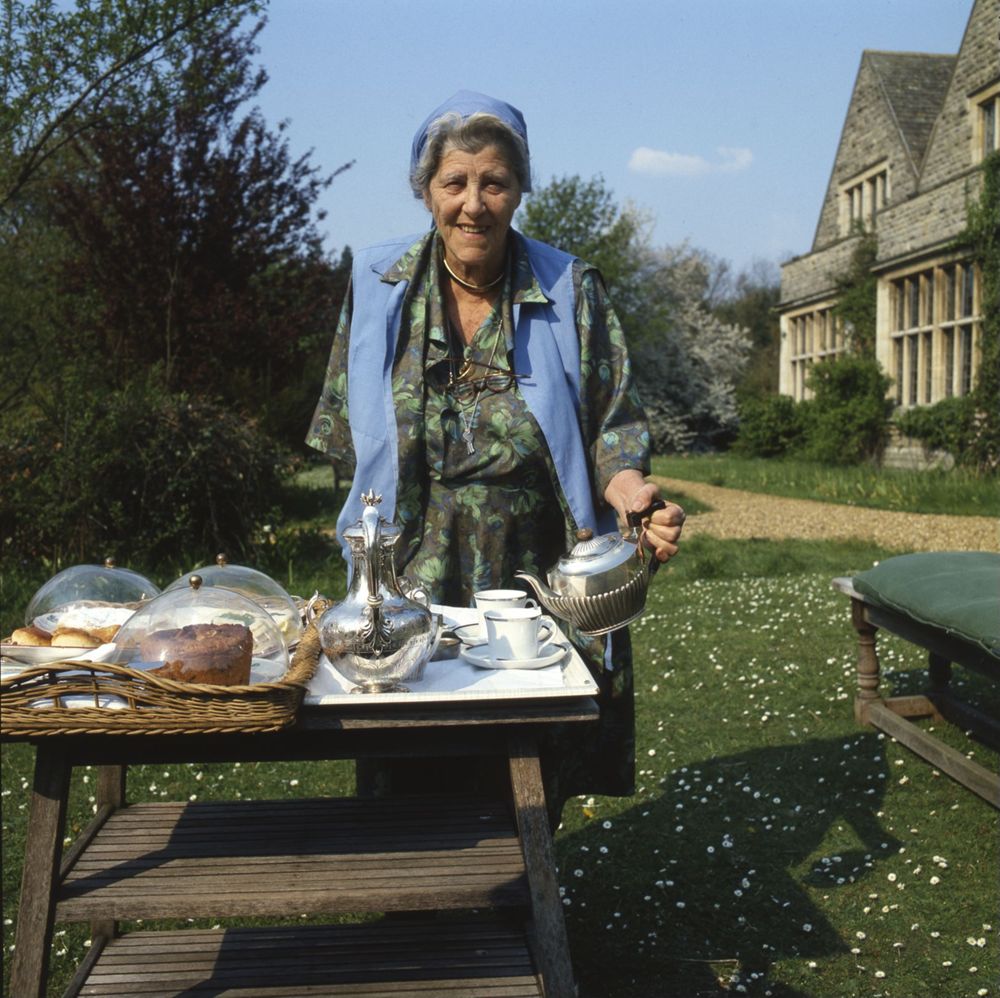
Highly staged, and characterised by a sense of fun,  it’s wondrous to observe the outfits people have chosen to wear for their photographs. Renowned interior designer Nancy Lancaster appears in a straw sombrero with her elegant dogs leashed together in the foreground, presumably to stop them wandering off and spoiling the composition.  Behind the dogs is one of the most unlikely pieces of garden kit I have ever seen – a wickerwork wheelbarrow.  Others, like Dame Miriam Rothschild, seen serving tea in her garden, seem far less concerned about appearances, although the quality of her china teacups and silver teapot shatter the illusion this is any ordinary gathering.

Interior and garden designer Nancy Lancaster (nee Perkins) (1897-1994) in her garden with two dogs at Haseley Court, Great Haseley, Oxfordshire.

Natural scientist and author Dame Miriam Rothschild (1908-2005) pouring tea in her garden at Ashton Wold, Northamptonshire.

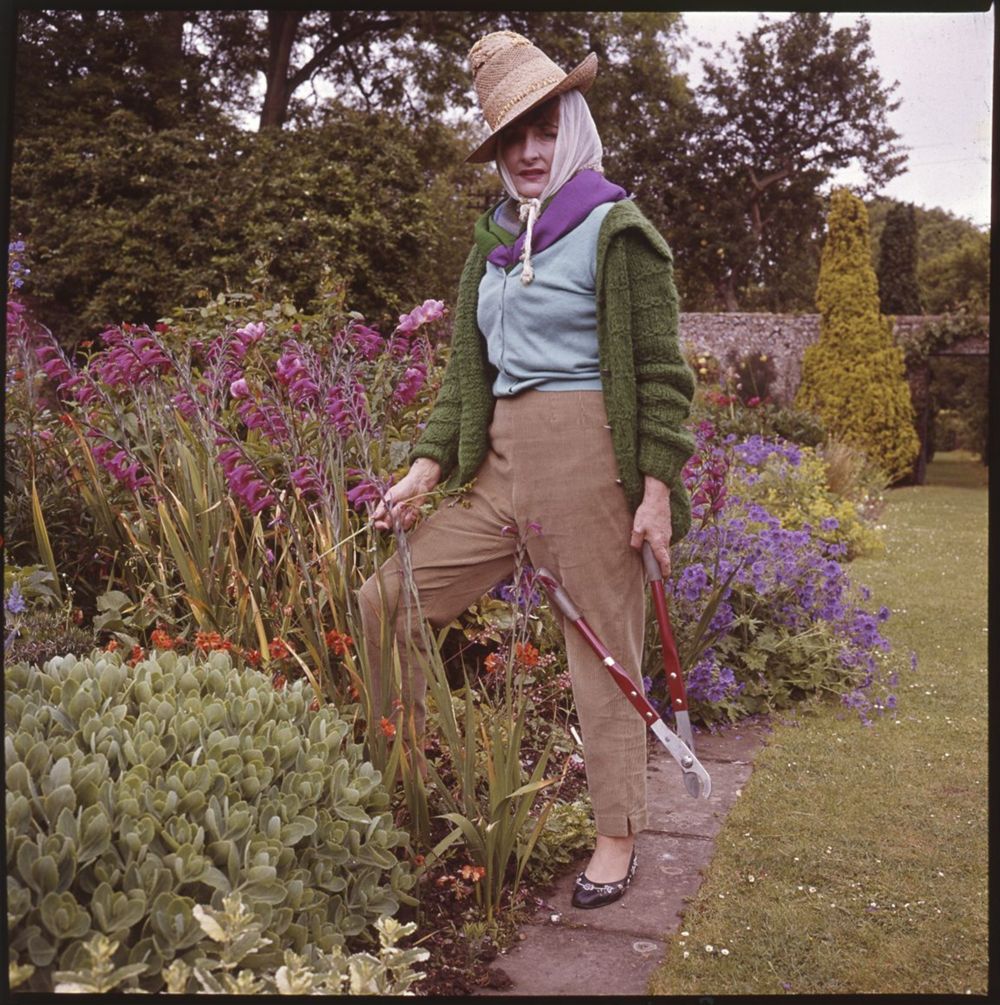
Model and plantswoman Lady Rhoda Birley (nee Lecky Pike) (1900-1981) holding a pair of garden shears in her garden at Charleston Manor, Sussex.

‘Mrs William ( Parsley) Mure, London [ Cecily Mure, Buckingham Palace Mews]. Undated. Valerie Finnis / RHS Lindley Collections

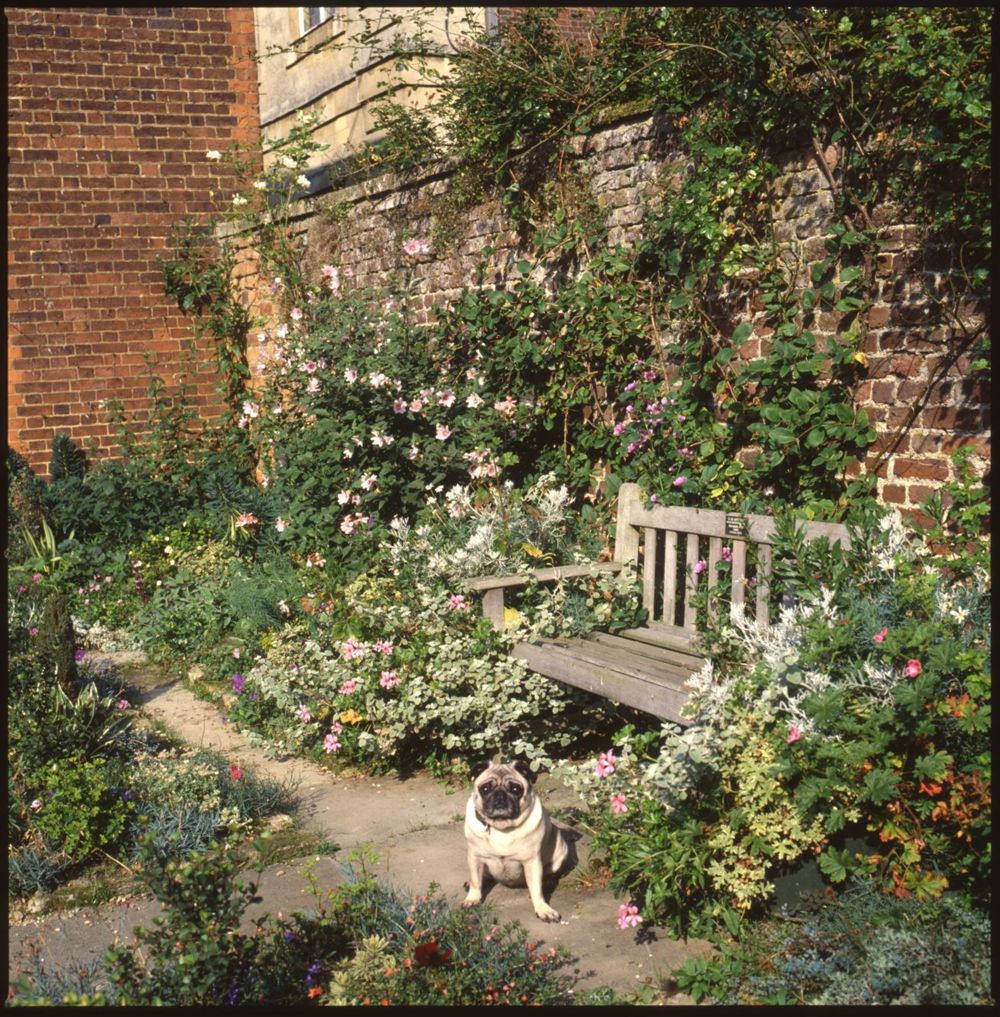
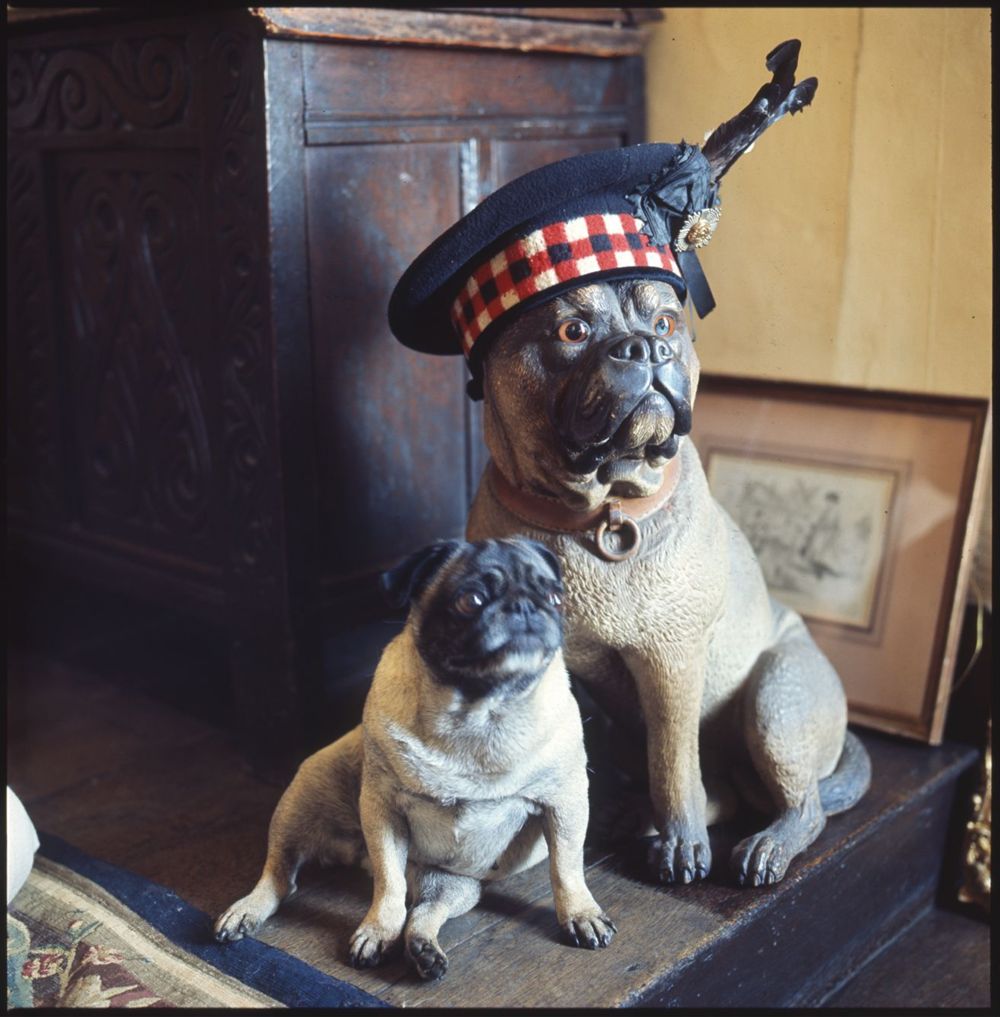
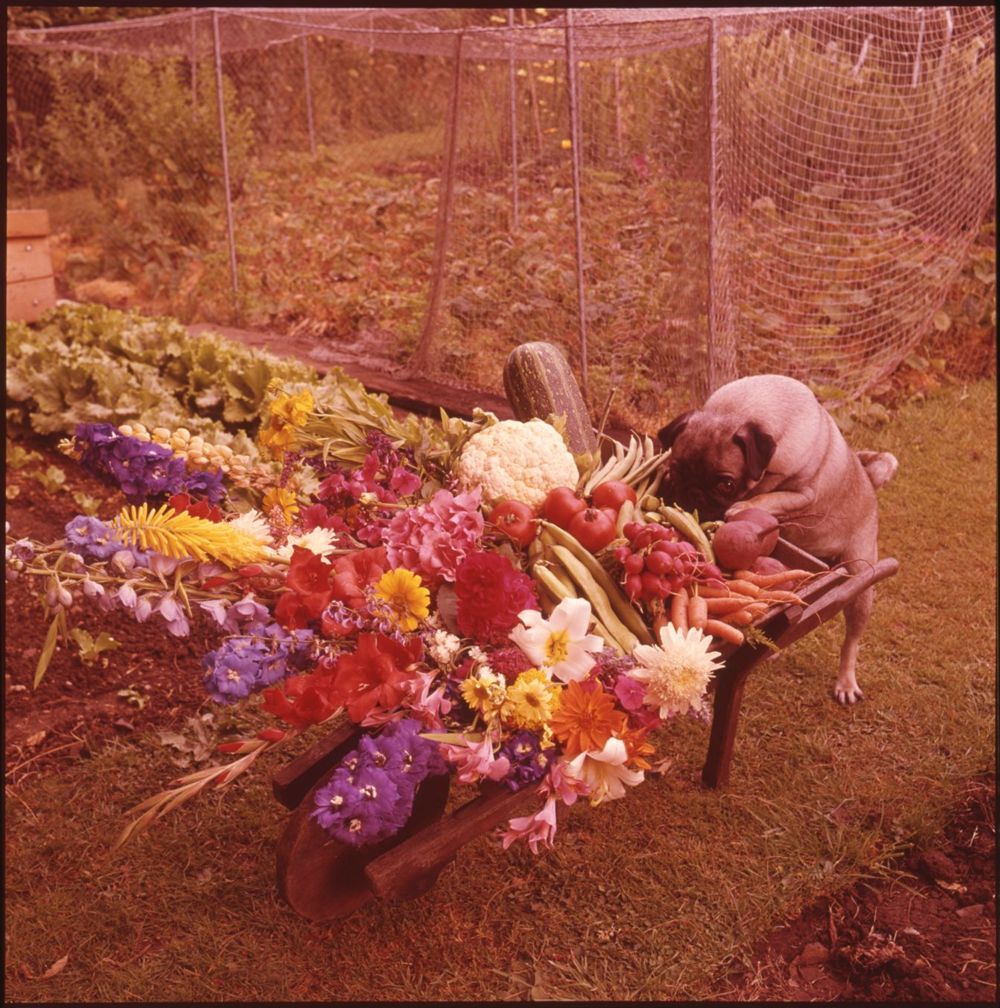
At home, Finnis and Scott appear to have had a happy domestic life, bound together by their enjoyment of plants, pugs and a shared sense of humour.  Despite his advanced years, Scott appears at ease posing for photographs in their garden at Boughton House, hosting events like the Alpine Garden Society International Conference, and parties for their friends.

One hundred years after her birth, Finnis’ remarkable record of gardening personalities from the 1950s to the early 80s, and gardening culture in the UK, seems especially valuable now in a world continually hungry for new ideas, and where yesterday’s plants and experts are so quickly forgotten.

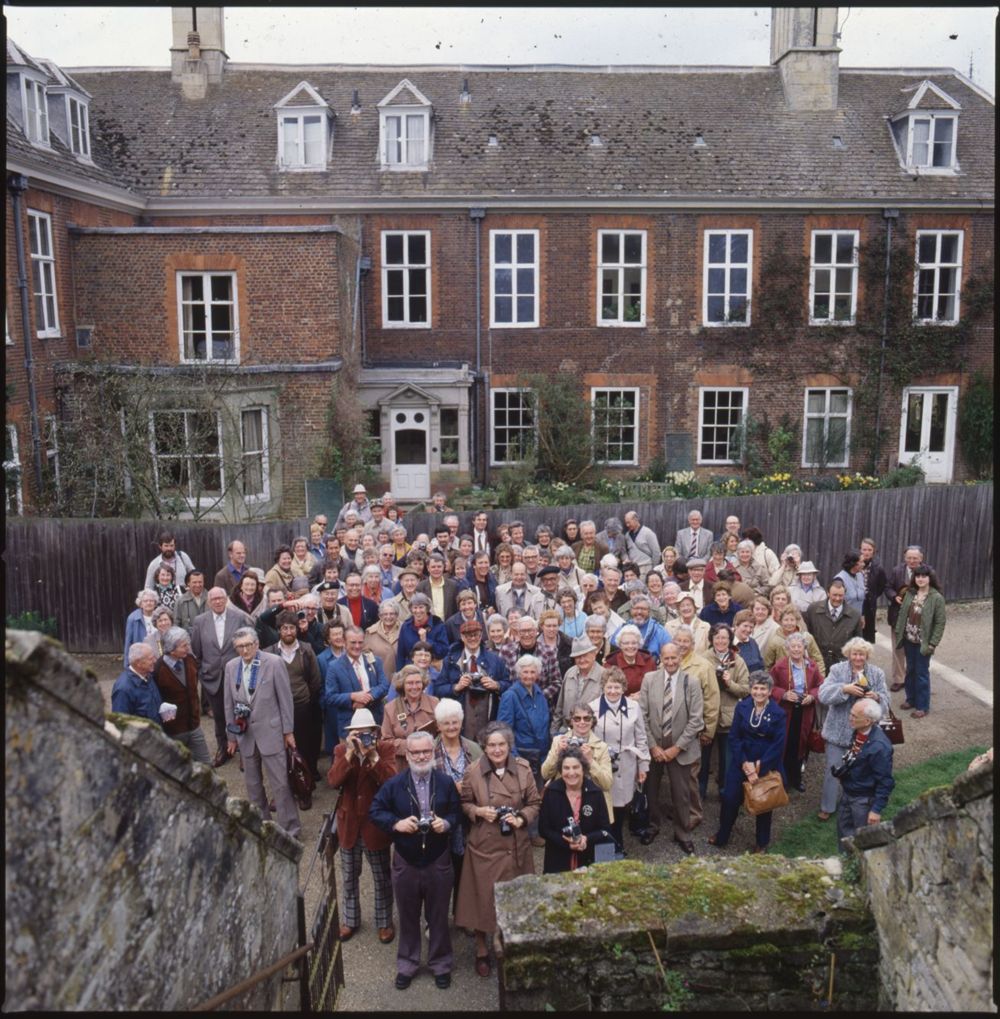
A large group shot showing members from the Alpine Garden Society (AGS) International Conference at the Dower House (Boughton House). (around 1975)

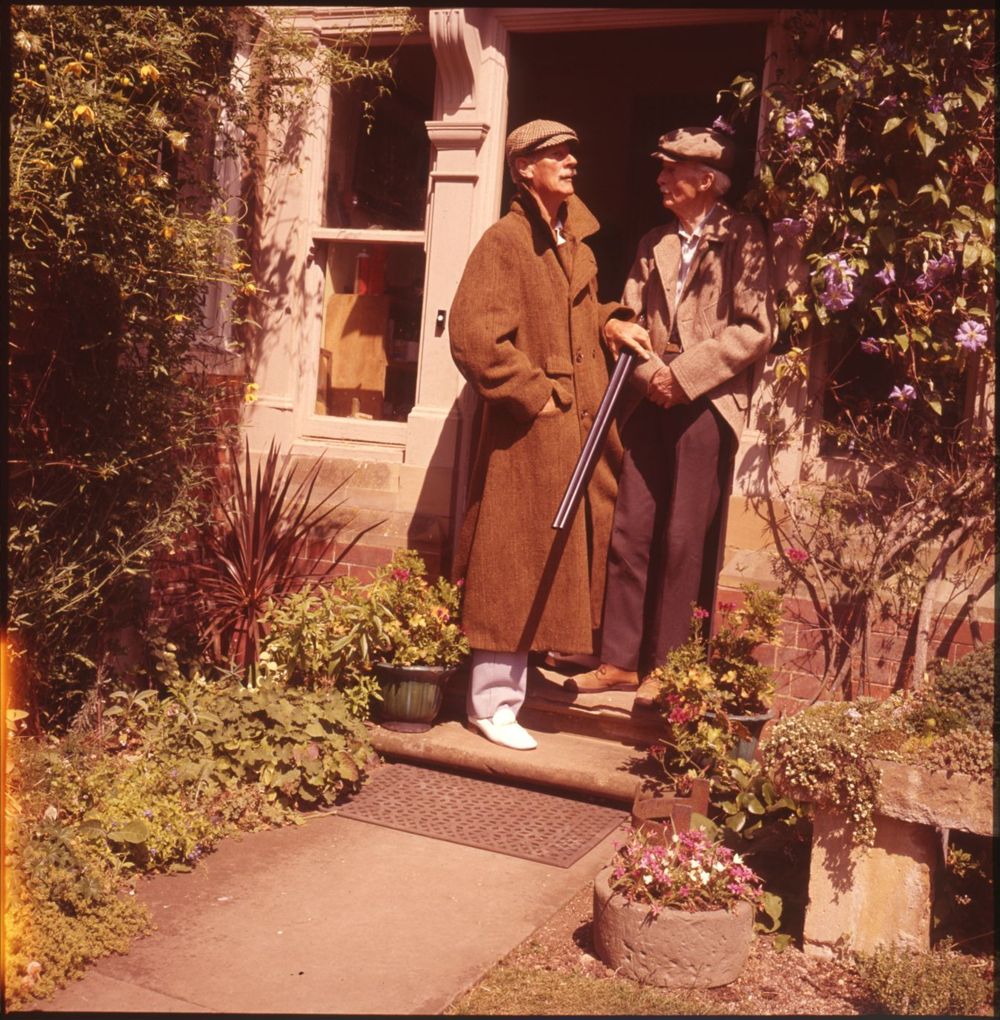
Diplomat and plantsman Sir David Scott (1887-1986) with portrait and fashion photographer Norman Parkinson (1913-1990) in the doorway of the Dower House (Boughton House). Scott is holding a shotgun in the crook of his elbow.

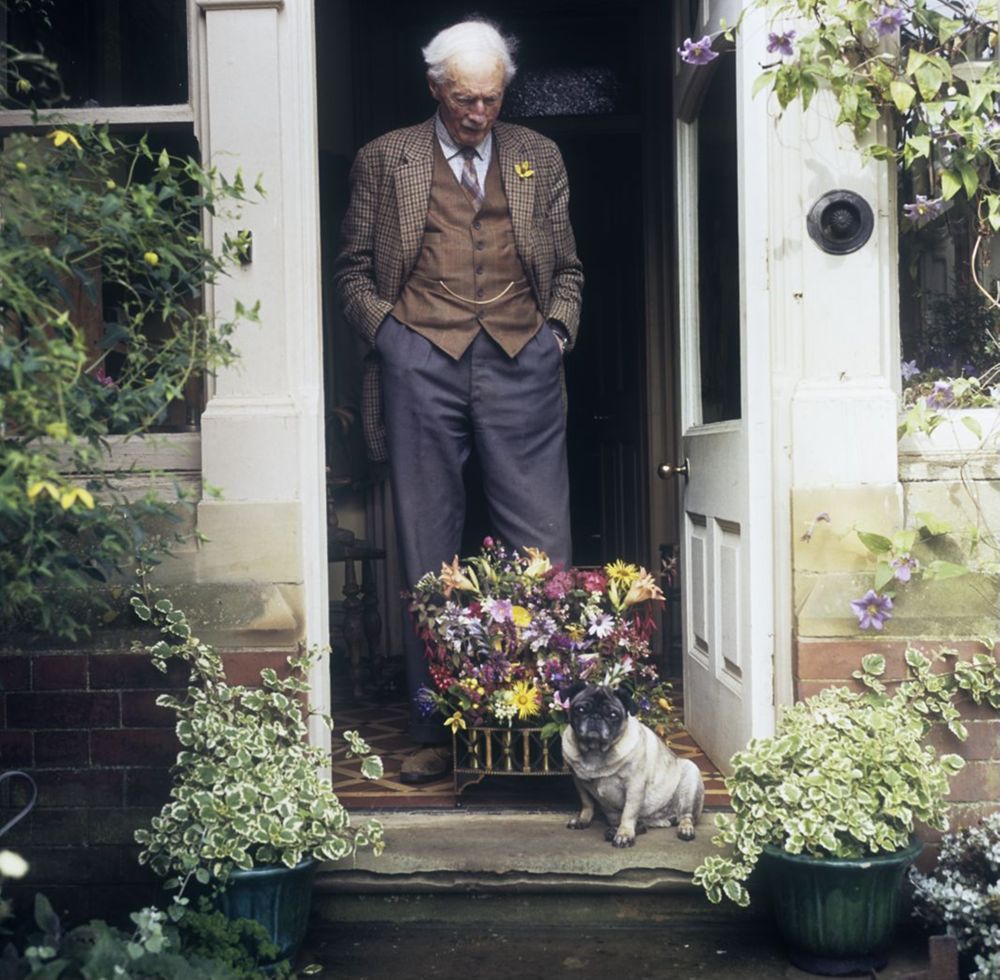
Sir David Scott (1887-1986) with his pug. Scott is in the doorway of the Dower House (Boughton House) looking down at a small display of flowers. The dog is likely Kate, the last pug David owned.

Valerie Finnis’ pug in the garden at The Dower House, Boughton House.

Valerie Finnis’ pug sitting next to a statue of a pug

Valerie Finnis’ pug pushing a wheelbarrow in the garden at The Dower House, Boughton House.

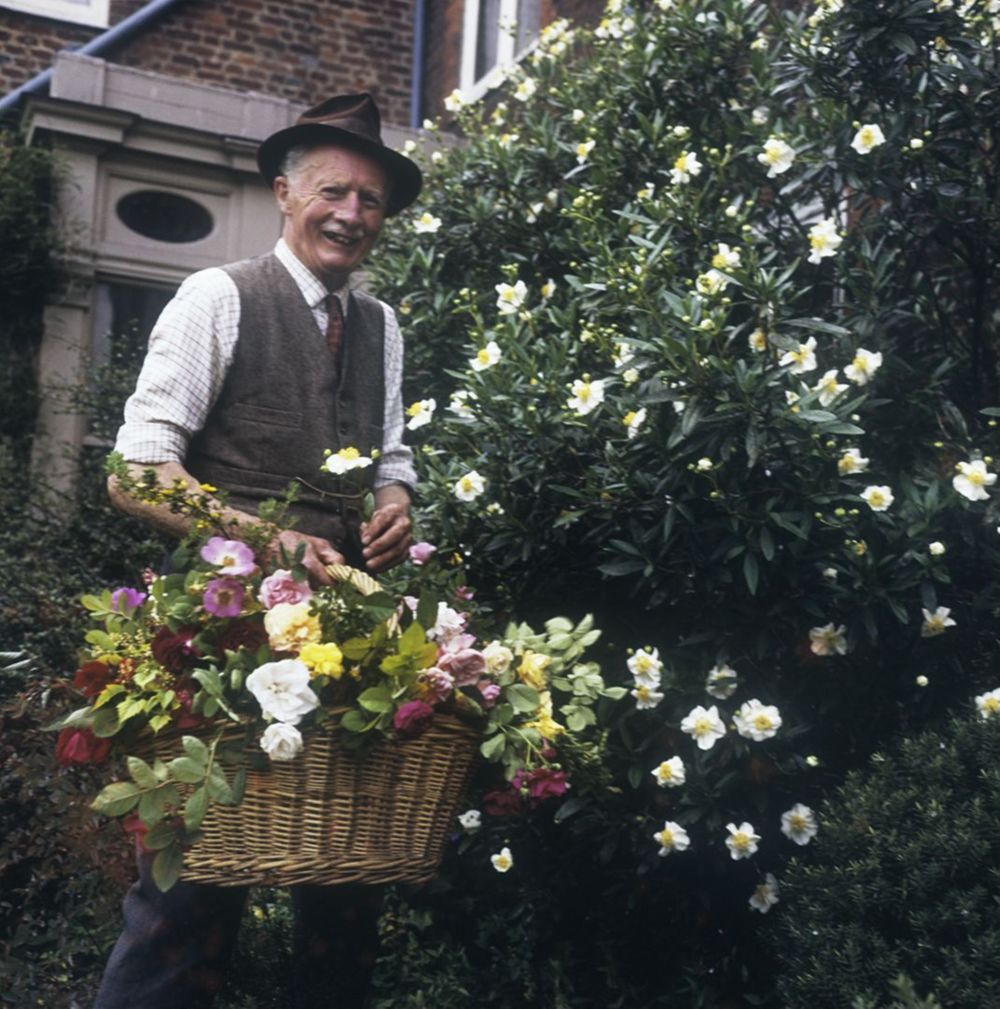
Diplomat and plantsman Sir David Scott (1887-1986) with a large basket of his old roses in his garden at the Dower House (Boughton House). He is standing next to a Carpenteria californica planted by his mother, Ada Mary Montagu Douglas Scott (nee Ryan) (1855-1943) in 1911.

Further reading:

Valerie Finnis Collection at the RHS online here
The Merlin Trust, Finnis’ charity set up to assist young gardeners here
Valerie Finnis Wikipedia here
Cecil Beaton at Waterperry – a previous post from 2022 here
Kew Gardens in Wartime

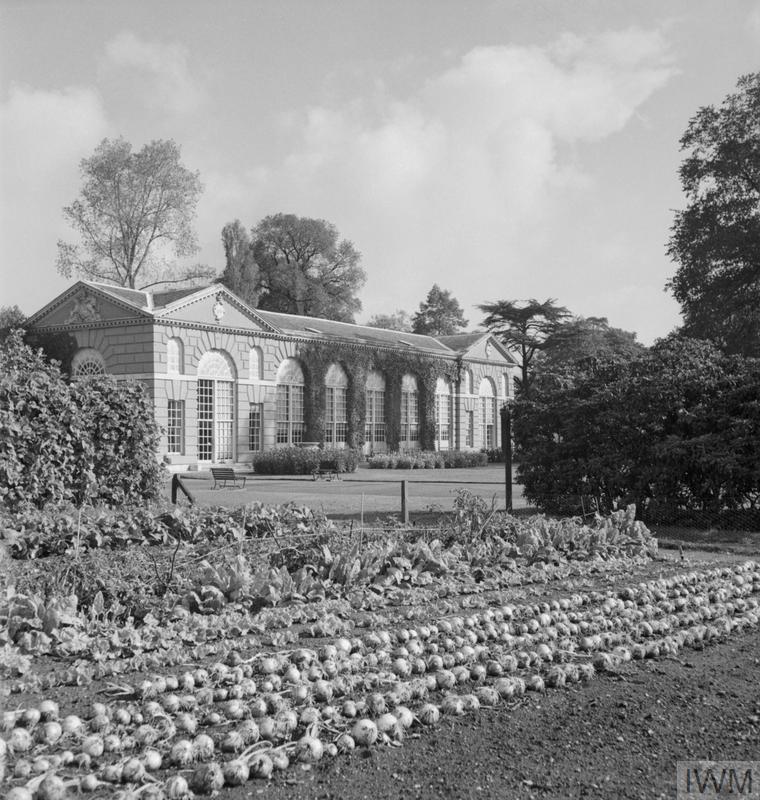
From a series of Ministry of Information photographs: The Work of Kew Gardens in Wartime (1943). With the impressive old orangery as a backdrop, vegetables grow in neat rows in the sunshine on the model allotment at Kew Gardens. The orangery belonged to the royal garden in 1761 and is now a museum. Copyright: © IWM.

There’s something so incongruous about long lines of freshly harvested onions laid out to dry in front of the famous orangery in Kew Gardens, where ordinarily we might expect to see well kept lawns or decorative beds of flowers.  But in 1943, when these photographs documenting the work of Kew Gardens were taken for the Ministry of Information, England was at war.
Images from an unnamed photographer detail Kew’s contribution to the war effort, when research activities were re-focused onto the production of food, medicines and materials, which were in short supply.  The National Archives records,

‘Staff concentrated on finding local alternatives for no longer importable goods, such as medicinal plants and vitamin rich foods. From 1940 the cultivation of pharmaceutical plants not of interest to commercial growers, but necessary for the war, became a new feature in the Gardens. Botanists were also involved in the research of rubber yielding plants and the use of nettle fabric for reinforcing plastic in aircraft construction.’

Keeping the iconic gates of Kew Gardens open during World War 2 was another priority, providing a place for the public to visit during the uncertainties of war.  This ‘business as usual’ stance from the Gardens was a boost to morale, and there’s something reassuring and calmly defiant about the fragile glasshouse structures standing firm, despite occasional bomb damage.

After the outbreak of World War II in 1939, Kew Gardens closed to the public briefly to reorganise staff, relocate its invaluable collections of books and specimens to safer locations away from the capital and make preparations for possible air raids.  Kew then remained open throughout the war, and according to the National Archives, attendance at Kew Gardens grew during the war years, surpassing the numbers of visitors in peace time.

An evocative colour film from 1941, likely shot by amateur filmmaker Rosie Newman, shows the Gardens teeming with people admiring the flowers and enjoying a moment of relaxation in the sunshine.  (link below)

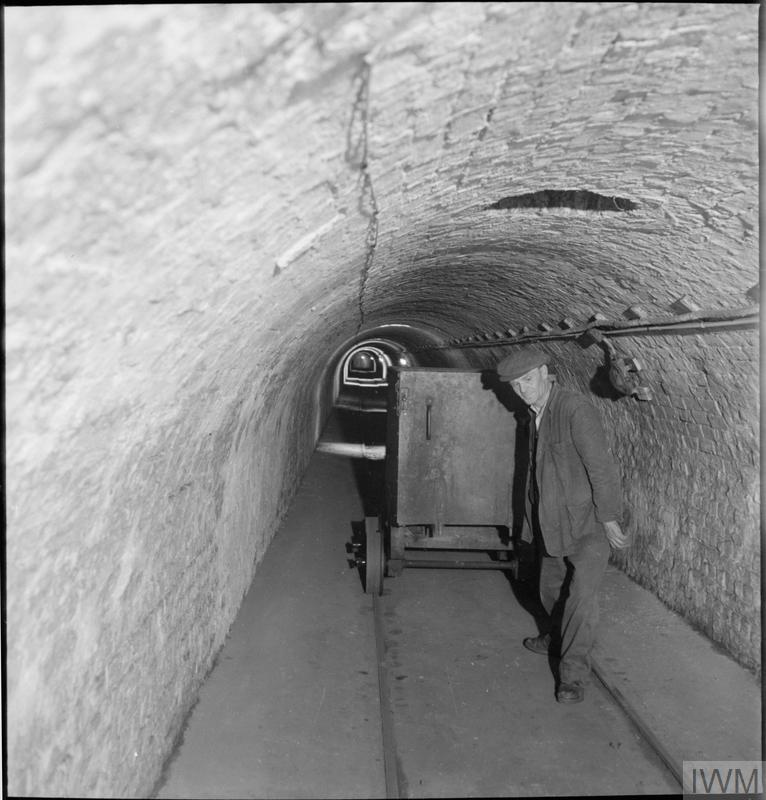
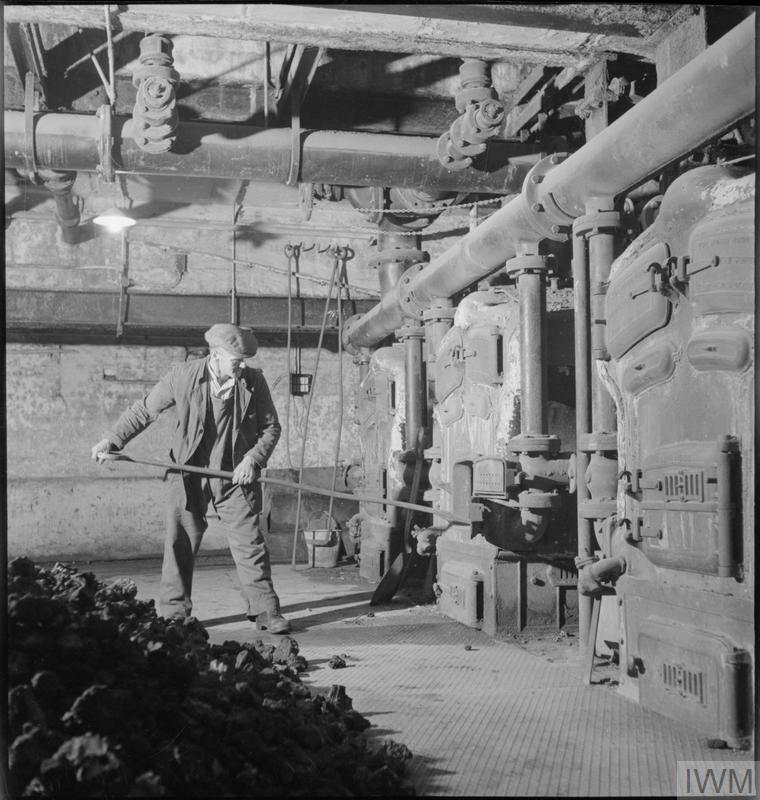
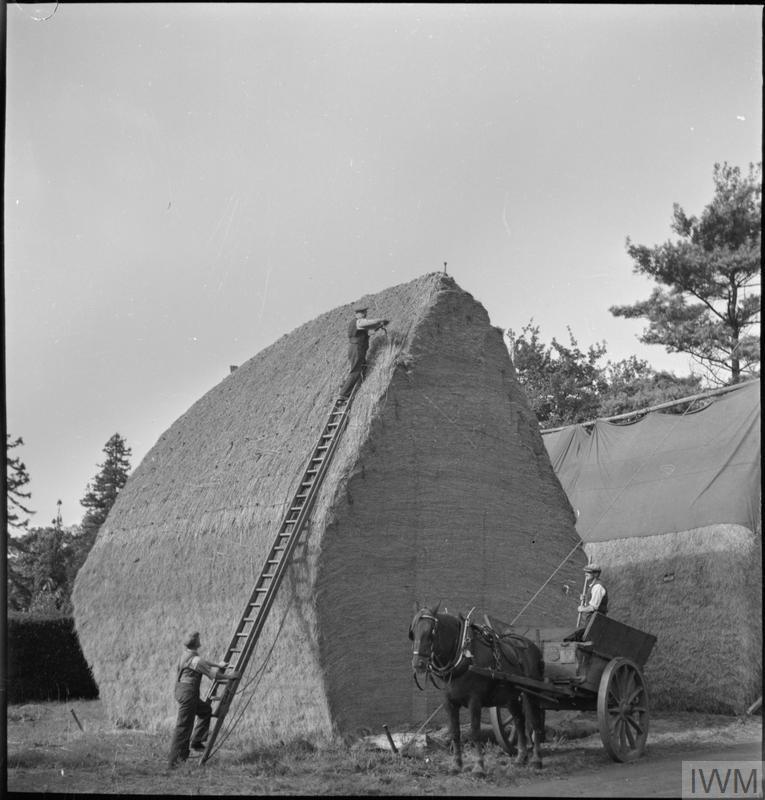
The activities of Kew’s employees are placed at the centre of these photographs, underlining the equal importance of everyone’s contribution to the huge task of running the Gardens in difficult circumstances.  The tasks of ordinary workers like R Halsey, seen in a long tunnel fetching coal and stoking the furnaces beneath the Palm House, are especially striking, as is an image of refugee J A Simon from Alderney in the Channel Islands pictured building a traditional Channel Island hay rick.  The hay was used to feed five working horses in the Gardens.

As part of the government’s Dig for Victory campaign, a ‘model’ allotment was constructed in the Gardens to Ministry of Agriculture specifications, and used to demonstrate the cultivation of vegetables to visitors.  Some of the large lawns were provided to local residents to use as allotments.

As well as educating the public about how to grow their own produce, the challenge of food shortages was addressed by Kew via the development of new methods of crop cultivation methods.  William Campbell, curator of Kew, pioneered a new process for growing potatoes more economically.

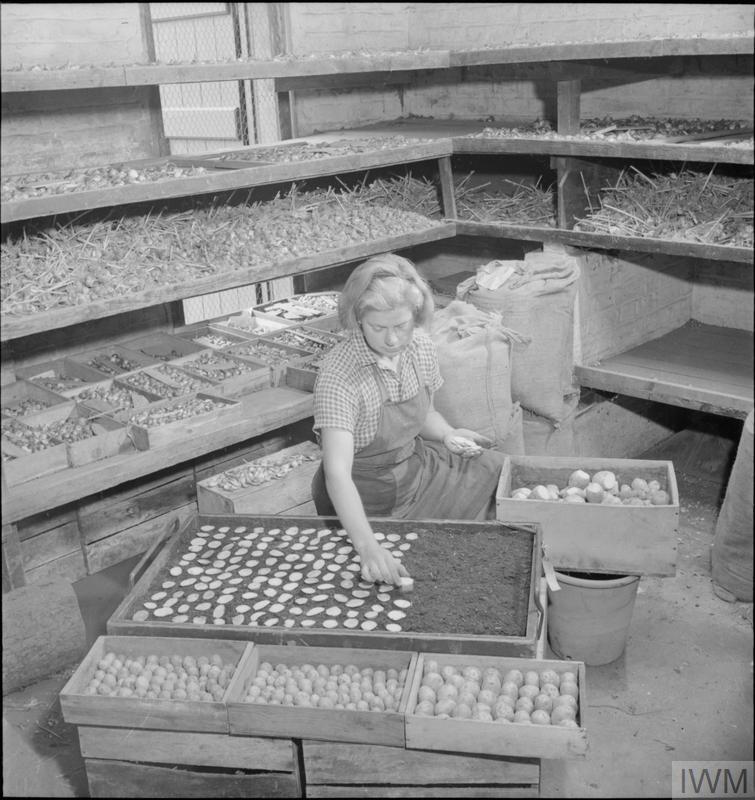
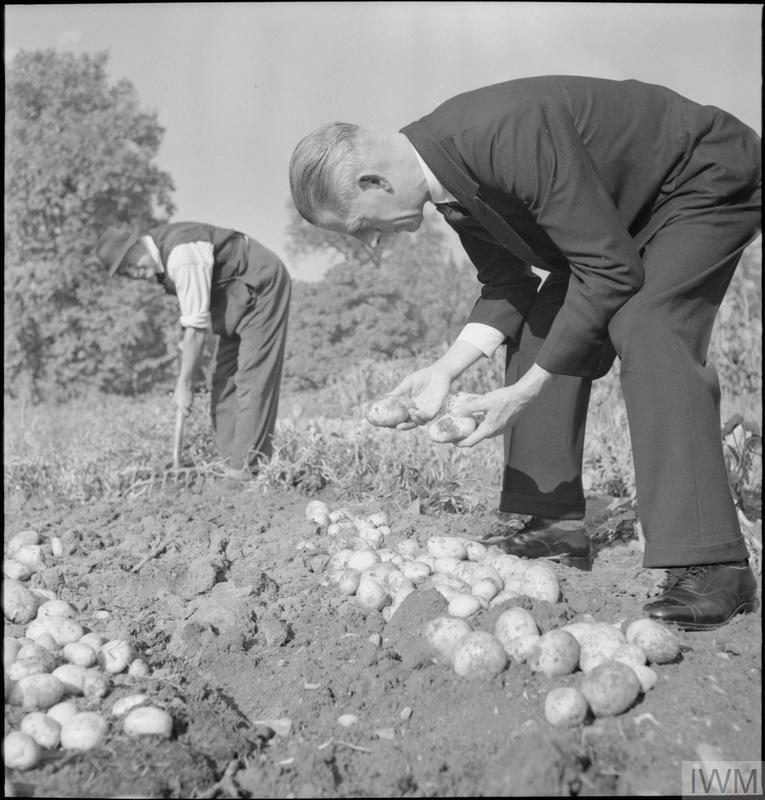
Traditionally, whole seed potatoes were planted into the ground to produce a crop, but Campbell’s new system divided a whole seed potato into slices.  Sections containing an ‘eye’ were placed into a large tray to grow on, demonstrated by a female employee in one of the photographs.  Each of these slices grew into a separate plant, increasing the number of potato plants available to grow on, and plants raised in this way were said to produce a heavier crop than those produced by the usual method, increasing yields.  Campbell is pictured with one of the gardeners, inspecting the trial potato crop cultivated by use of his system.

As staff at Kew Gardens were called up for national service, their numbers were supplemented by women gardeners during the war years.  According to Kew’s records,

‘Fourteen women were enrolled onto the staff in 1940, joined by a further thirteen in 1941. Most had previously trained as gardeners while others arrived at Kew via the Auxilliary territorial Services and the Women’s land Army. The women referred to their uniform of apron and clogs as battledress.’

At the end of the war in 1945, operations at Kew Gardens slowly began to return to normal, as damage sustained to the site was repaired, and items which had been moved for safekeeping were returned.

Kew Gardens remains an important symbol of the UK’s cultural and horticultural heritage, and these images of its gardeners, technicians, and management give us a better understanding of the challenges they faced in wartime, embraced with stoicism and creativity.

Deep beneath the Palm House at Kew Gardens, R Halsey pulls a truckful of coke along a tunnel, which stretches for a quarter of a mile, to the furnace which supplies the House with heat. According to the original caption, the ‘House was originally heated by draught from a furnace through the tunnel which runs the length of the building’. Copyright: © IWM.

R Halsey stokes a furnace beneath the large Palm House at Kew Gardens. According to the original caption, these furnaces (there are two stokeholds under the Palm House) supply heat to approximately eight miles of hot water piping and burn about 800 tons of coke a year. Copyright: © IWM.

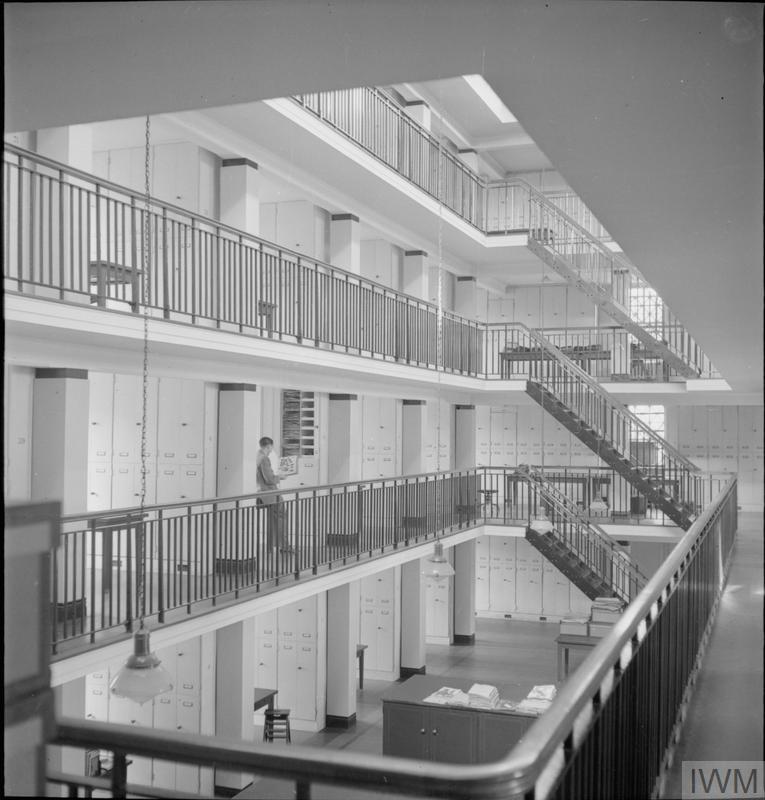
A view of the interior of the Herbarium at Kew Gardens, showing the scale of operations. The research centre covers four stories and includes dried plant specimens as well as books and journals. Copyright: © IWM.

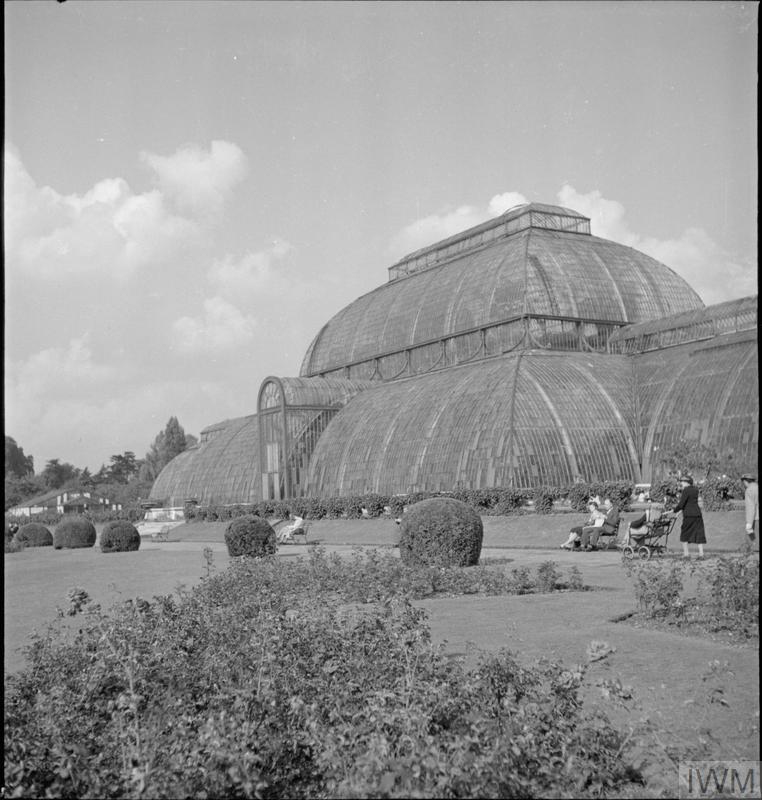
Visitors pass the impressive glass Palm House as they enjoy a relaxing stroll in the sunshine through the rose garden at Kew Gardens. There are between eight and ten thousand rose trees at Kew, and the rose garden has over 100 modern varieties. The dark panes of glass visible on the Palm House to the right of the photograph indicate where damage was sustained during an air raid. Copyright: © IWM.

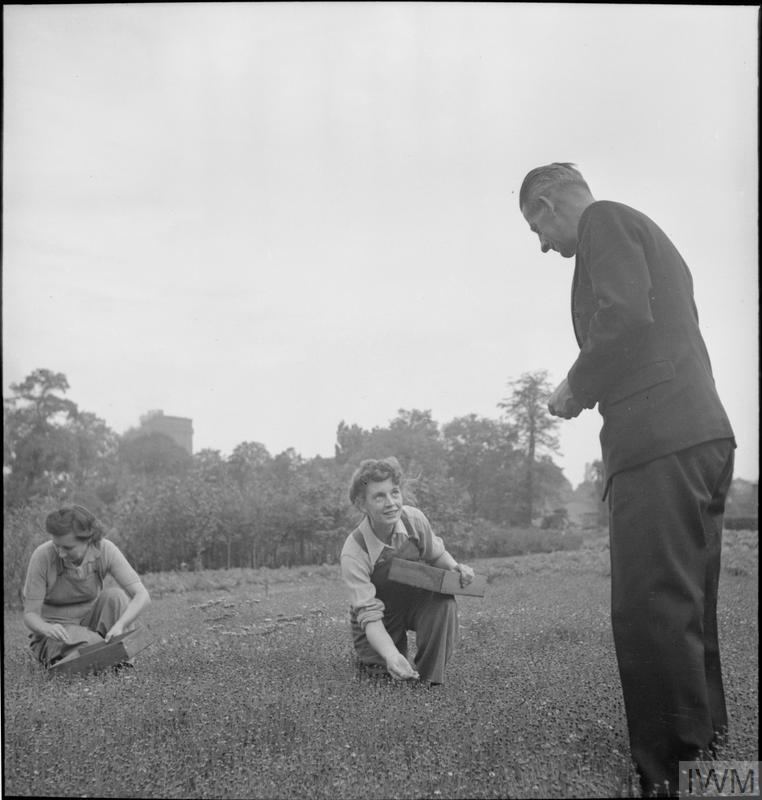
Curator of Kew Gardens, Mr Campbell, oversees the harvesting of seeds from the camomile lawn by members of the Women’s Land Army. The camomile was planted at the request of the Ministry of Home Security to be used as a quick-growing, wiry camouflage for new airfields. Copyright: © IWM.

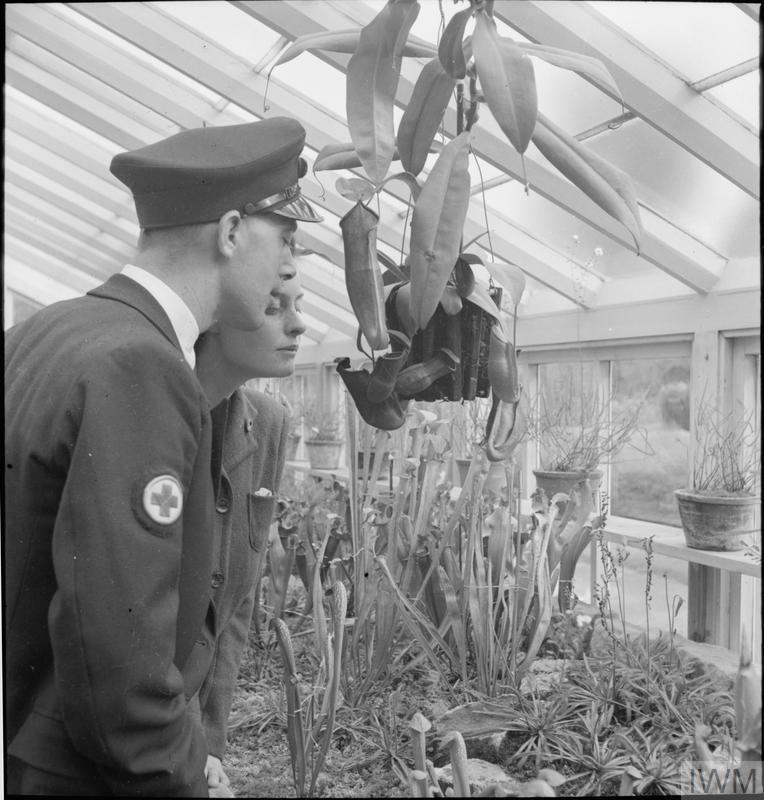
A member of the British Red Cross and his female companion inspect carnivorous pitcher plants from Malaya and Borneo in the tropical department at Kew Gardens. More insectivorous plants, such as the South African sundew and the American pitcher plant, can also be seen on the shelves of the greenhouse. Copyright: © IWM.

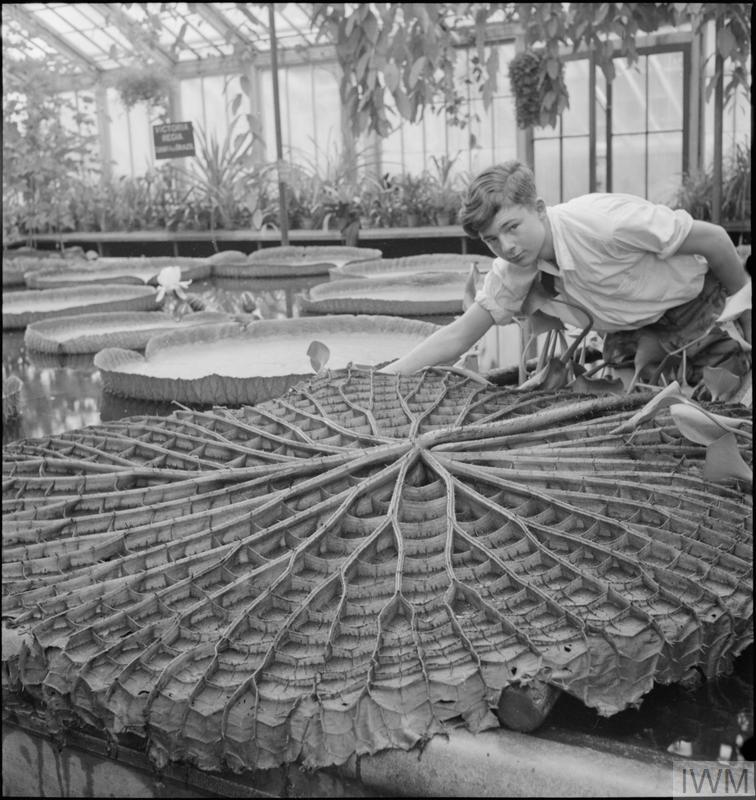
A young member of staff tends the ‘Victoria Regia’, a giant water lily from Guiana, in the tropical house at Kew Gardens. According to the original caption, the lily is very popular with visitors: ‘Grown from a seed the size of a pea in February, it develops leaves up to seven foot six in diameter by July. Underside of leaf is ribbed to help it float, and covered with prickles to keep off fish. Copyright: © IWM.

As part of an experiment requested by the Ministry of Food, an employee at Kew Gardens sows chips or slices of potato instead of full seed potatoes. According to the original caption, crops using this method were better than those grown in the normal way. Copyright: © IWM.

Mr Campbell (right), Curator of the Gardens, examines potato crops as they are lifted by a gardener. These potatoes have been grown experimentally, at the behest of the Ministry of Food, using a chip from a seed potato, rather than the whole thing. According to the original caption, crops using this method were better than those grown normally and ‘seed prepared at Kew is flown to Malta, Cyprus and Palestine to replace supplies cut off by war”. Copyright: © IWM.

J A Simon, a refugee from Alderney in the Channel Islands, and his colleagues build a hay rick in the sunshine at Kew Gardens. Kew cuts its own hay for the five Suffolk Punch horses which are used in the garden. They are building a traditional Channel Island rick, using a very large ladder. A horse and cart can be seen to the right of the photograph. Copyright: © IWM.

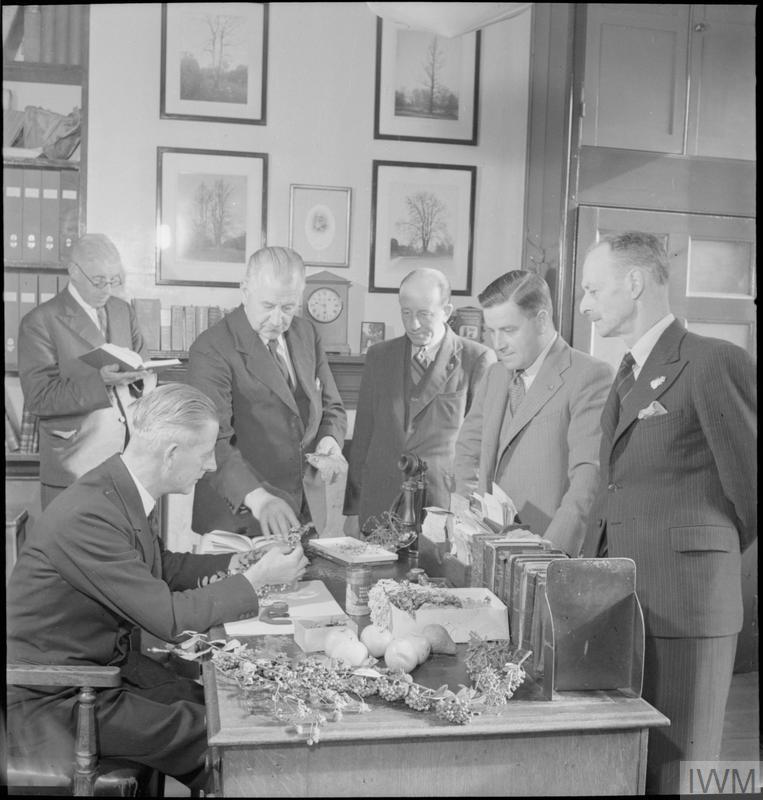
Curator of the Botanic Gardens, Mr Campbell (seated left) holds a daily meeting with his staff to discuss daily routine and to hand out specimens sent in for identification by the public. Left to right, the staff are: A Osborne (Arboretum), C P Raffil (Temperate House), L Stenning (Tropical House), S A Pearce (Decorative Department) and R Holder (Herbaceous and Alpine Department). Copyright: © IWM.

Further reading:

The Work of Kew Gardens in Wartime, Imperial War Museum online collection here

Papers of the Royal Botanic Gardens, Kew, during the Second World War National Archives here

Kew Gardens During the War – short film British Film Institute here
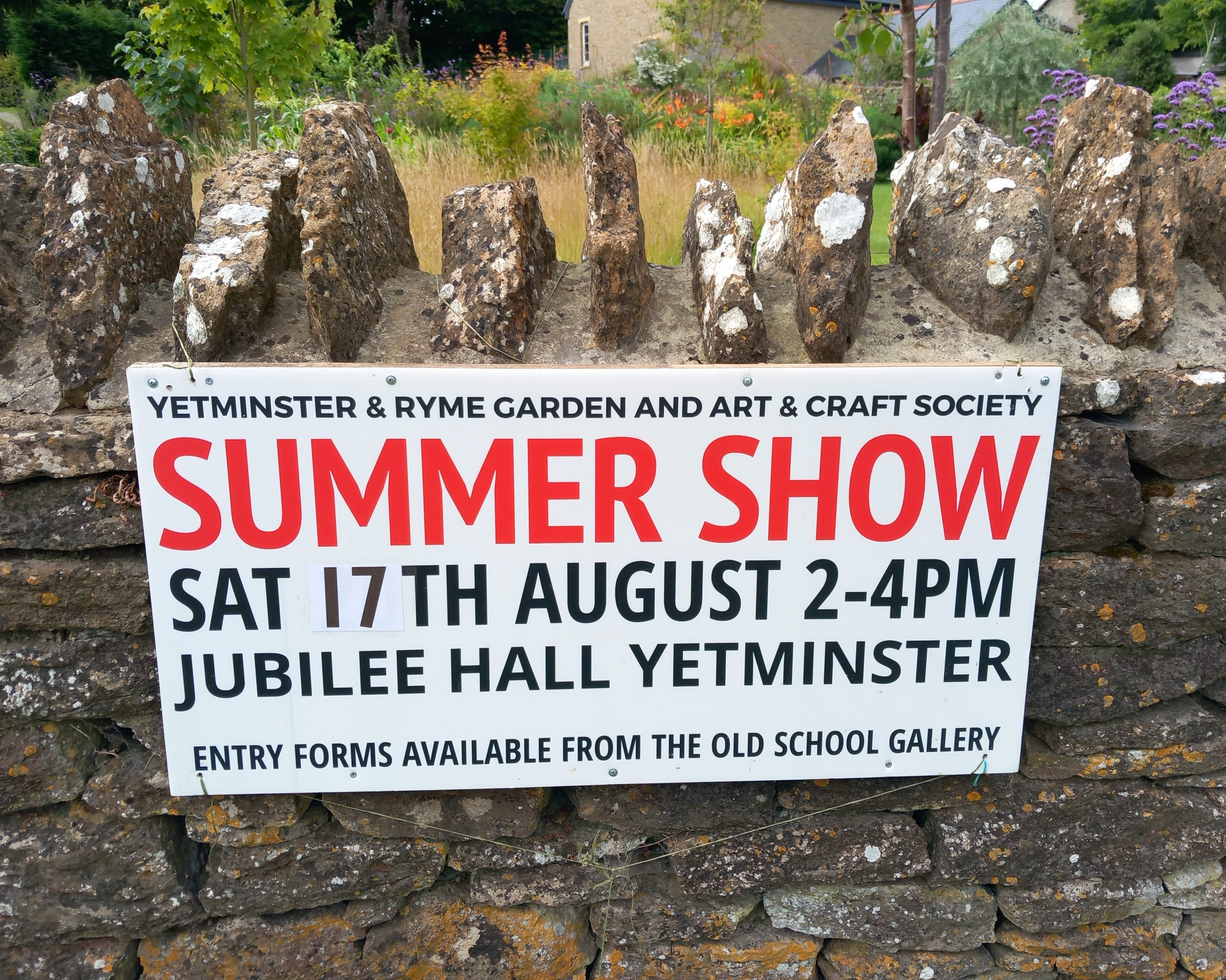
At Yetminster and Ryme Intrinseca Summer Show

Earlier this month, the Jubilee Hall in the Dorset village of Yetminster was thronged with visitors, gathered to celebrate the annual Garden and Arts & Crafts show.  This popular local event shared with nearby village Ryme Intrinseca is a chance for residents to admire displays of locally produced garden flowers, fruit and vegetables, cookery and crafts, and catch up with their neighbours over a slice of homemade cake and a cup of tea.

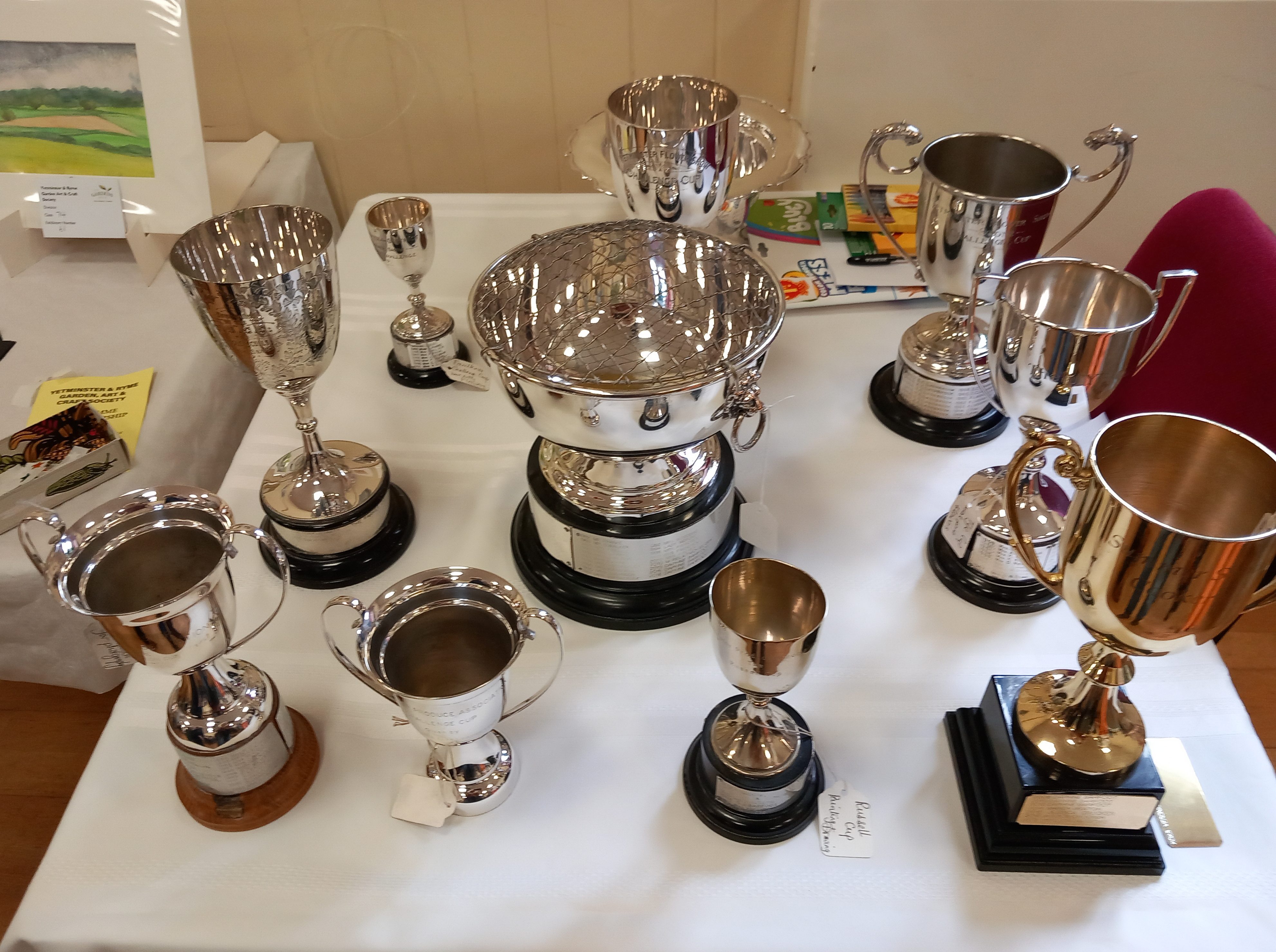
Organised by local garden and horticultural societies, village shows like this one are still regular fixtures across the UK over the summer months.  Generally held on a Saturday, competitors deliver their entries to the venue in the morning, arranging their exhibits on trestle tables for judging.  The show opens its doors to the public in the afternoon, with certificates placed next to the winning entries and towards the end of the day, trophies are awarded.  Classes for vegetables, fruit, and flowers are published well in advance of the show, along with competition rules that must be followed closely if an entrant is to stand a chance of winning a prize.

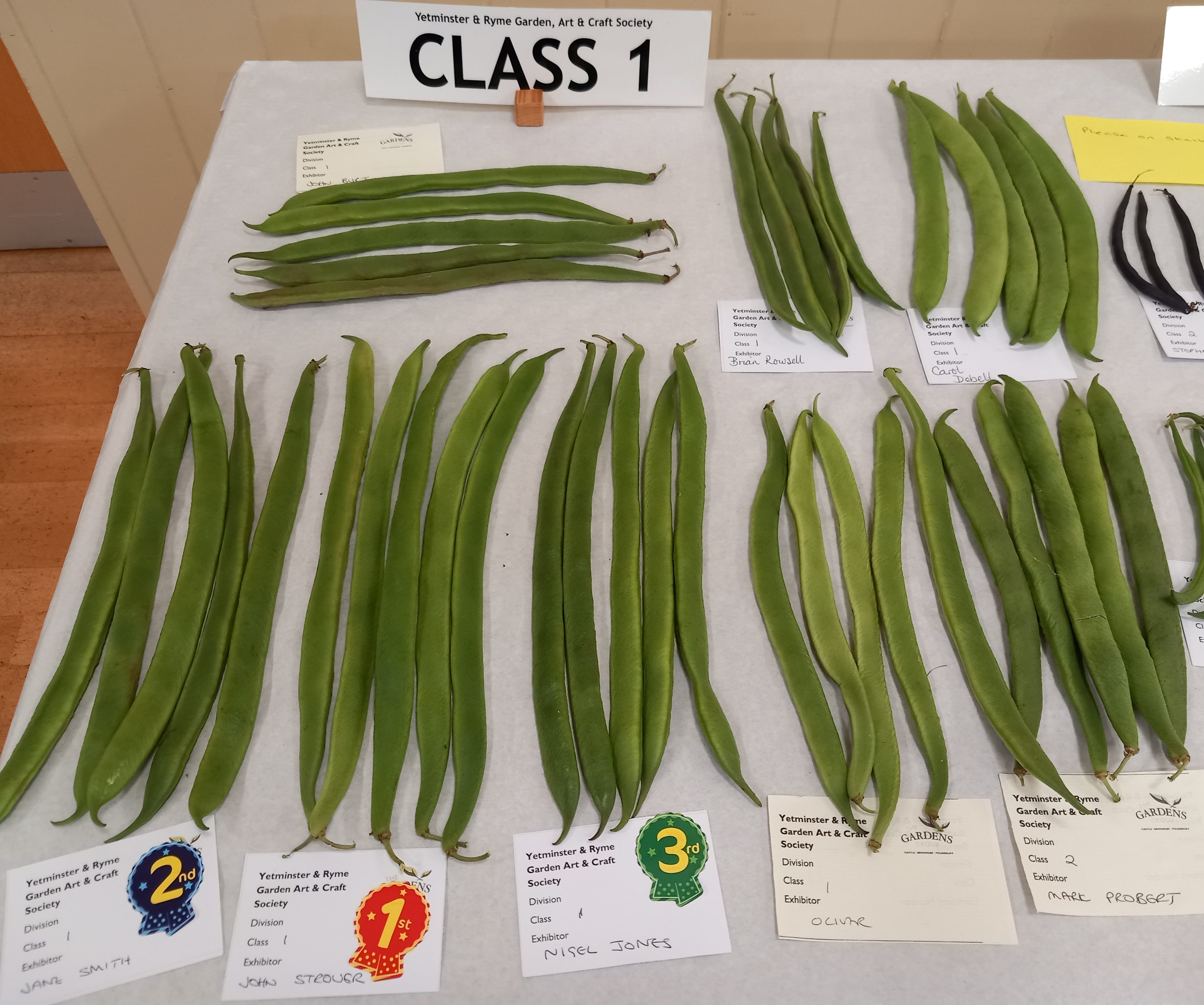
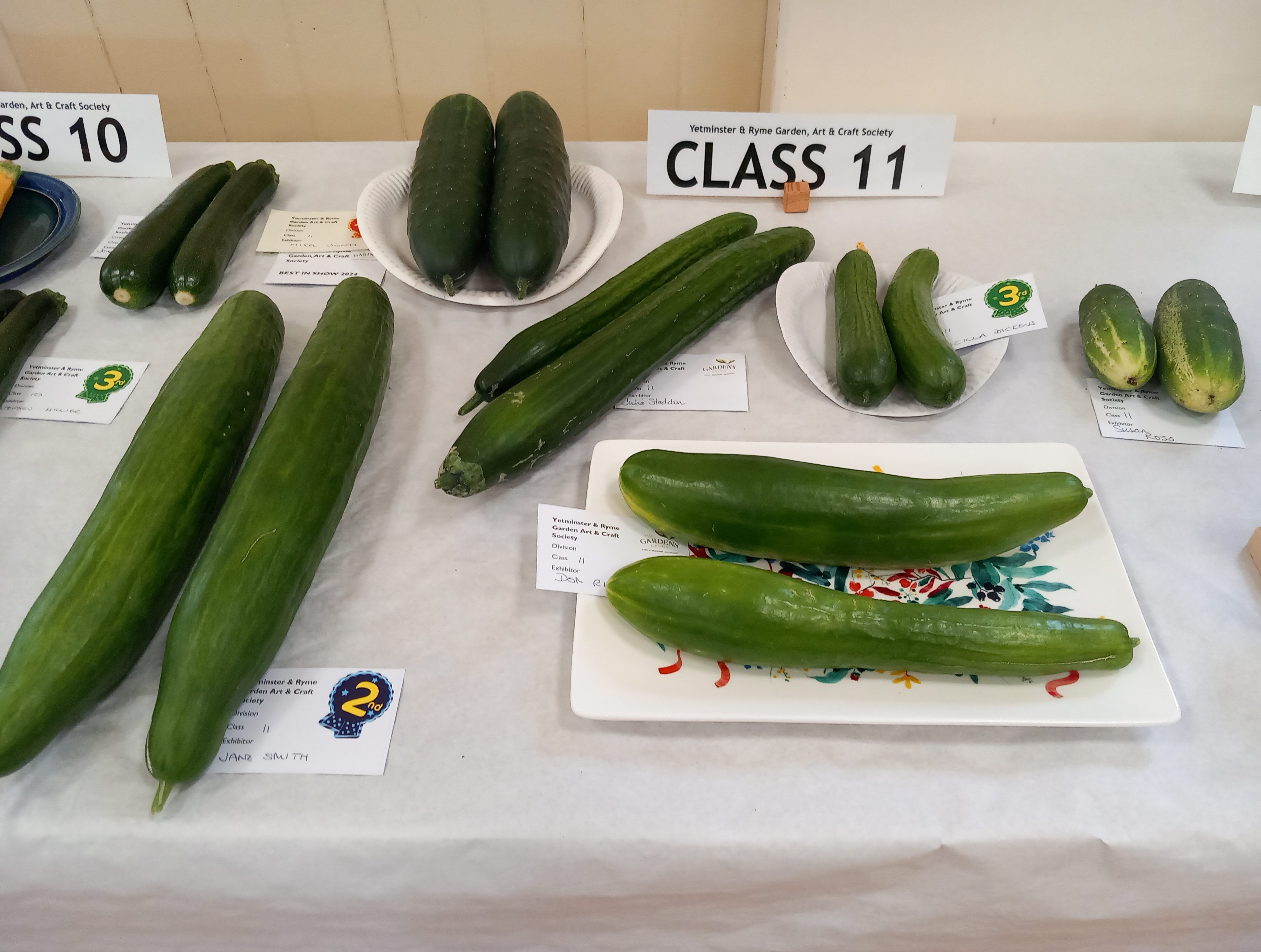
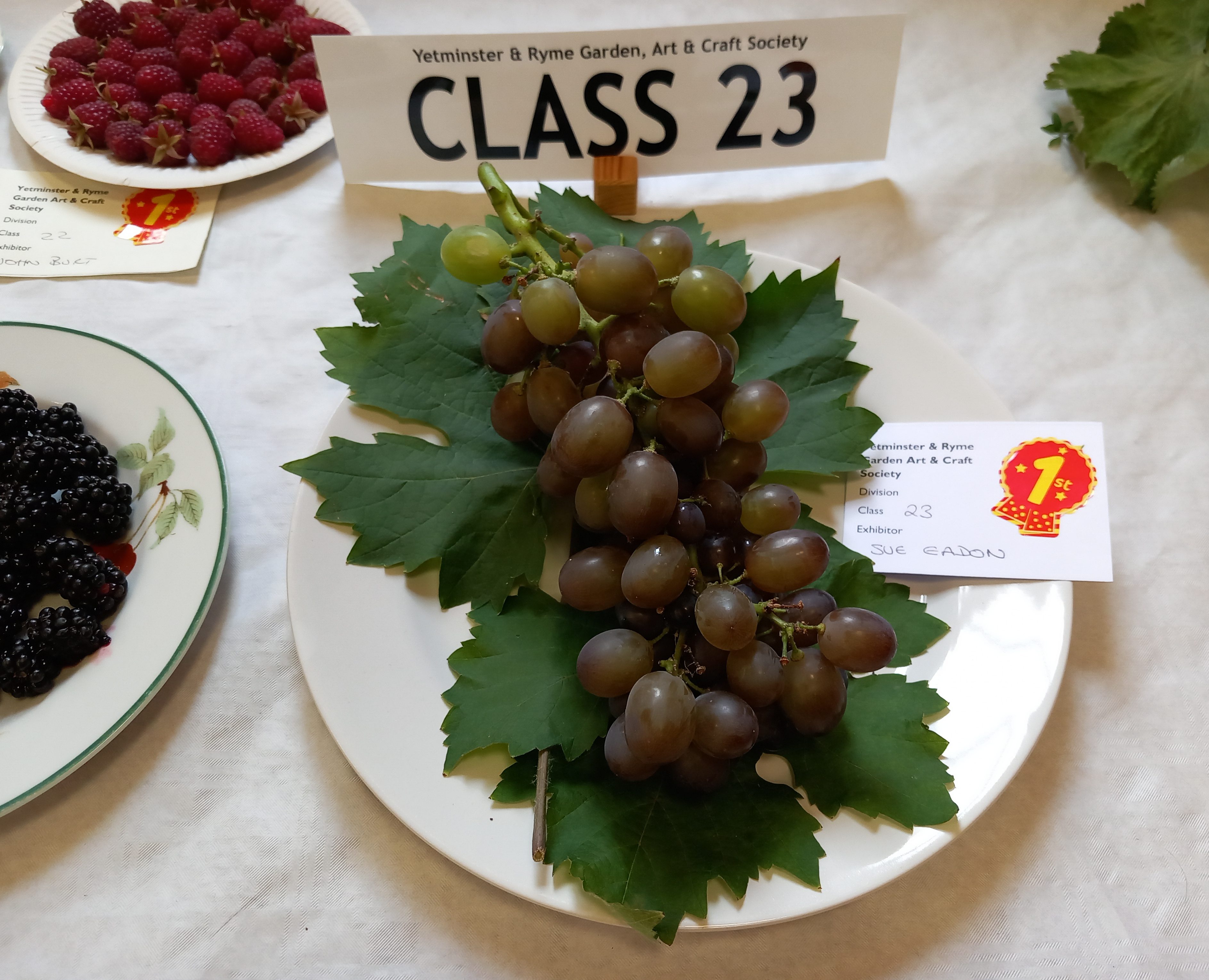
This year at Yetminster, there were sixteen classes for vegetables, each reflecting crops ready for harvest in mid-August.  Runner beans, ripe tomatoes and cucumbers arranged in pairs looked impressive, as did potatoes, onions and a single golden pumpkin.  In the fruit section an enormous bunch of grapes beautifully displayed on a bed of vine leaves took a first prize, alongside displays of the new season’s apples and plums, and a mouth-watering selection of berries.

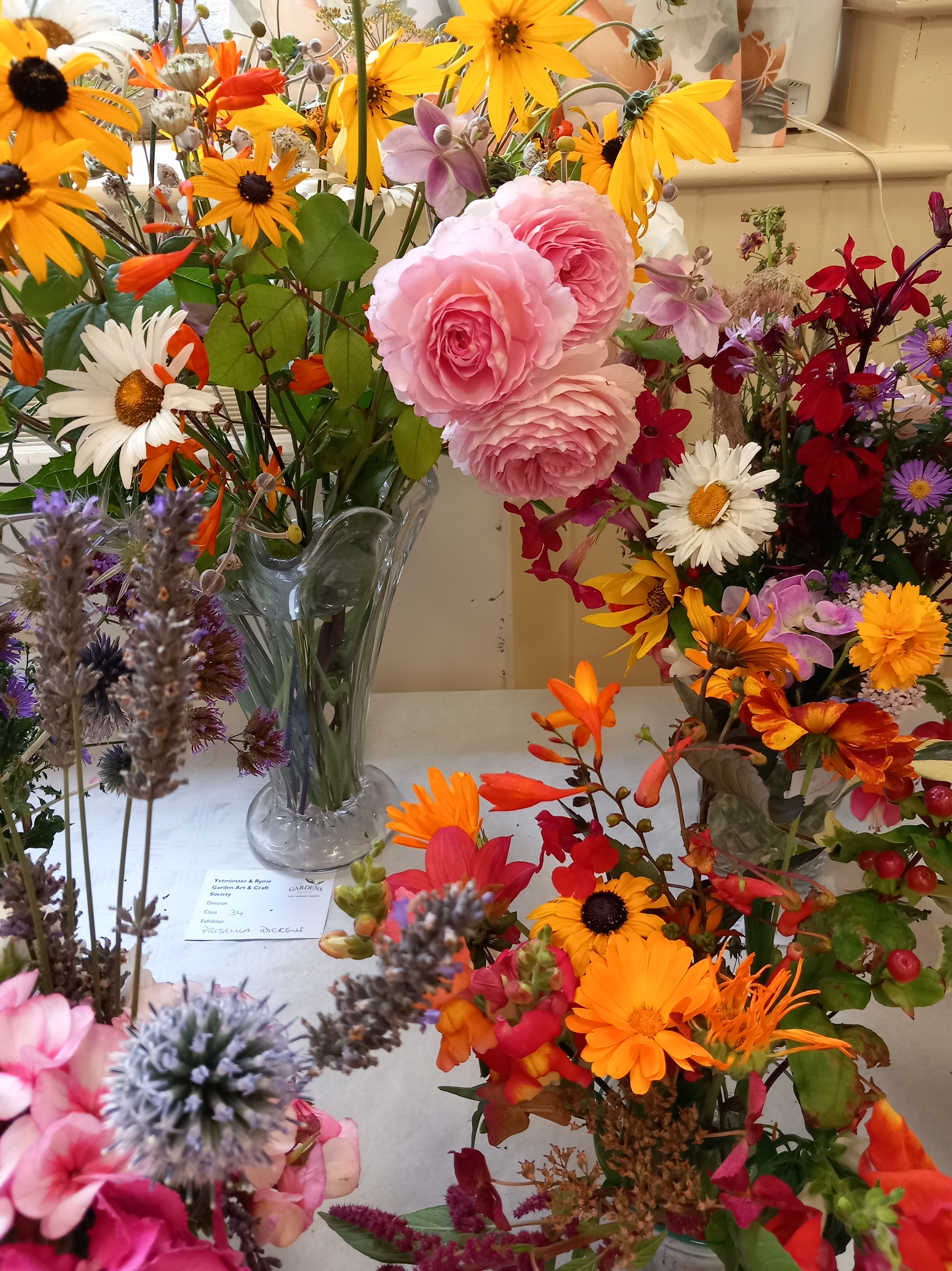
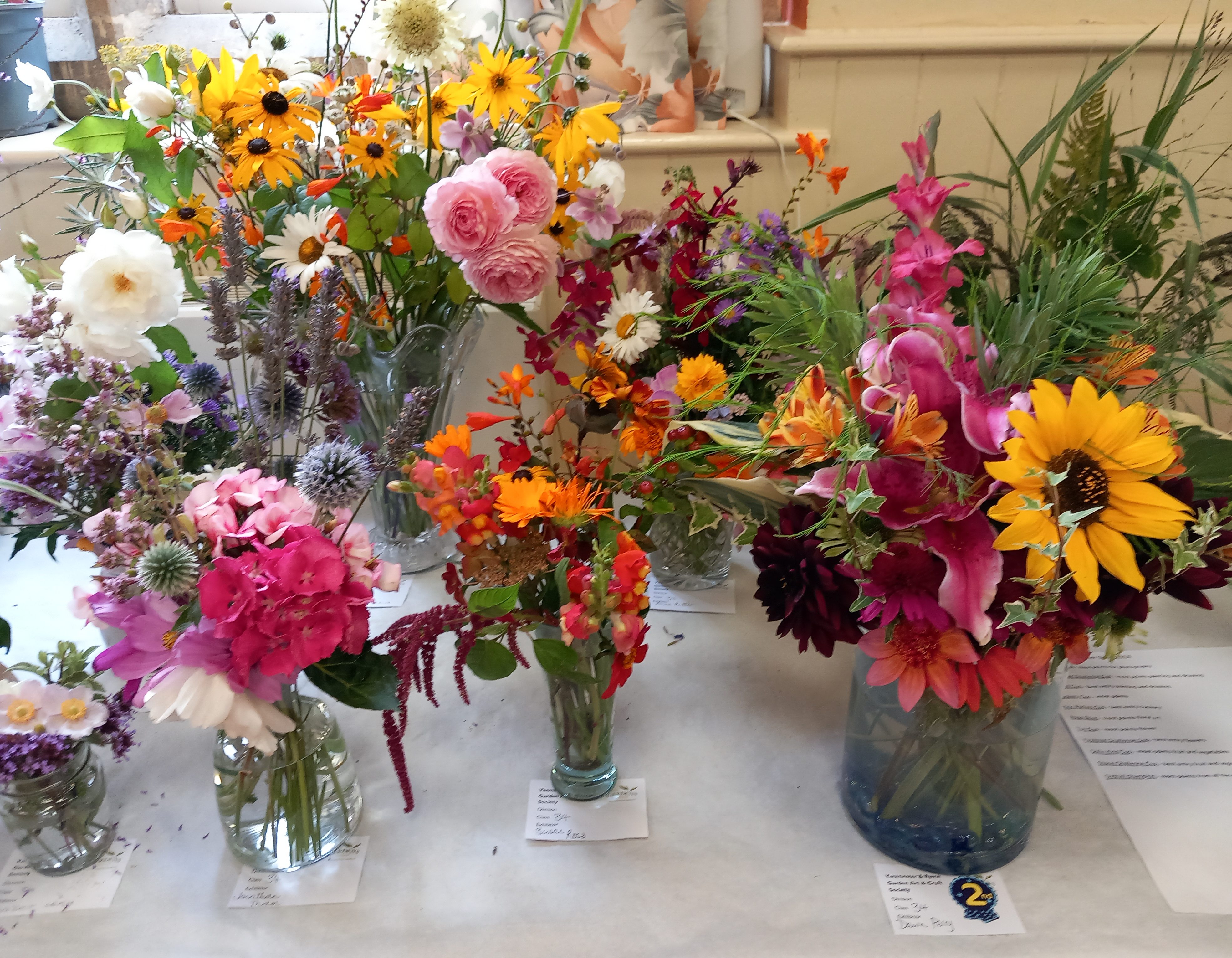
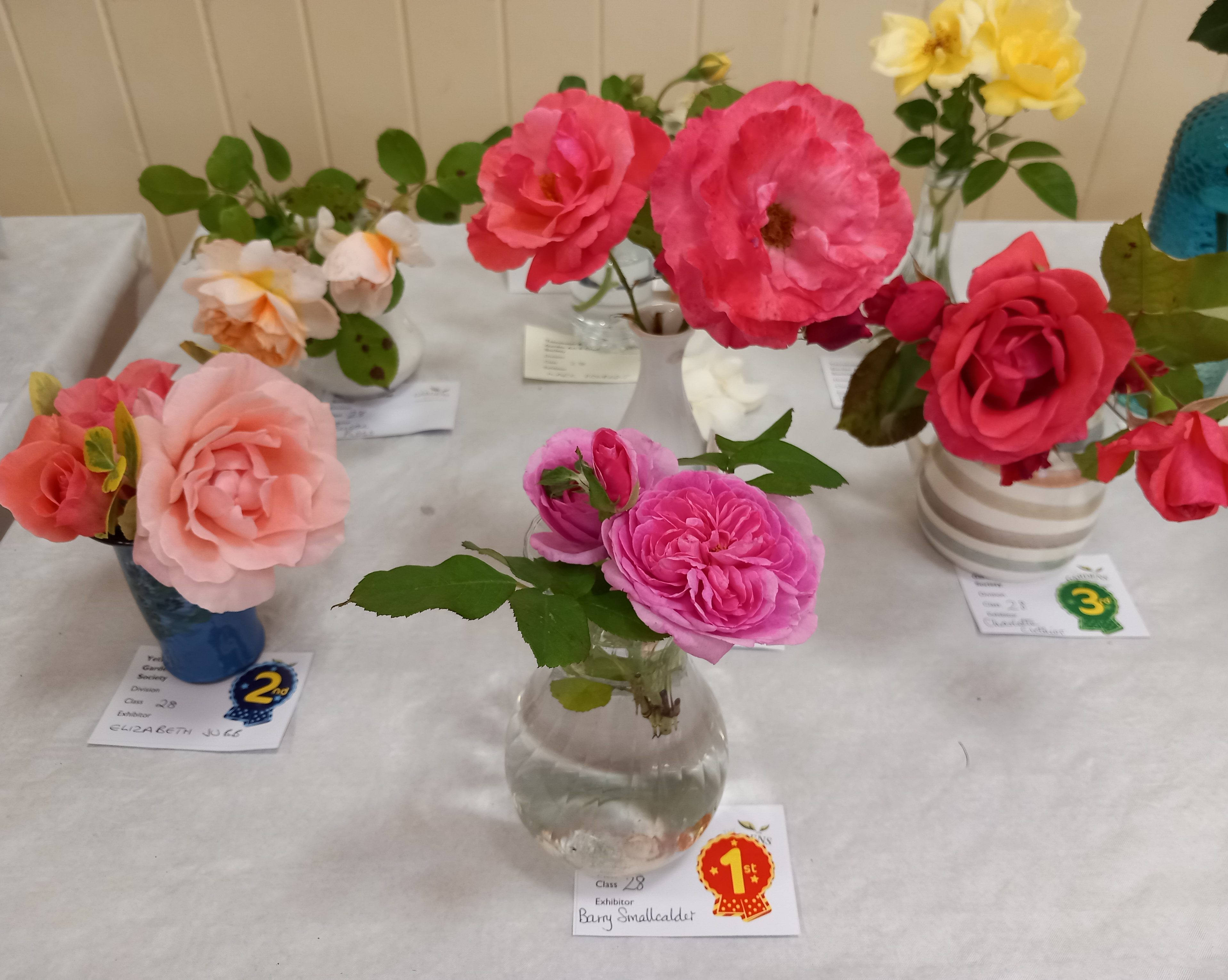
In the section for flowers there were classes for sweet peas, roses, dahlias and pansies or violas, where all the stems must be home grown.  Class 34, A Mixed Vase of Garden Flowers was one of the most popular with competitors, each arrangement overflowing with late season blooms.  The fiery yellows and oranges of sunflowers, rudbeckia and crocosmia seemed to radiate summer heat, and stems of Japanese anemones, roses, dahlias, phlox, leucanthemum and asters were reminders of the continuing abundance of the flower garden from late August into autumn.

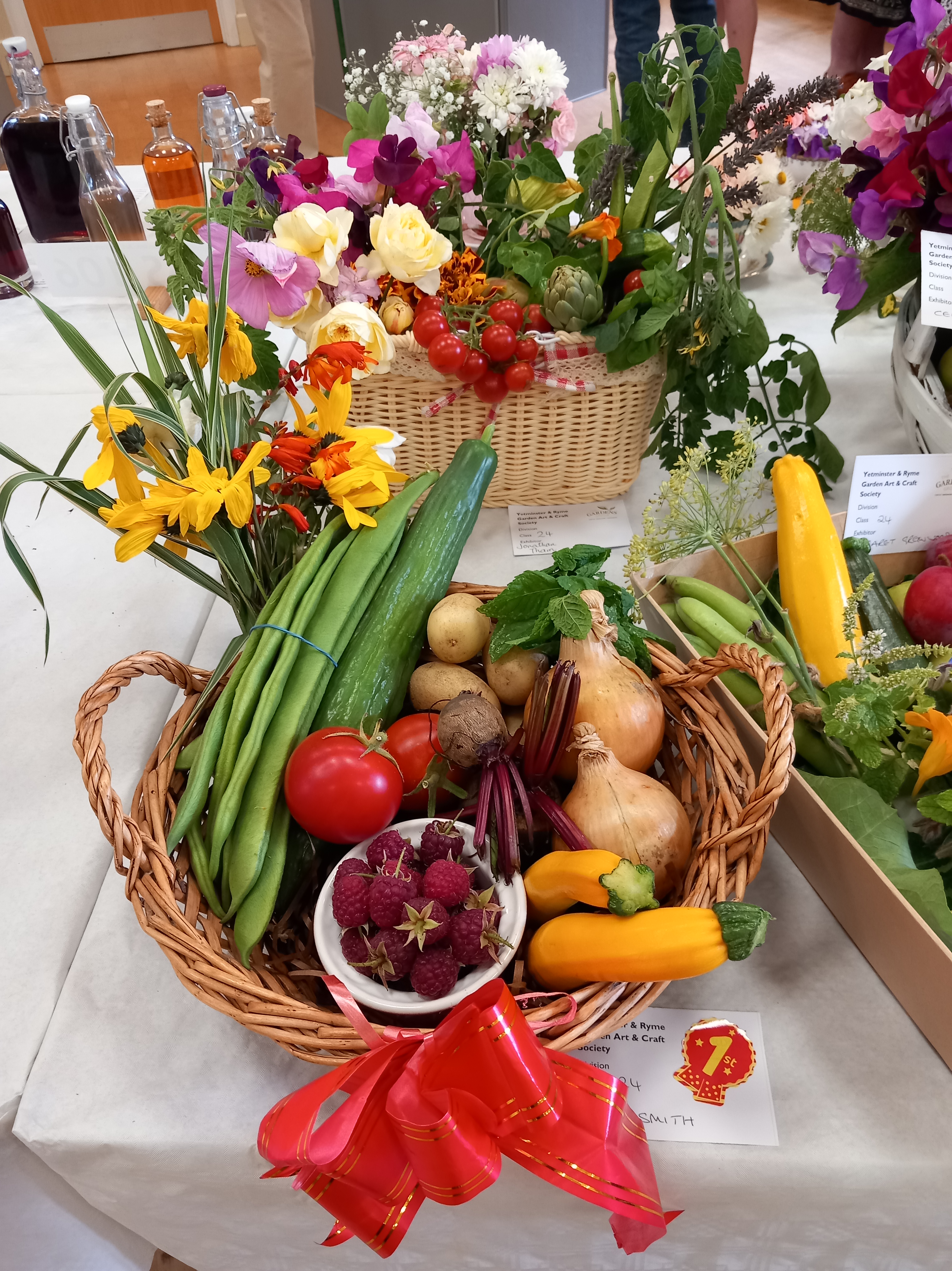
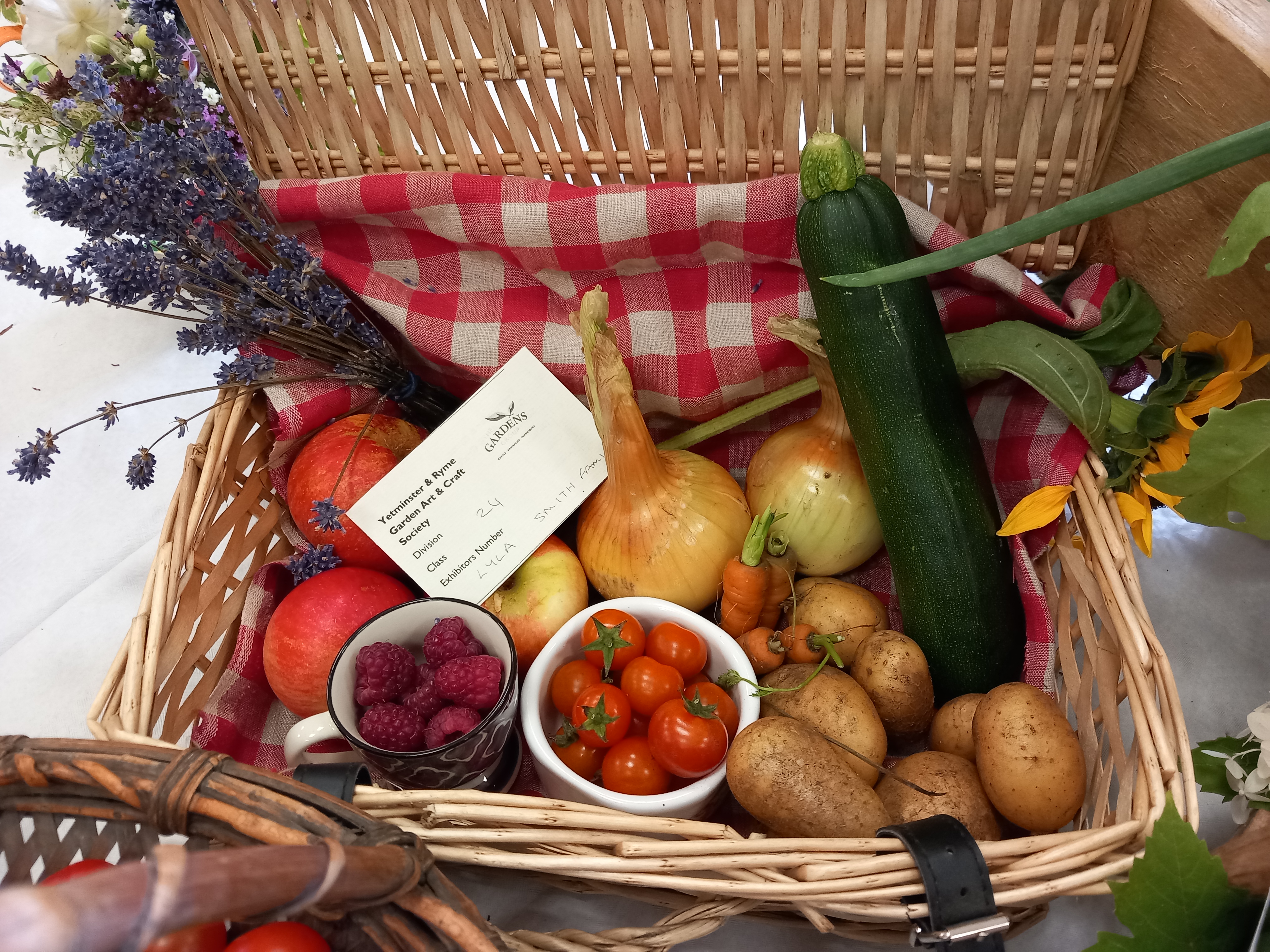
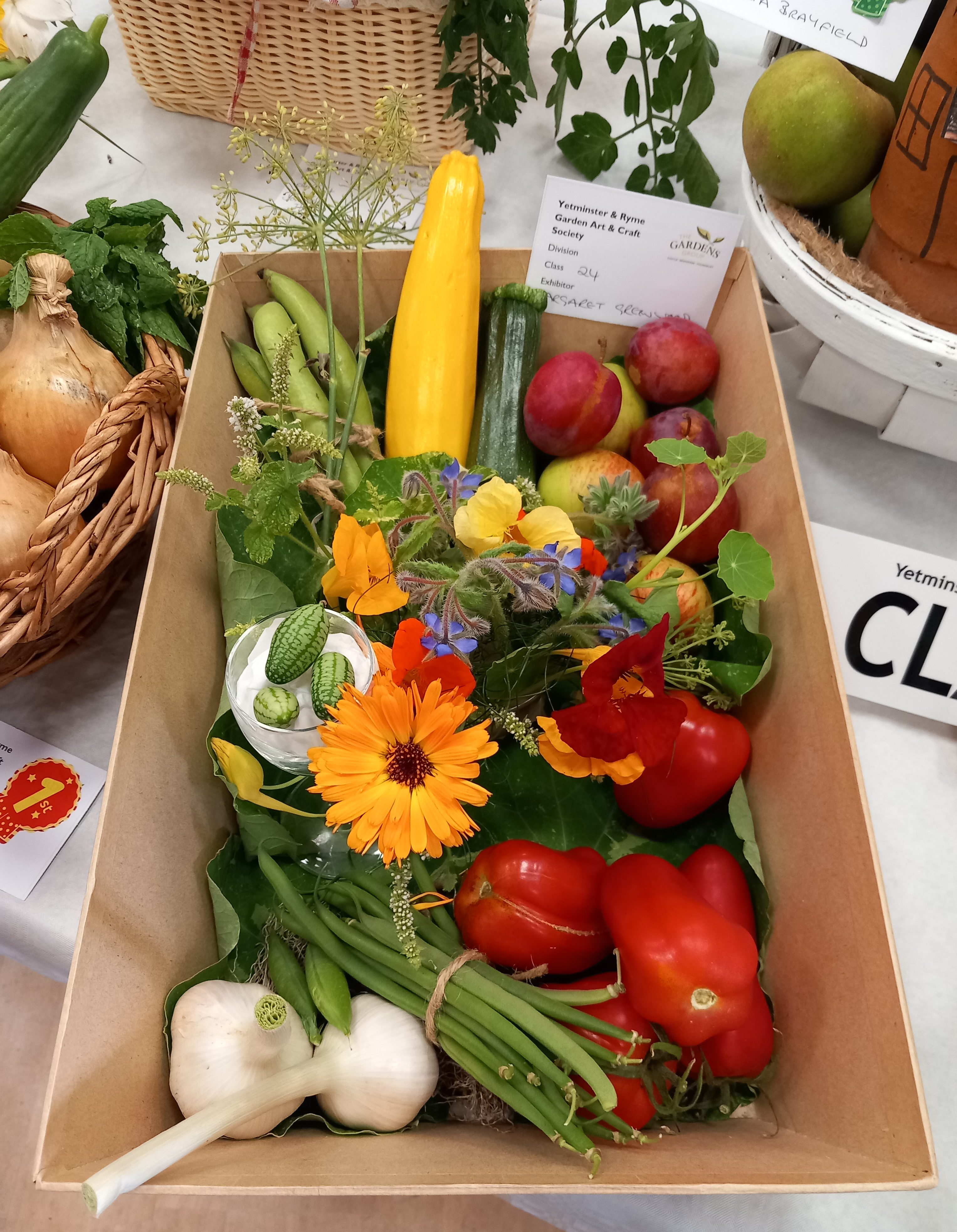
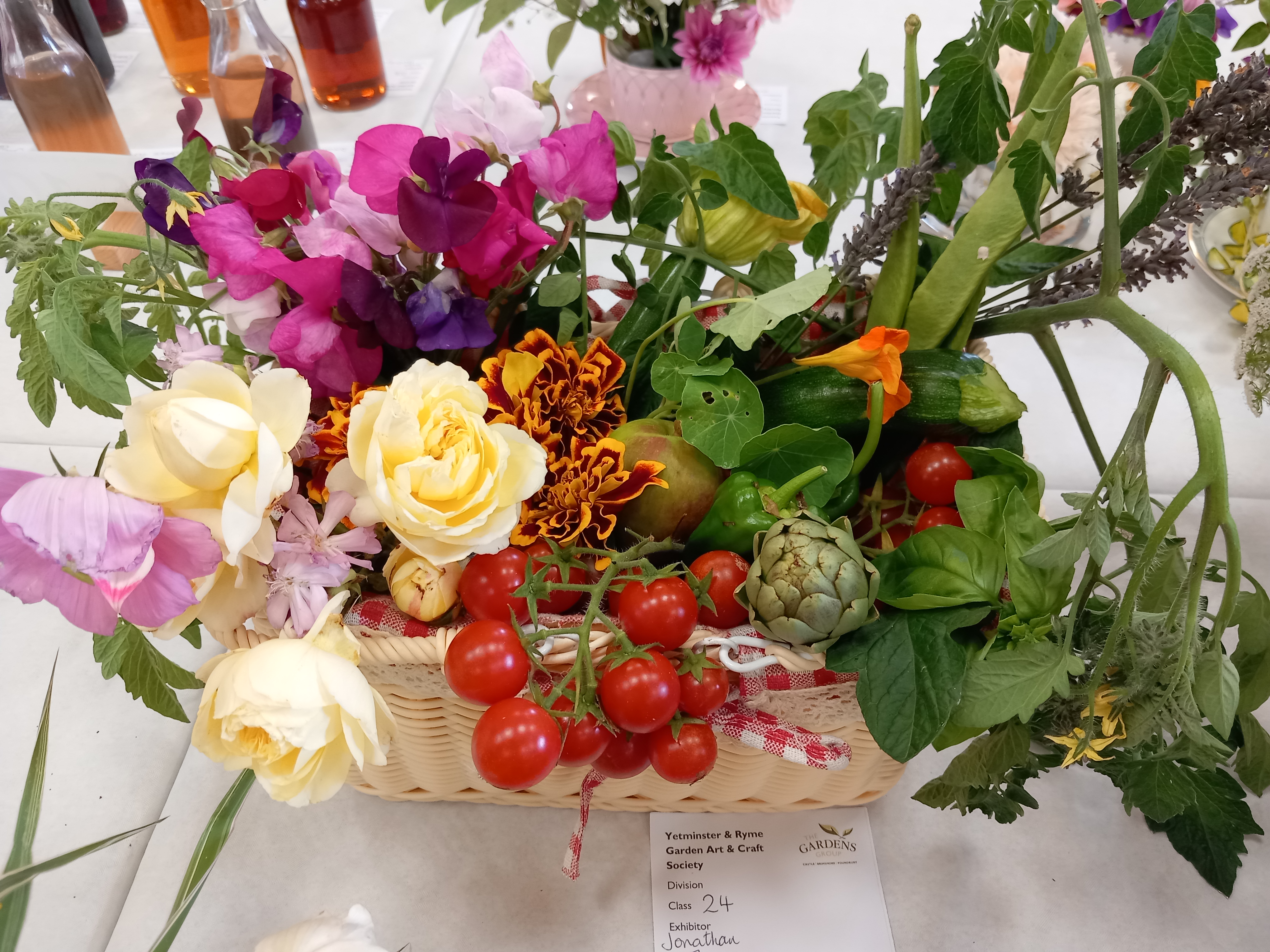
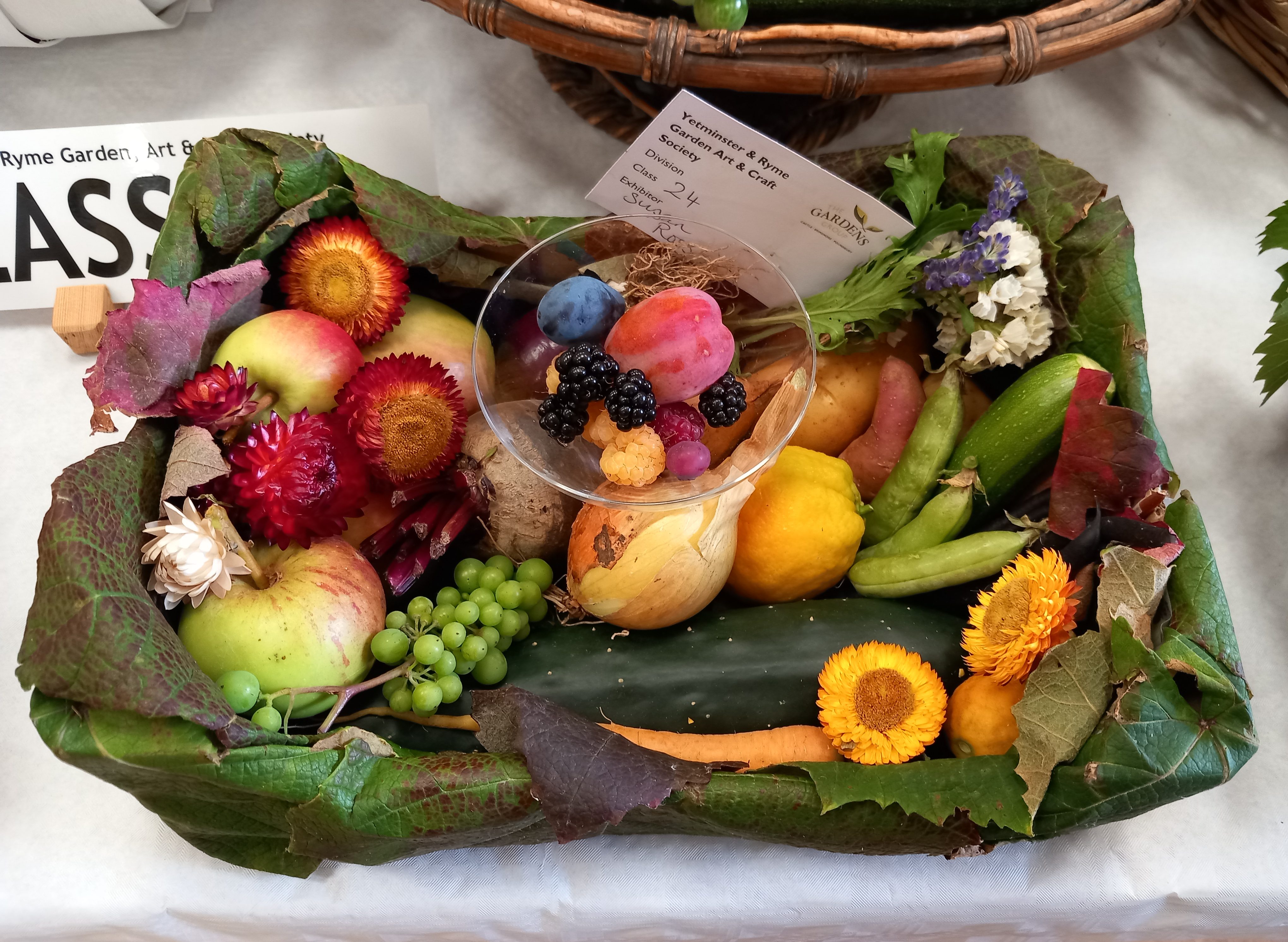
My Garden in a Box was another popular class, inviting growers to show the best from your garden to include any vegetables, fruit and flowers, arranged as an attractive presentation in a basket or box not exceeding 14 inches at the longest measure.  This broad category encourages creativity and enables entrants to build a narrative around their garden.

The winning box combined runner beans, tomatoes and beetroot, two onions, their tops expertly tied with raffia, a dish of raspberries and a container of garden flowers, allowing us to imagine the owner’s well-tended and productive plot.  Another entrant arranged roses, sweet peas and a truss of perfectly ripe cherry tomatoes to spill over the edge of a gingham-lined wicker basket, filled with fruit and French marigolds, as if arranged for a summer picnic on the lawn.

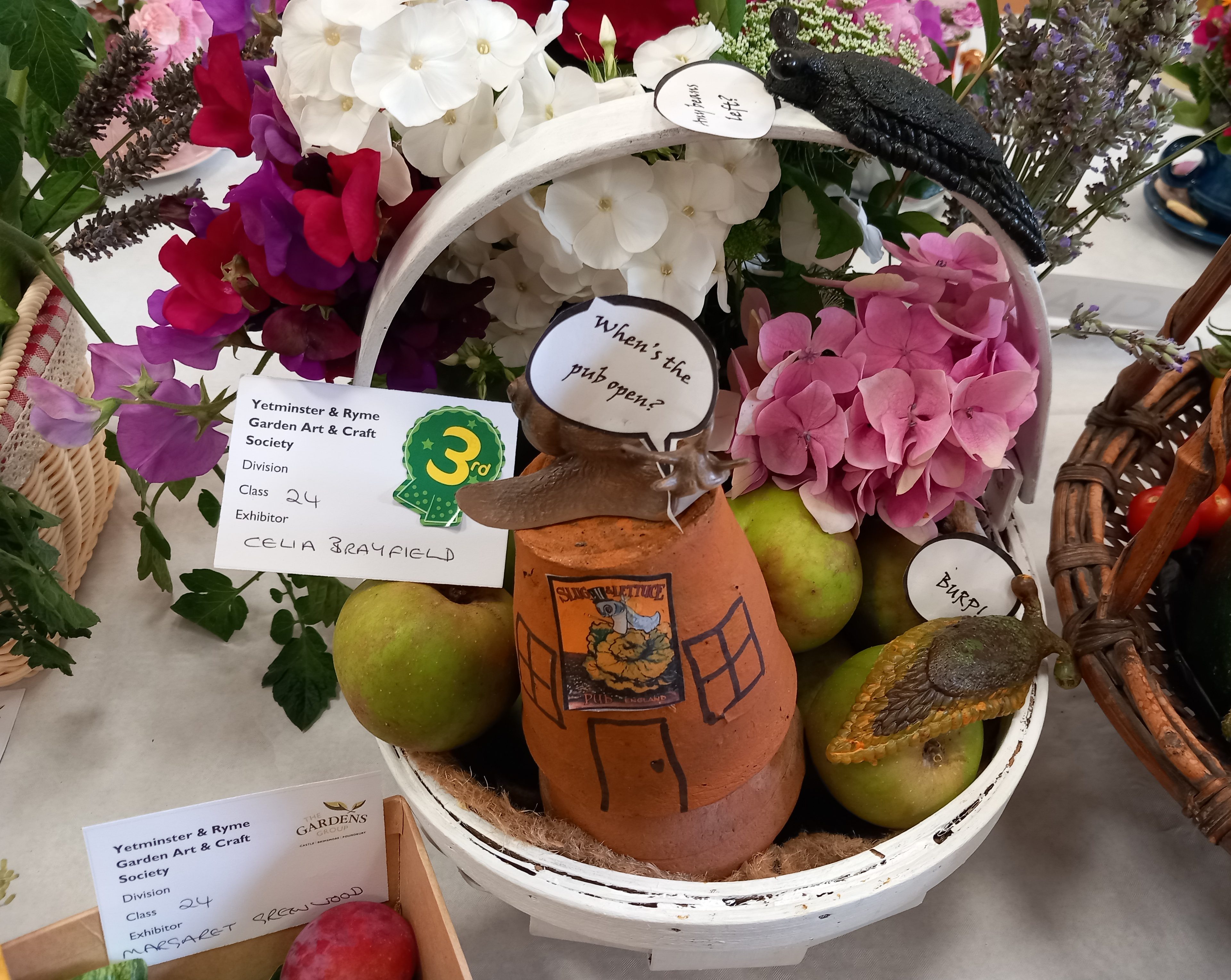
This class also provides potential for humour.  Celia Brayfield’s entry centred on a trio of enormous plastic slugs, with paper speech bubbles detailing their impatient wait for their ‘pub’ to open – a beer trap contained in a flower pot – and their malevolent delight having eaten all the beans.  This garden was represented by a basket filled with apples and decorated with hydrangeas, phlox and sweet peas, some of the few flowers these creatures seem to avoid.  Recently on the BBC’s Gardeners’ World presenter Monty Don reminded us how we can, at times, be over serious about our gardens, so I’m sure he would have approved of this entry’s well deserved third prize.

The flower show in the UK has a rich history, dating back to the florists’ societies of the seventeenth and eighteenth centuries, when auriculas, carnations and tulips were popular flowers to grow and exhibit.  Floriculture, or the cultivation of flowers for show, increased in popularity into the nineteenth century as these events evolved to include new plant introductions such as dahlias and chrysanthemums.

In urban centres, the tradition of local flower shows saw a decline in the twentieth century.  But in rural locations, gardening clubs and horticultural societies have been the guardians of the village flower show, preserving its spirit of competition, fun, and its role as an important social event.

As well as organising their excellent show, Yetminster & Ryme Intrinseca Garden and Arts & Crafts Society holds regular meetings of interest to gardeners throughout the year.  Details below:

Class 1 Runner Beans, 5 Pods

Class 11 Cucumbers 2 of one variety

Class 7 Tomatoes: non-cherry type 5 of one variety
Class 8 Truss of cherry tomatoes

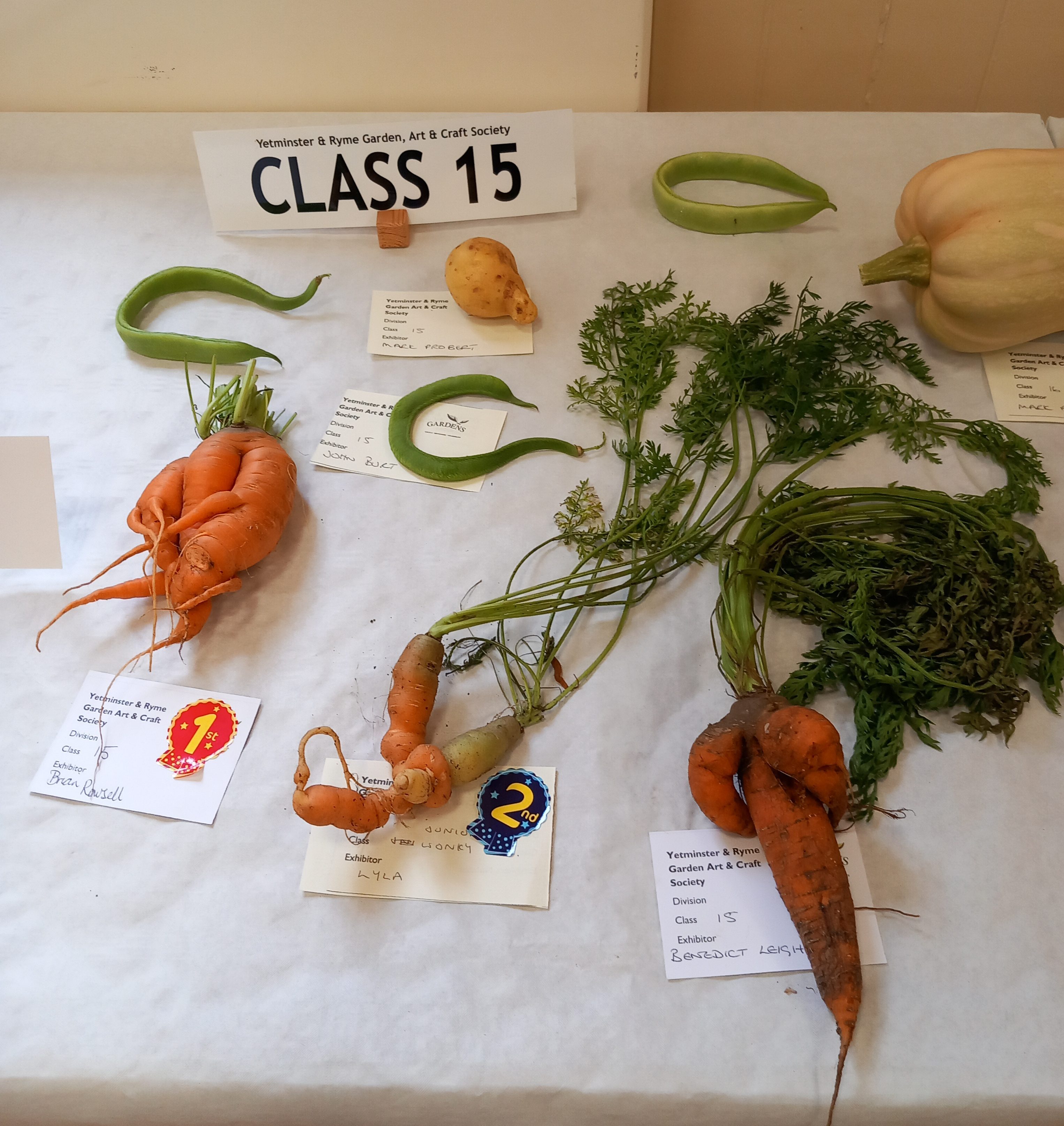
Class 15 A Wonky Vegetable

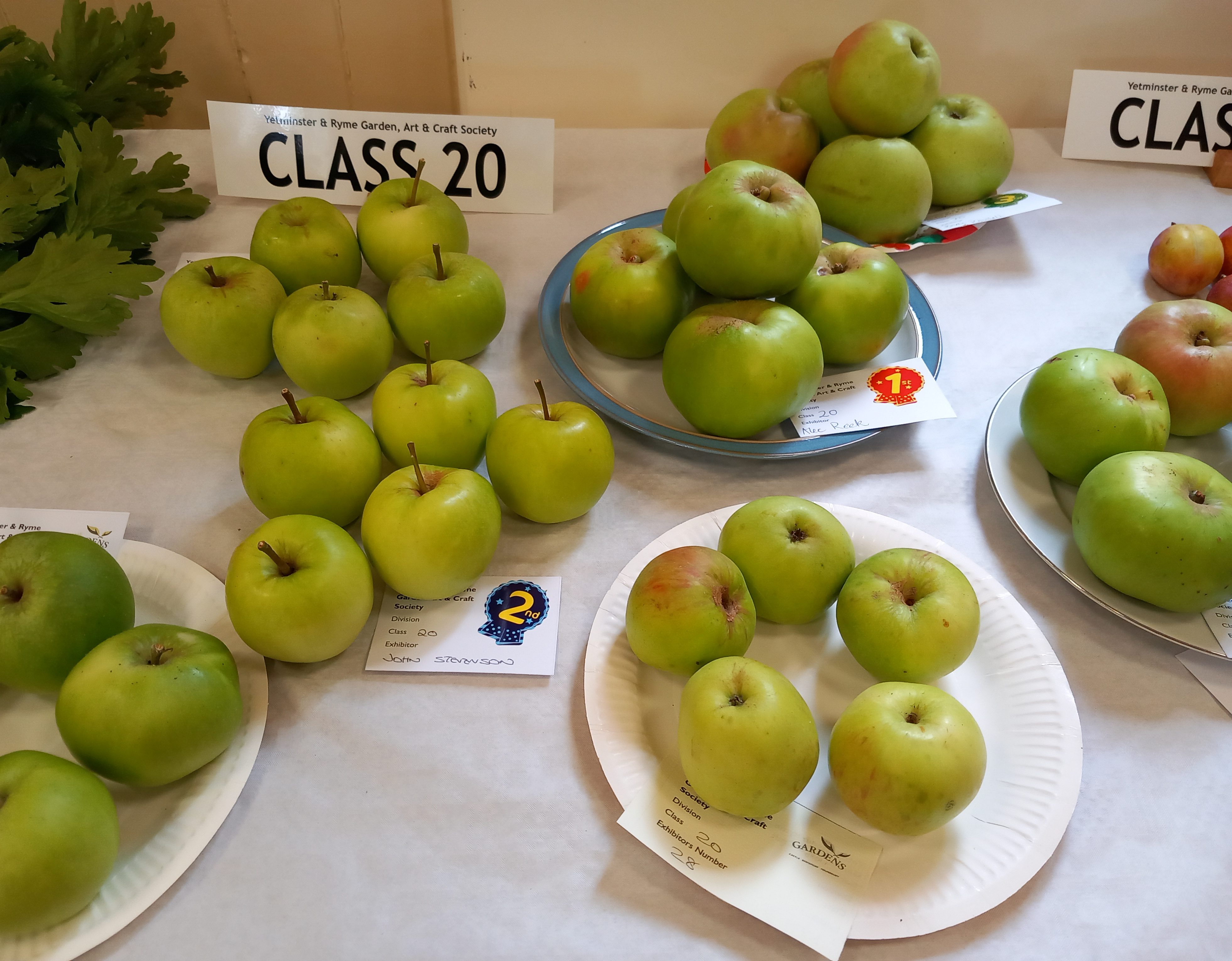
Class 20 Apples Dessert or Cooking 5

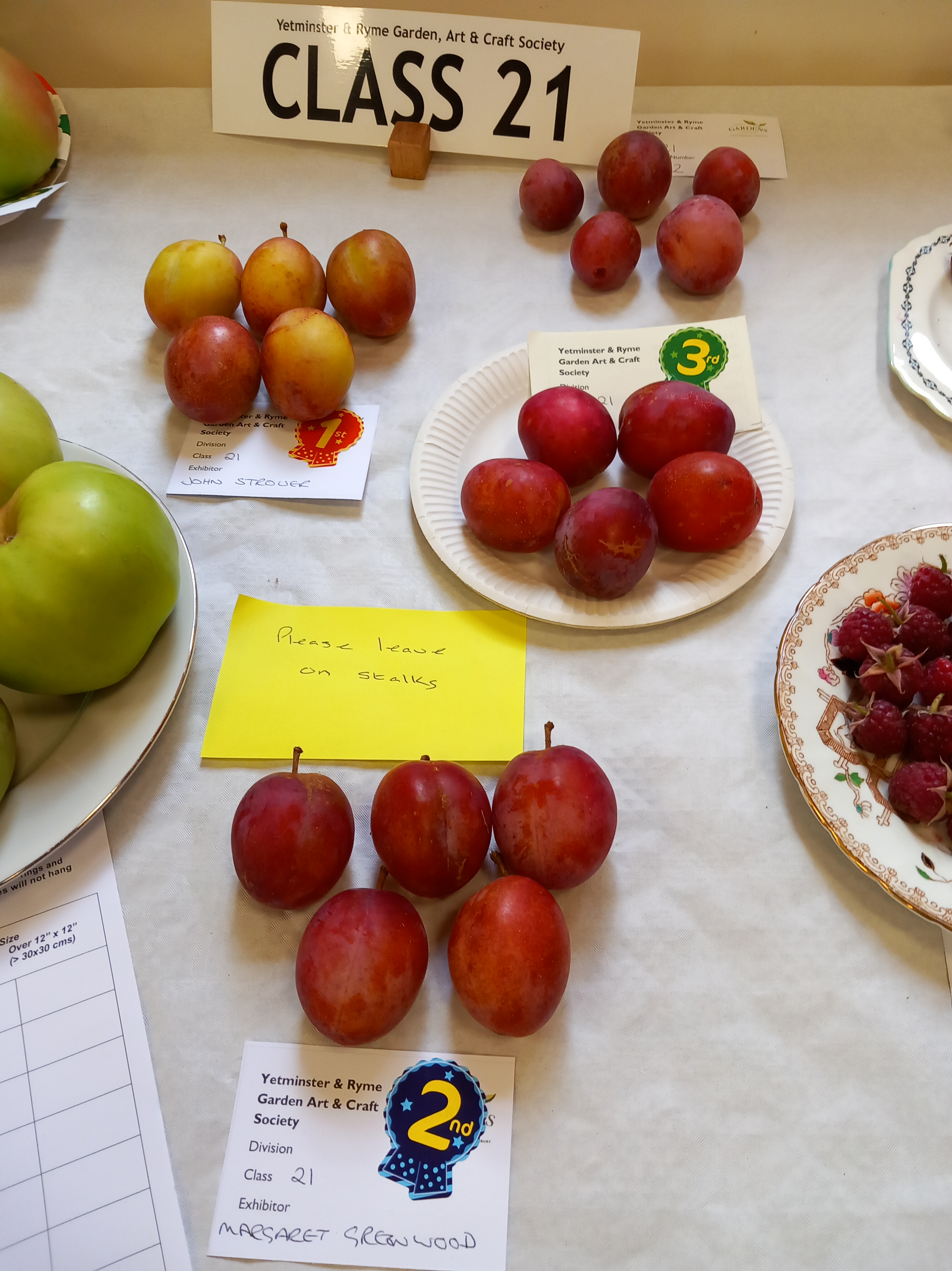
Class 21 Plums or Gages 5
A yellow post it note reminds one competitor that stalks are supposed to be left on the entries.

Class 23 Dish of Fruit of one kind not above (ie. apples, plums and soft fruit)

Class 34 Mixed Vase of Garden Flowers

Class 28 Three stages of a rose. Three stems from the same rosebush to include a bud, a half bloom and full bloom with their own foliage. This prize winning rose looks like it might be ‘Gertrude Jekyll’

Class 24 My Garden in a Box Winning entry

Class 24 My Garden in a Box

Class 24 My Garden in a Box

Class 24 My Garden in a Box

Class 24 My Garden in a Box

Class 24 My Garden in a Box
Third prize

Further reading:

Yetminster and Ryme Intrinseca Garden and Arts & Crafts Society here
Mary Delany’s Pelargoniums

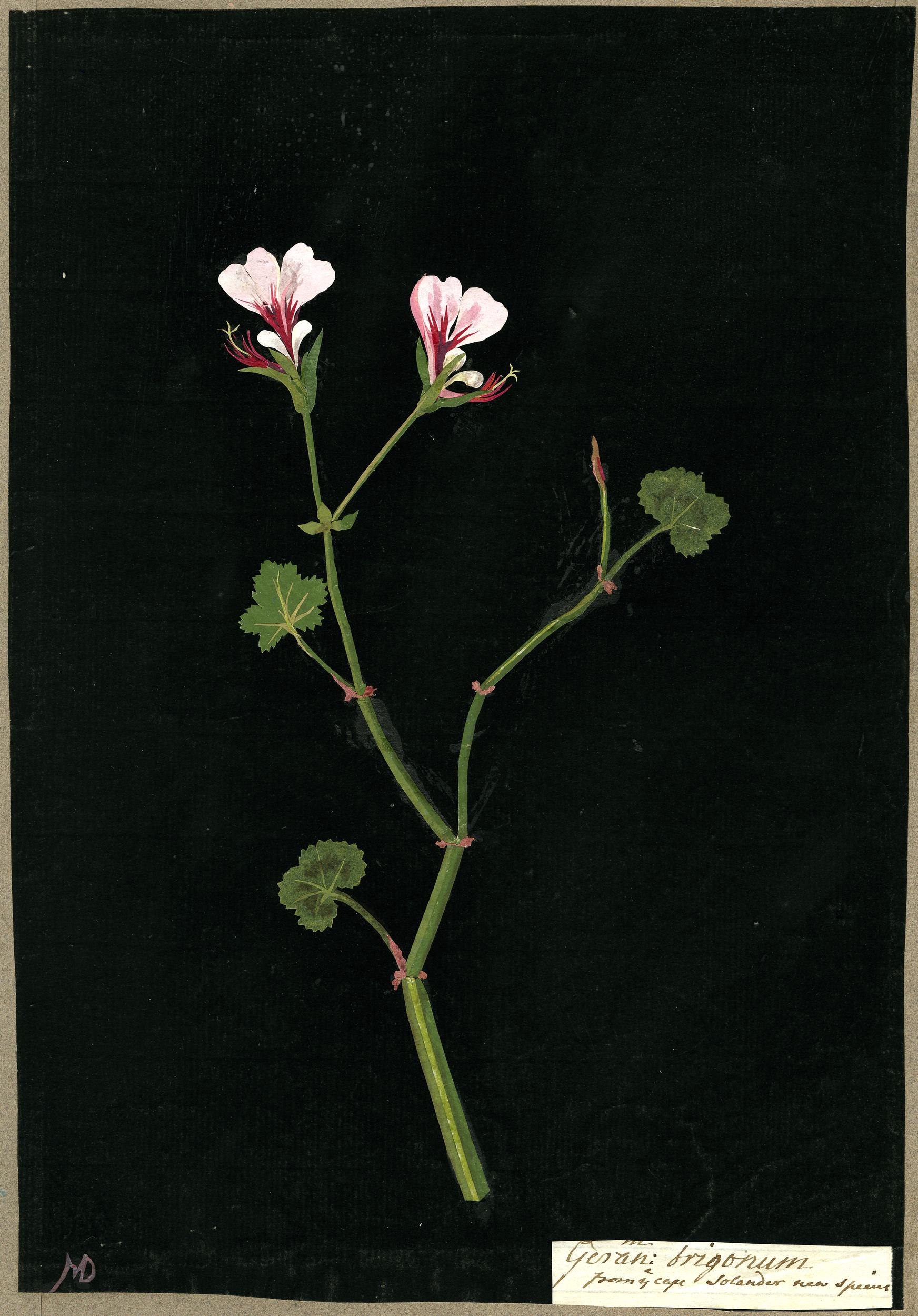
Geranium Trigonum, from an album (Vol.IV, 82). 1778

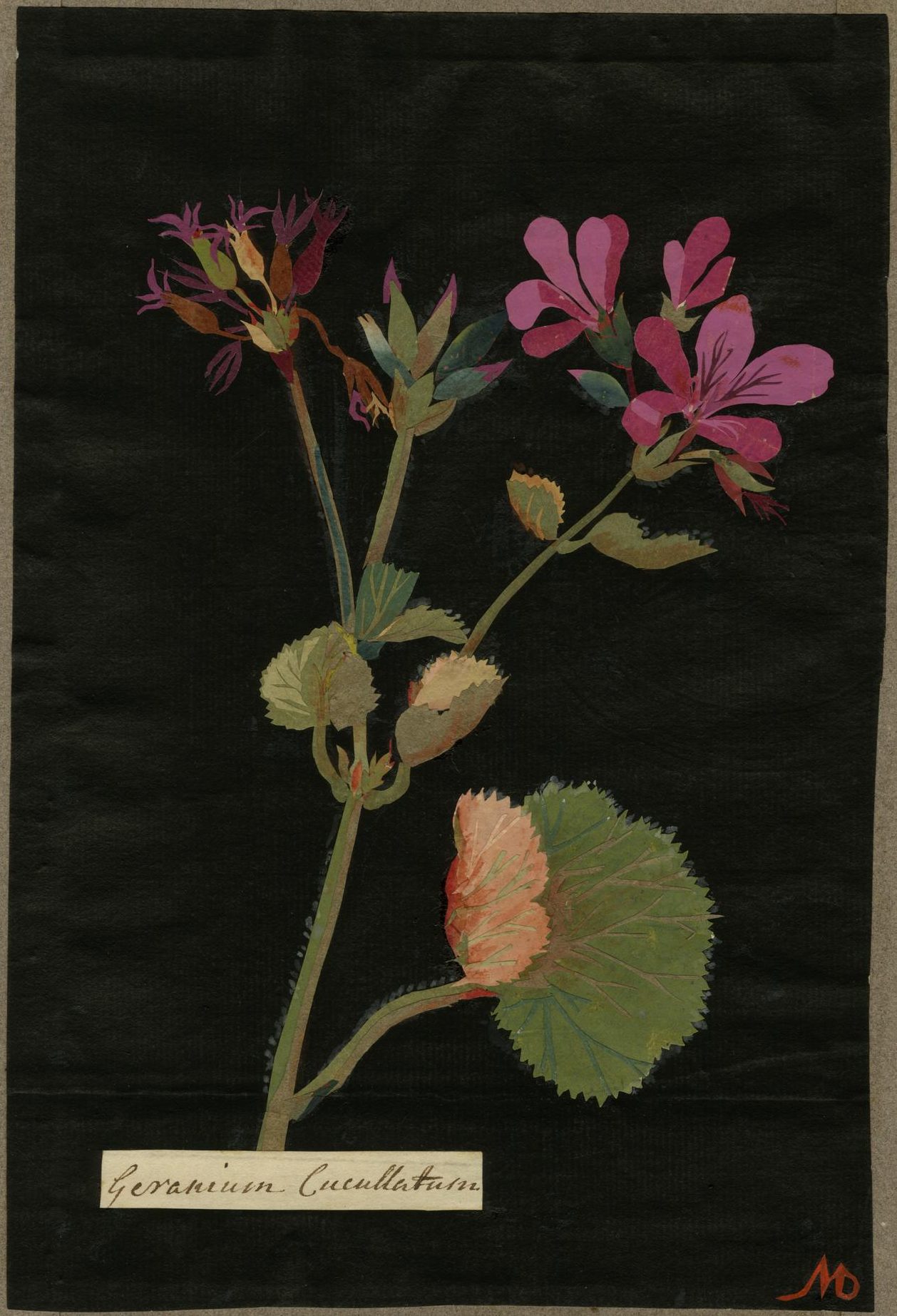
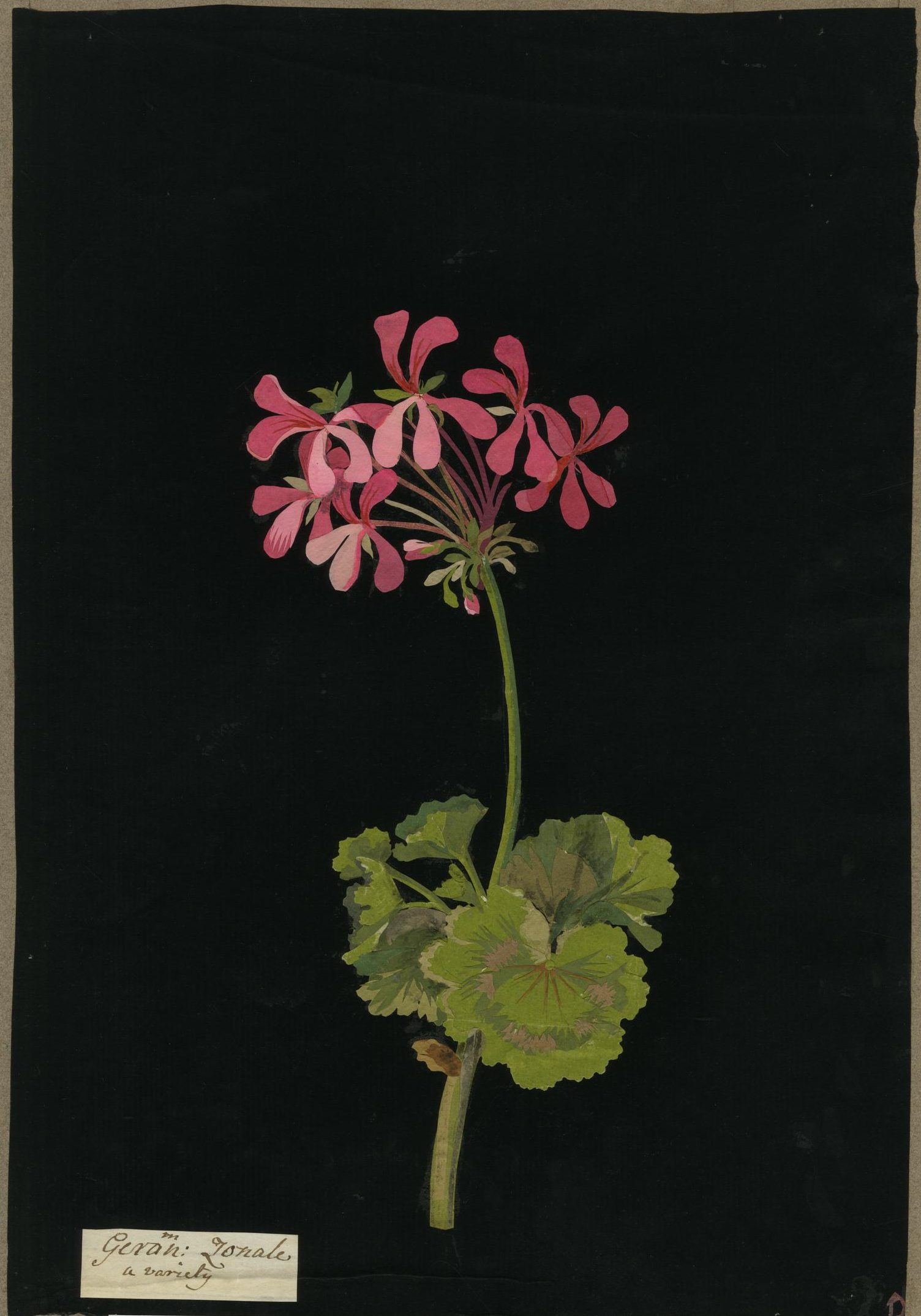
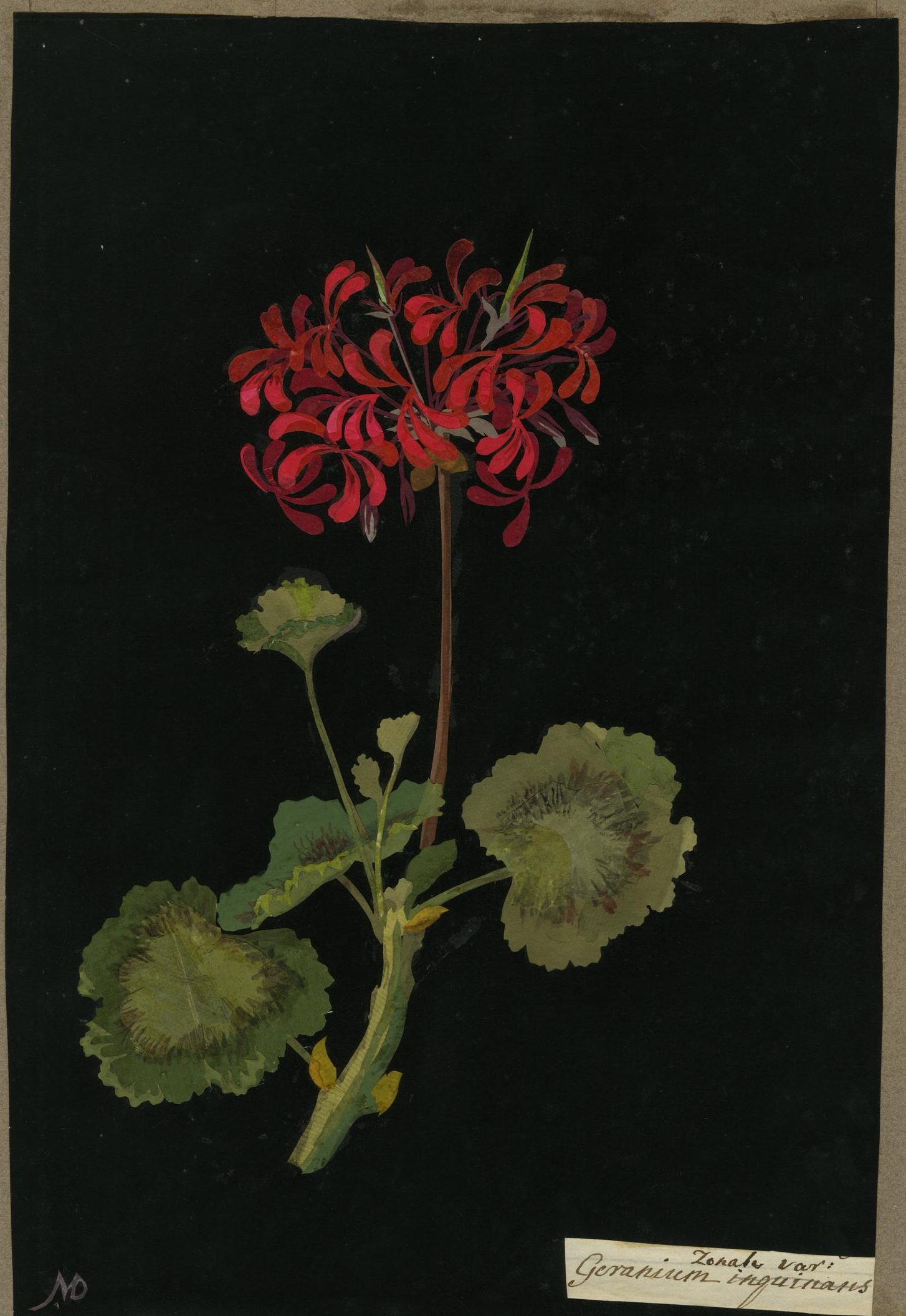
Two pairs of white petals streaked with deep pink at their centres seem to glow against their inky black background, demanding our attention despite their modest size.  Carried on tall stems with few leaves, these flowers belong to Geranium trigonum, a scrambling subshrub from the South West Cape, in South Africa.  The velvety texture of the leaves and stems of Geranium cucullatum, also from the South West Cape, is suggested by tiny fragments of coloured paper.  This plant’s fine covering of hairs are an adaptation providing protection from the fierce rays of the sun.  Contrasting tones in pink highlight the petals and buds of Geranium zonale, emphasising the three dimensional character of the individual flowers and the rounded composite flower head.

Geranium Cucullatum (Monodelphia Decandria), from an album (Vol.IV, 87). 1774

Geranium Zonale, from an album (Vol.IV, 84). 1778

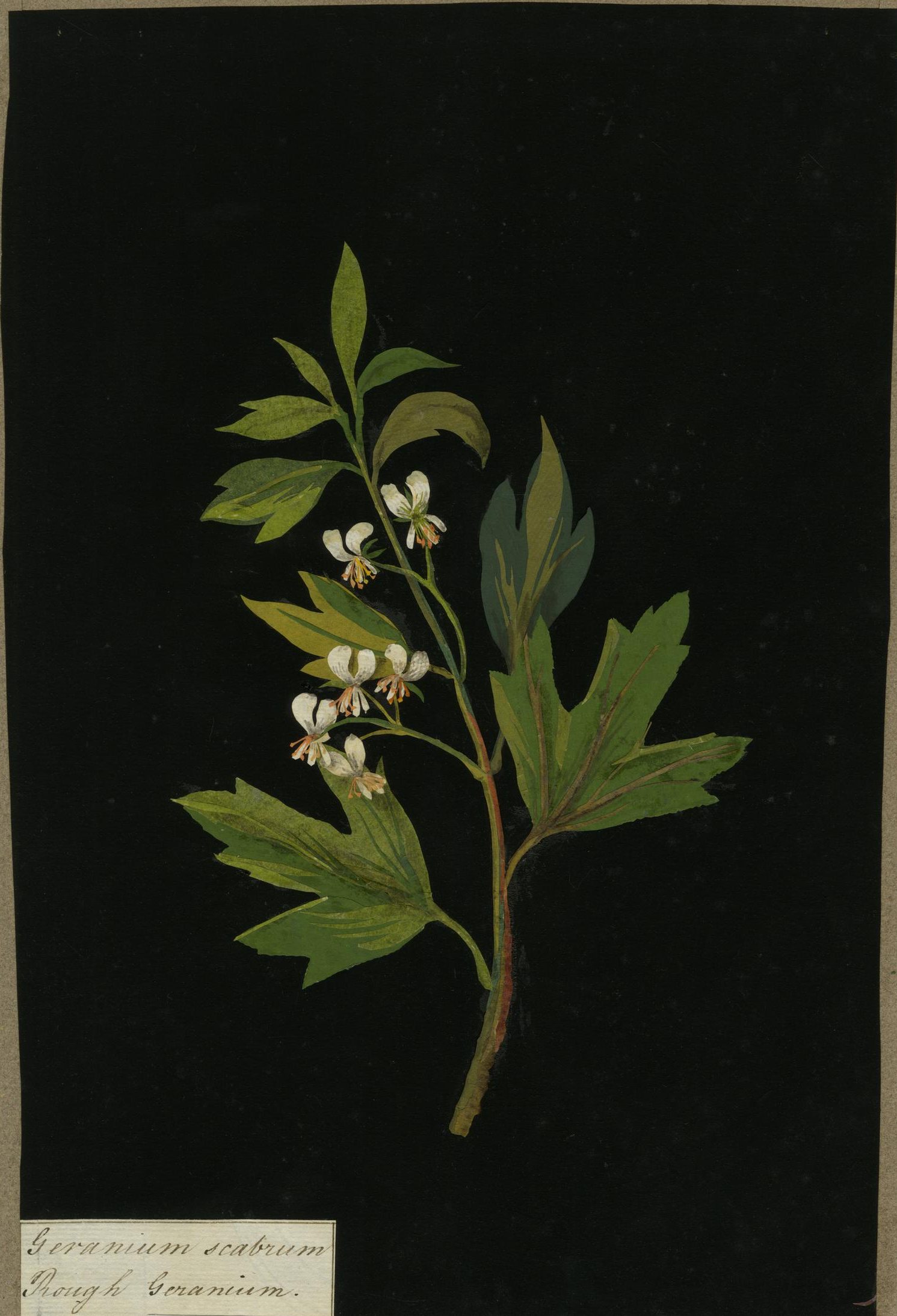
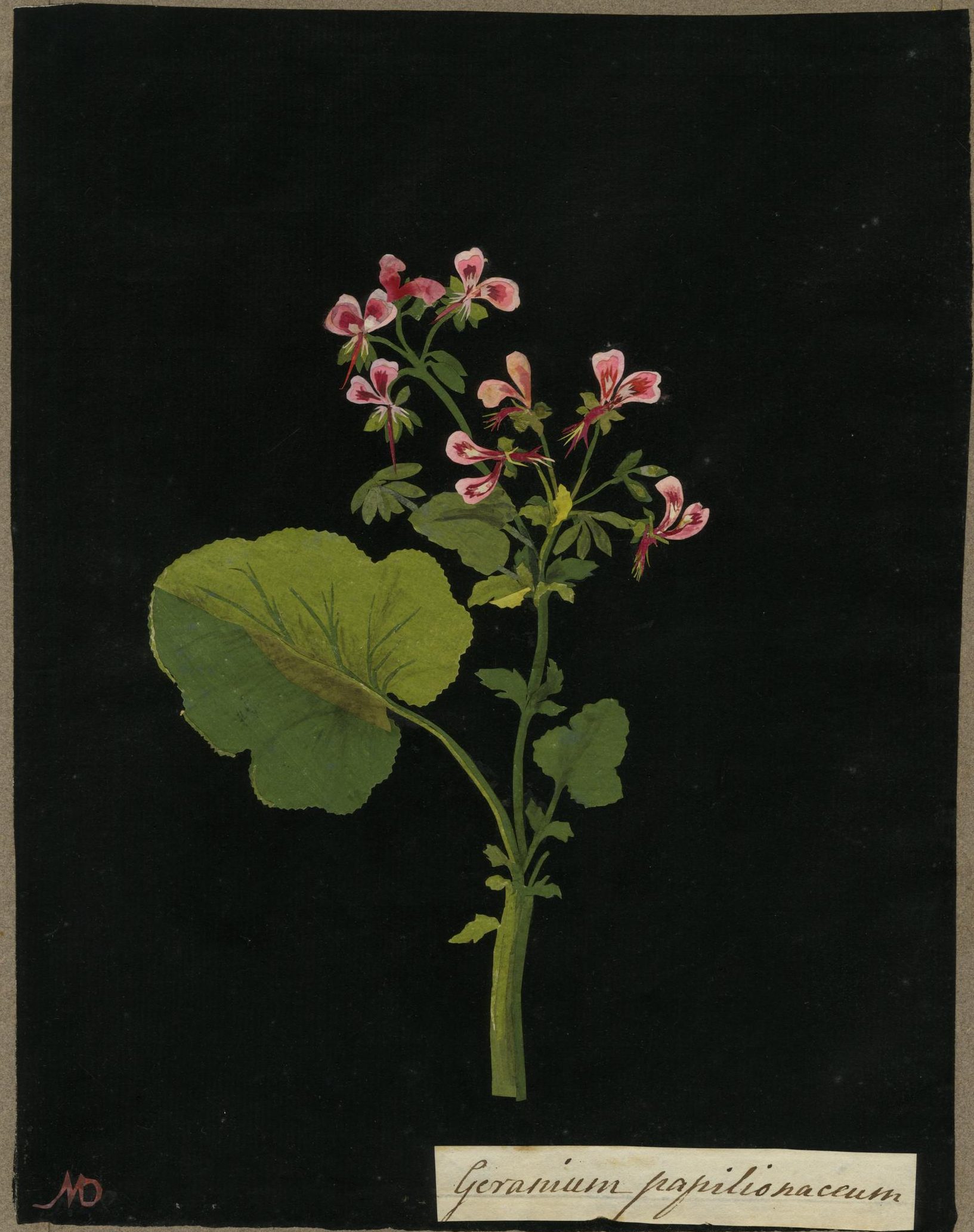
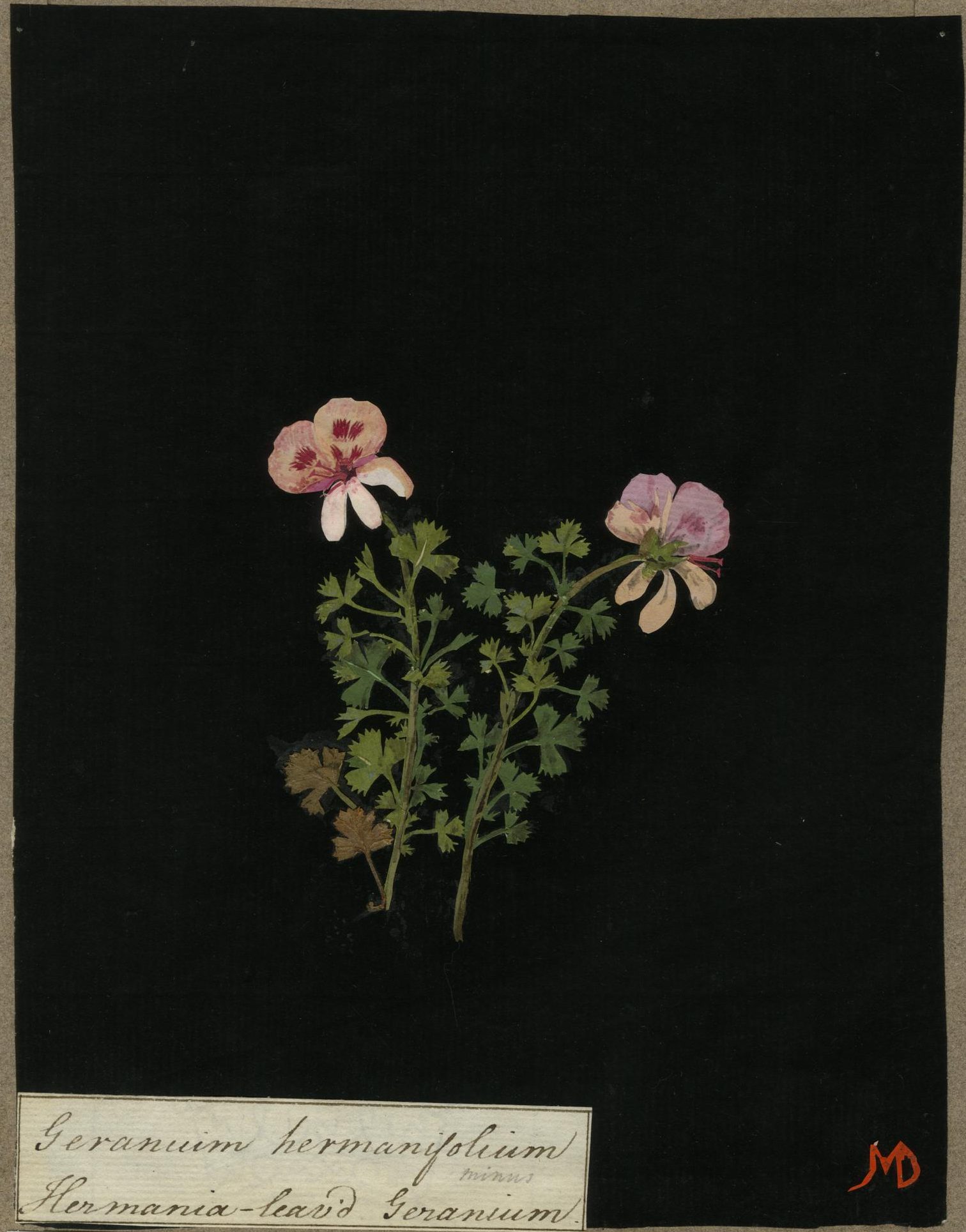
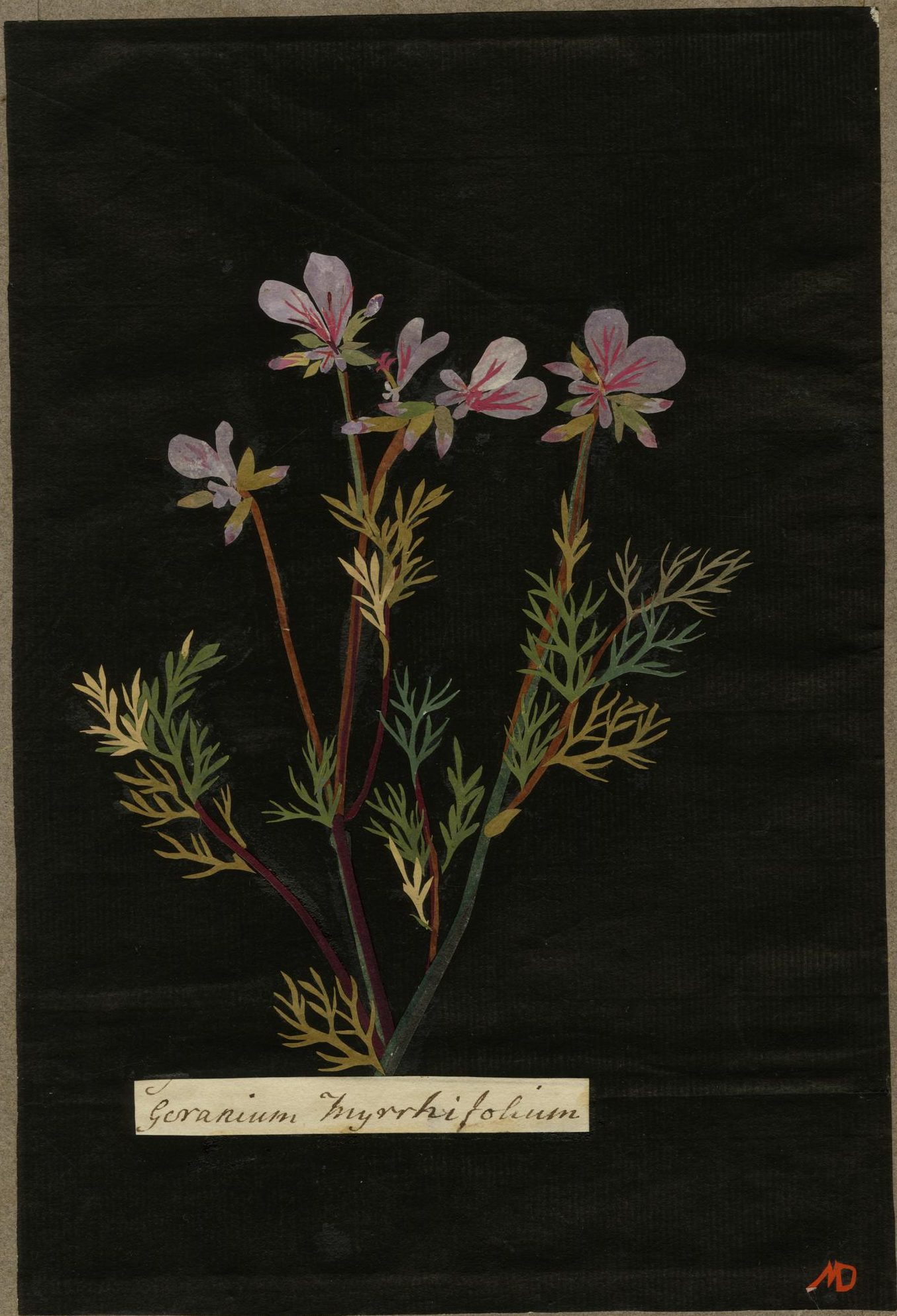
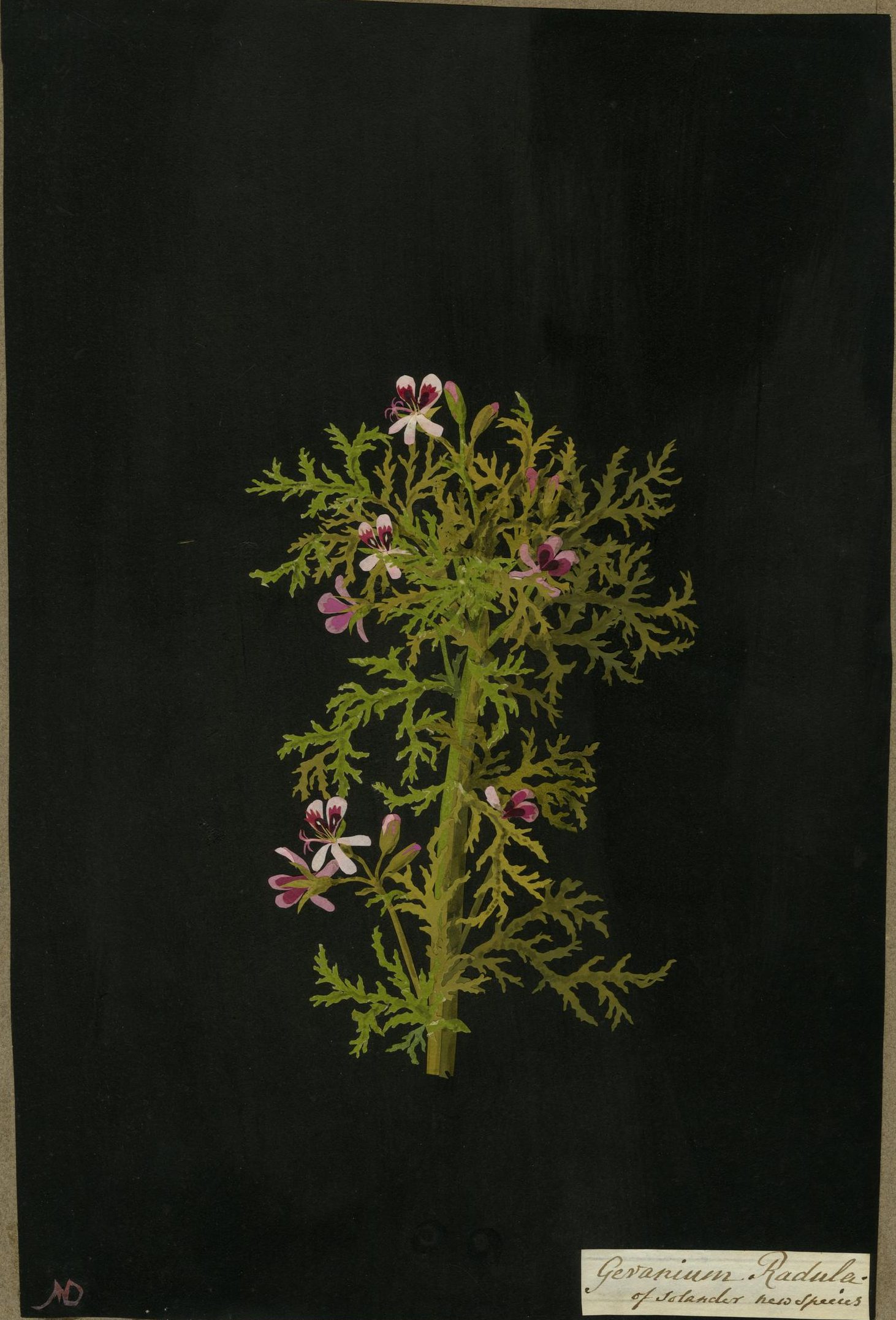
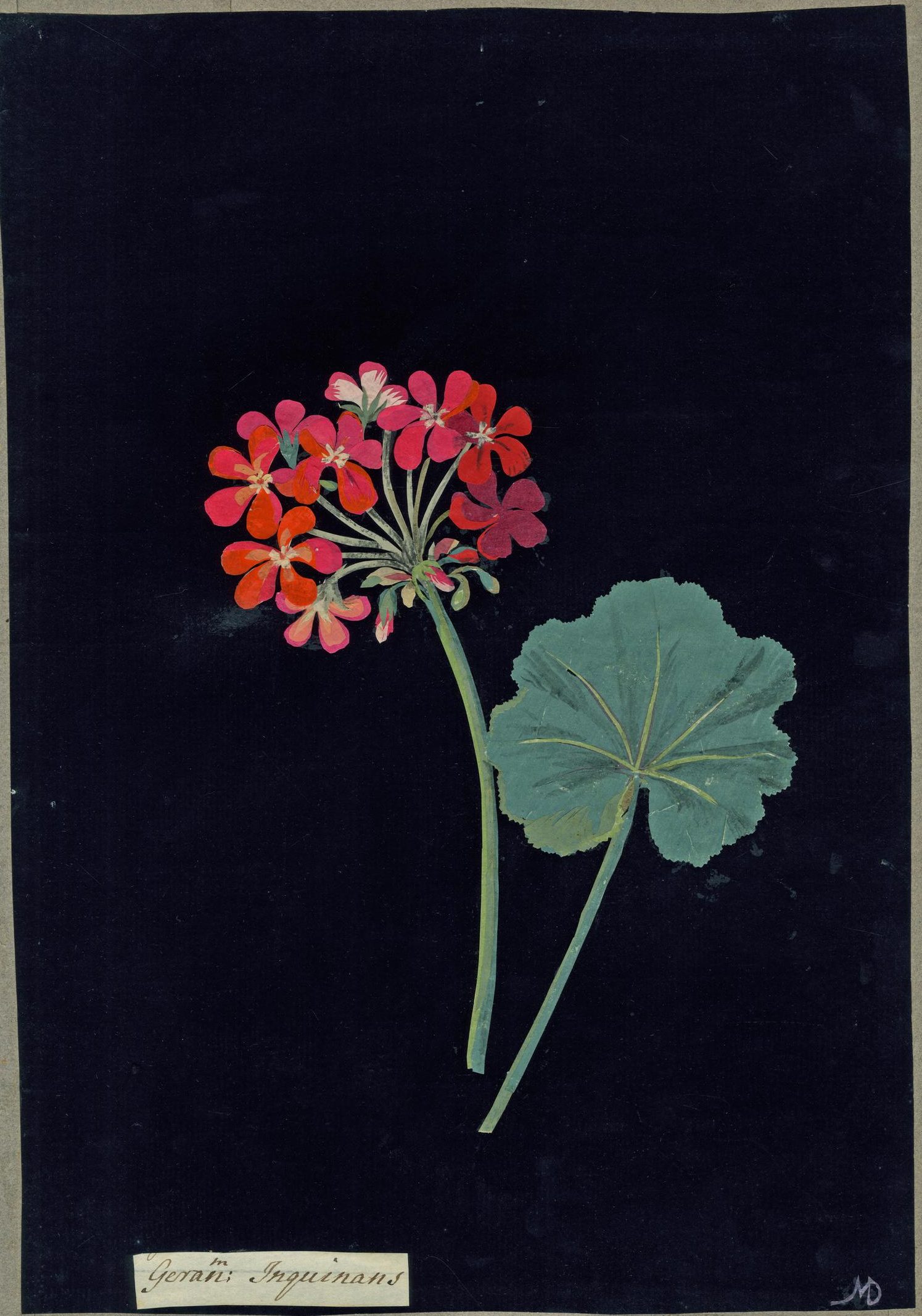
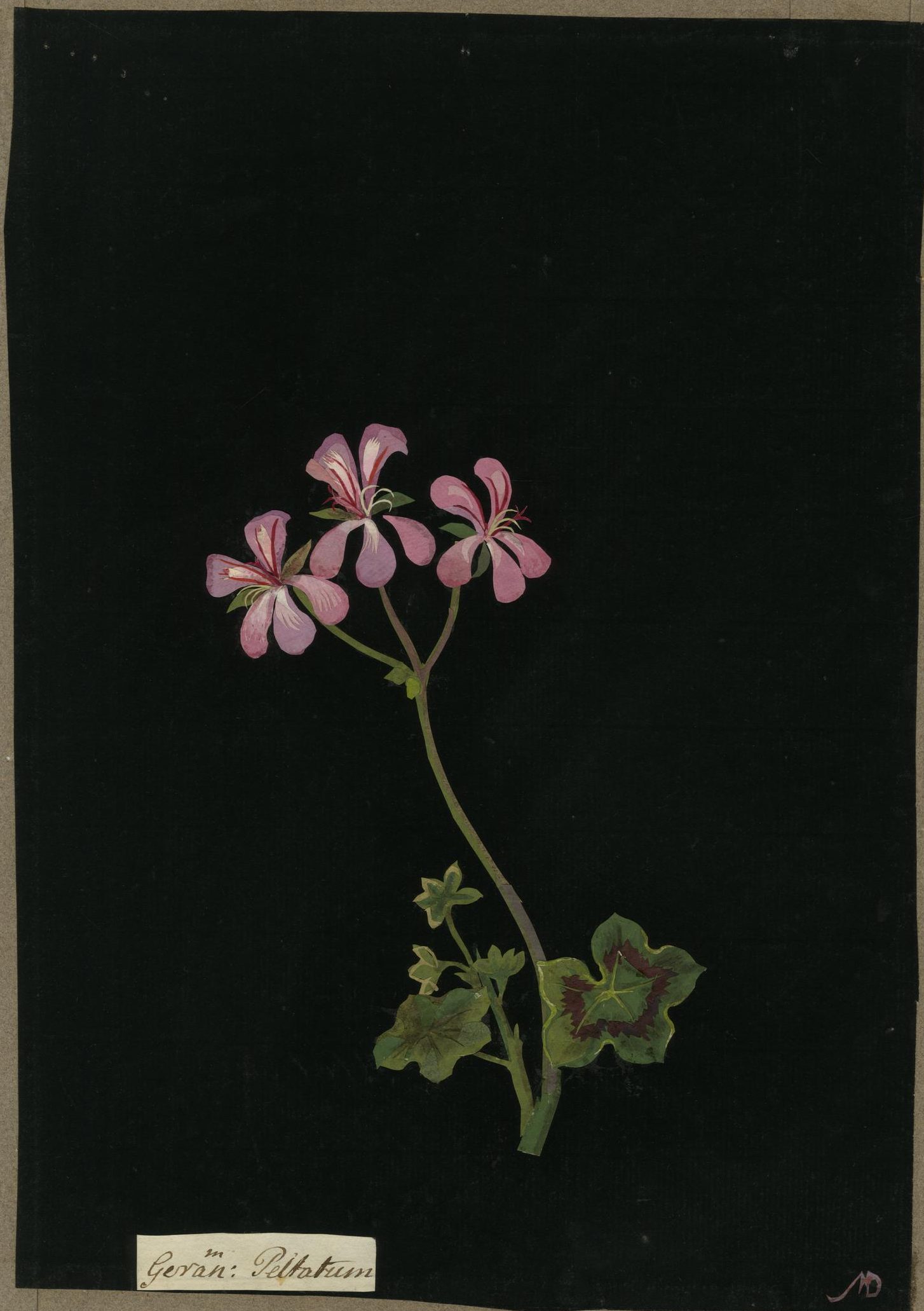
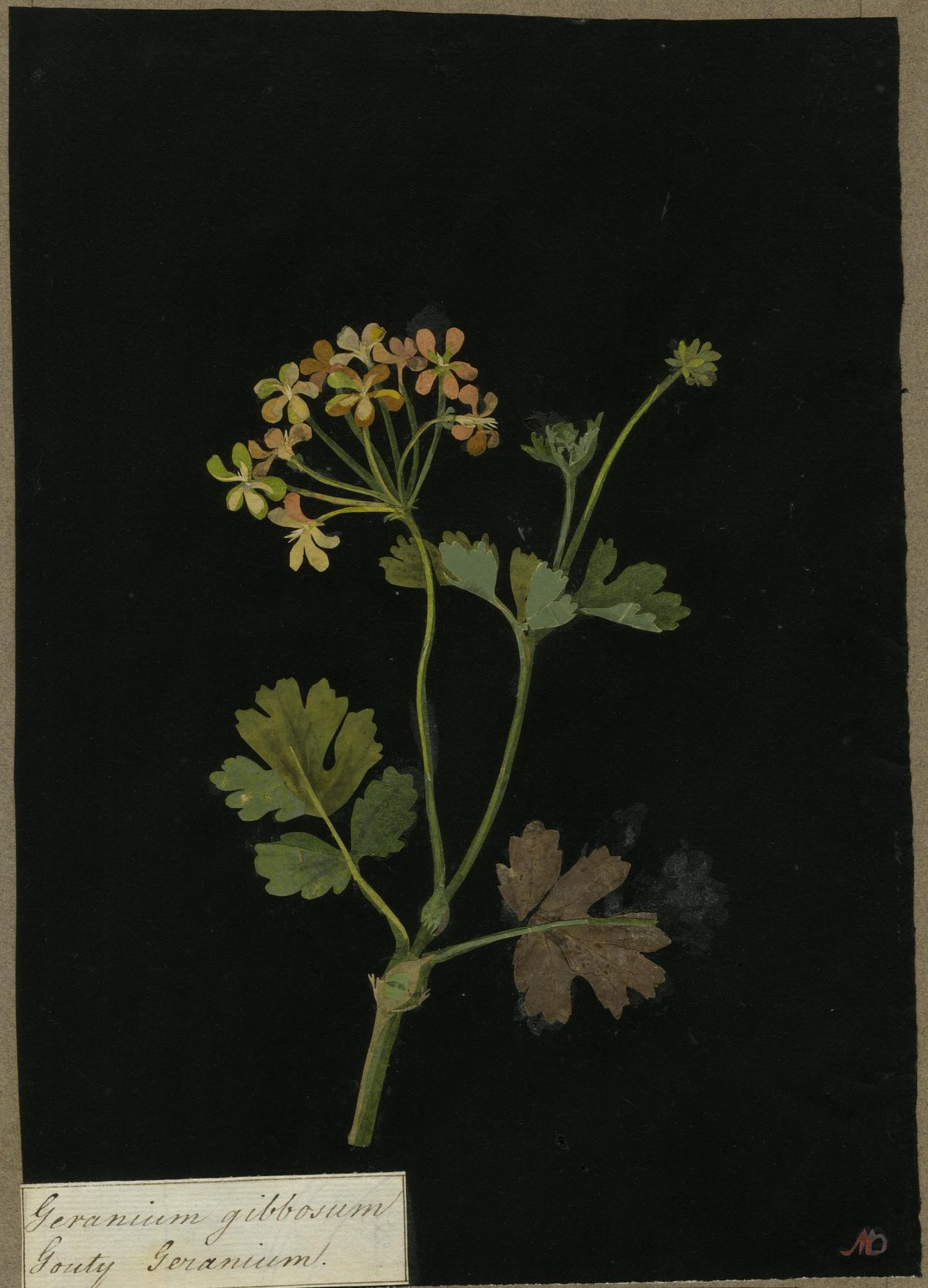
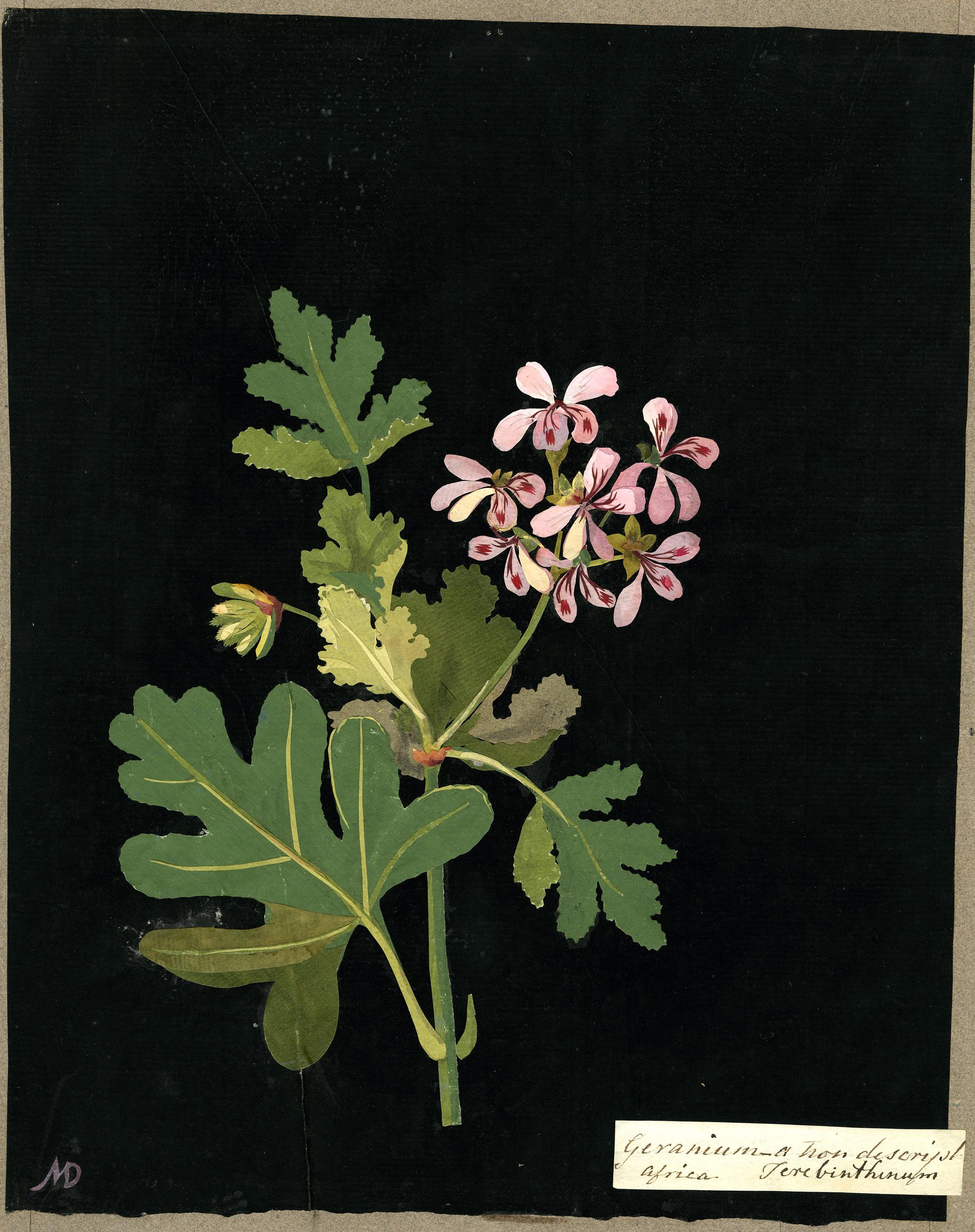
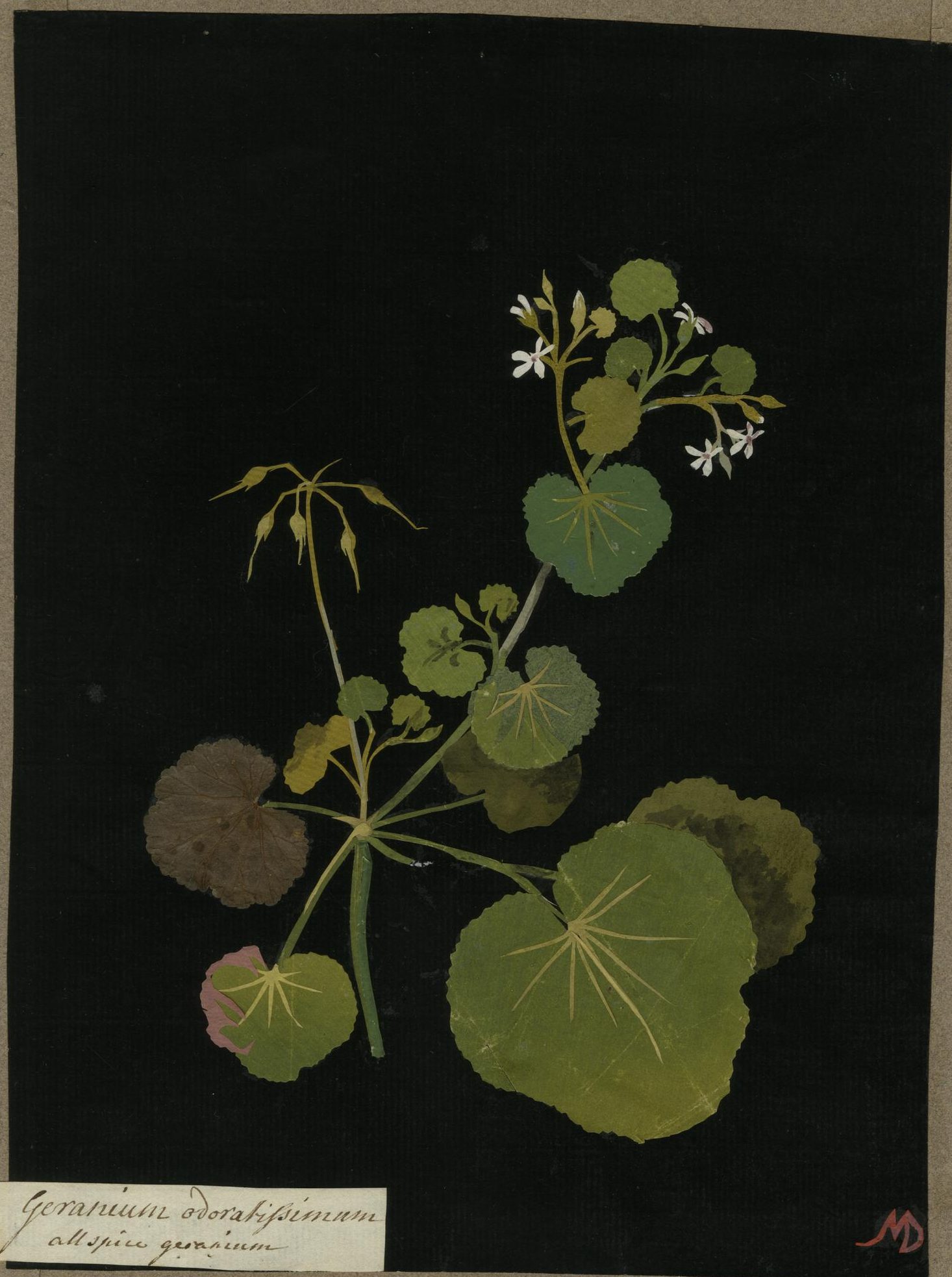
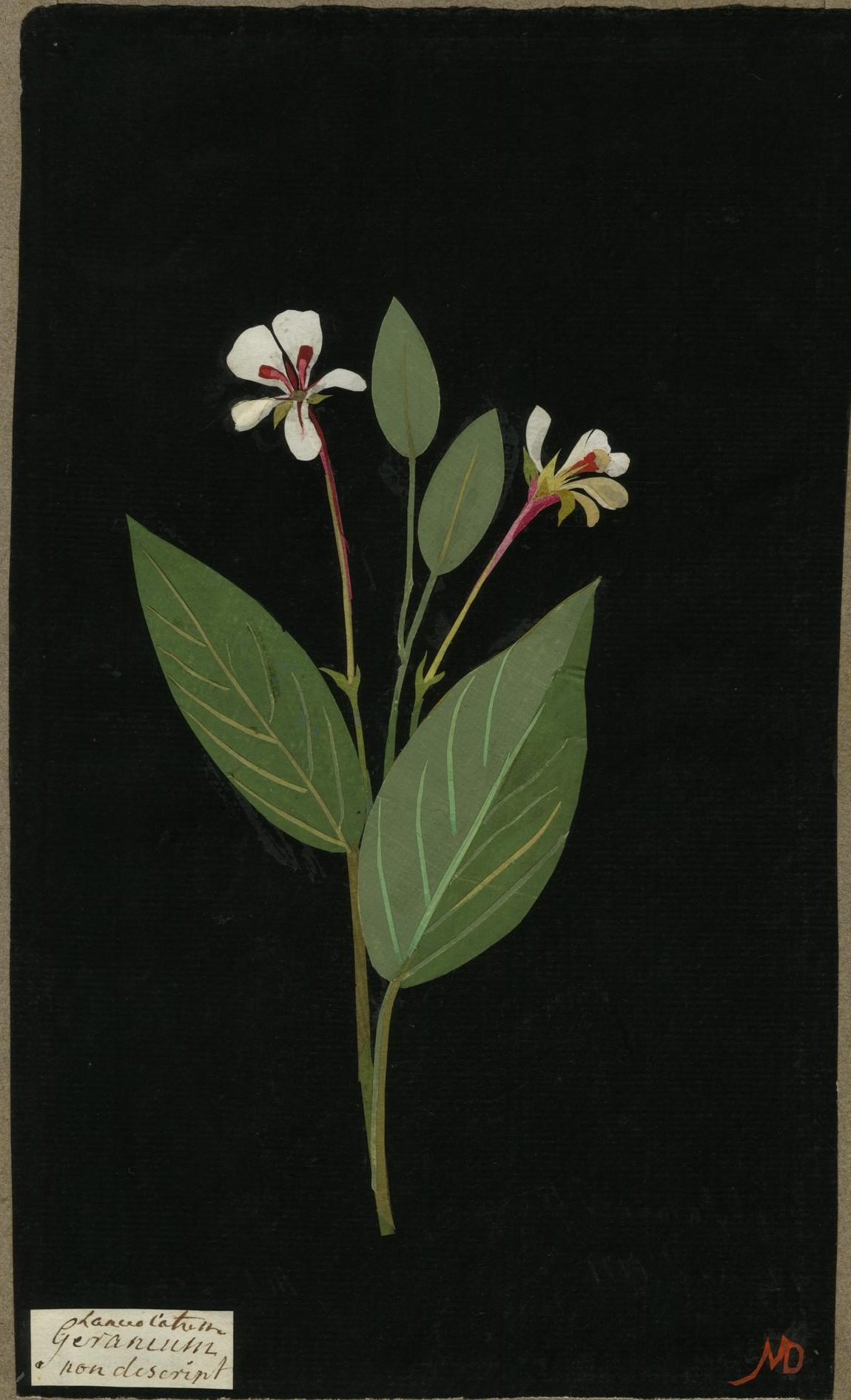
These examples, from more than twenty detailed pelargonium studies made by Mary Delany (1700 – 1788), were produced in the 1770s towards the end of her life, and form part of a series of almost a thousand of her plant portraits now held at The British Museum.  Delany’s collage images were constructed using cut out coloured paper, secured onto a painted background using wheat based adhesive.  Delany, who was skilled in drawing, embroidery, shell work and cutting silhouettes, called these images her paper mosaicks.

Delany’s choice of plants depicted in her collages was wide ranging, from familiar garden plants like daffodils and roses, to wild flowers and weeds, including thistles and bindweed.  She also recorded dozens of plants newly imported into England, such as Magnolia grandifora, passion flower, nerines, aloes, and of course, South African geraniums.

According to Molly Peacock, author of The Paper Garden (2011), a survey and appreciation of Delany’s life and artistic output, it was a fallen geranium petal and its similarity in tone to a piece of coloured paper that inspired Delany’s great late life project.

Geraniums (or pelargoniums) are plants familiar to everyone today, valued for their brightly coloured blooms, long flowering season and tolerance of dry conditions.  But in the eighteenth century, these plants were rarities, transported from South Africa by nurseries mainly concentrated in London, specialising in exotic stock for sale to a fashionable clientele.  These species geraniums collected from the wild were the ancestors of our modern pelargonium plants.  One of Delany’s labels, Gernanium zonale a variety, would seem to suggest that the process of breeding hybrids of these plants was already underway in the 1770s.

In the botanical world of the late eighteenth century there was no clear distinction made between the hardy, herbaceous geraniums native to Europe and the tender plants newly introduced from South Africa which needed protection from frost.  Carl Linnaeus included all the species in one genus, Geranium, and these were not separated until 1789, by the French botanist Charles Louis L’Héritier de Brutelle.  Today, both plant families are still commonly (and rather confusingly) referred to as geraniums.
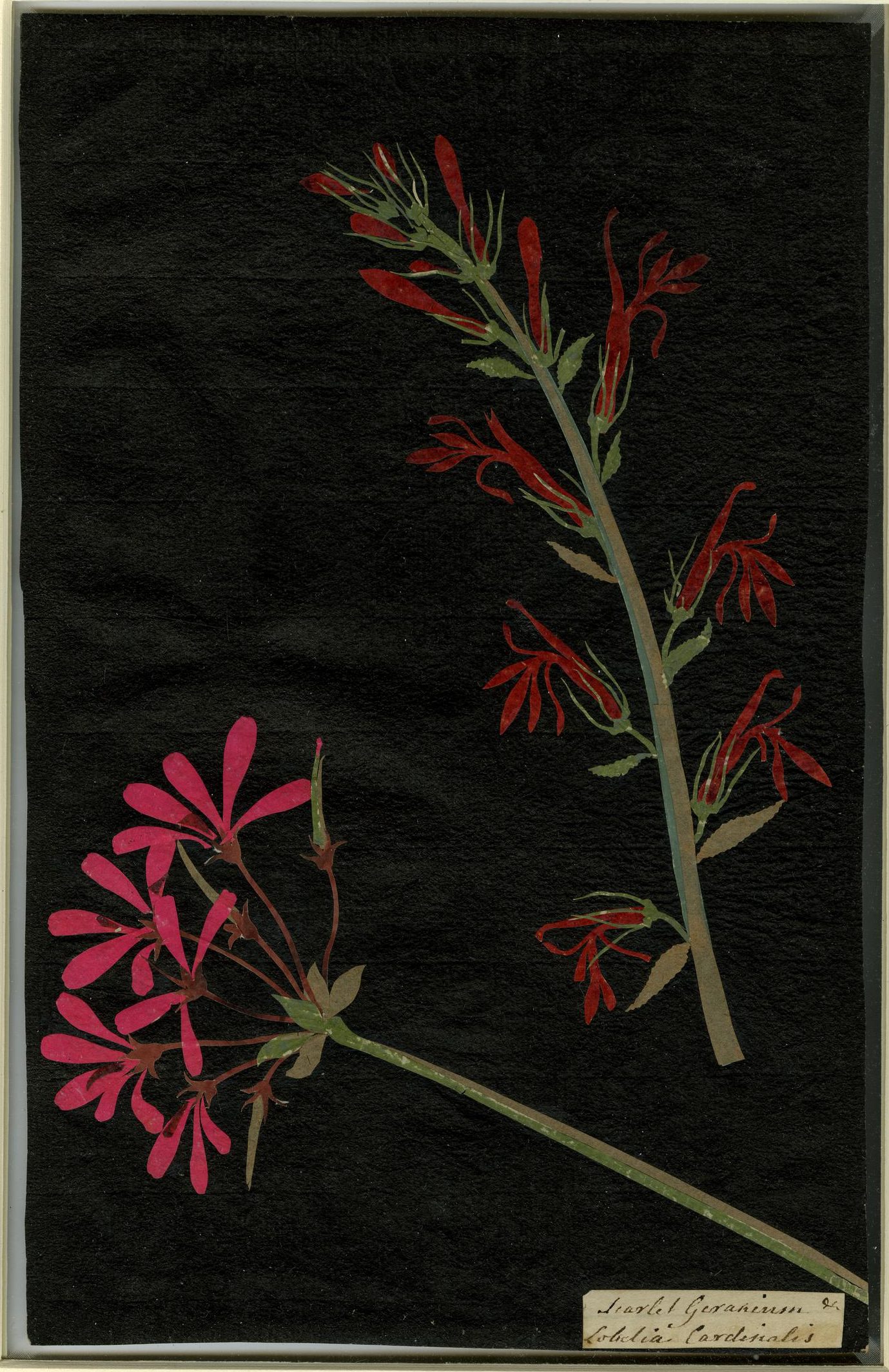
A geranium flower with bright red petals arranged with a stem of Lobelia cardinalis is identified as one of Delany’s earliest collages, labelled as her ‘first essay’ (1773).  This decorative piece establishes the core of her design style, with precisely cut elements assembled to suggest flowering stems, their colours vibrant against a dark background.
Scarlet Geranium and Lobelia Cardinalis, formerly in an album (Vol.V, 29). 1773

From this piece, Delany’s collages developed rapidly in their sophistication and ambition.  She started to produce botanical style portraits of single specimens, with accurate details of anthers, stigma and calyx for each flower, as well as foliage, buds and seed heads arranged to convey the character of each plant. Delany frequently records damage and signs of ageing on these plants, emphasising their physicality.  She always supplied a label for each collage with the plant’s Latin name, using the Linnean classification system, as well as the common name.

This botanical angle in Delany’s work was likely a result of meeting renowned botanists Joseph Banks and Daniel Solander as guests of her friend Margaret Bentinck, Dowager Duchess of Portland, with whom she shared an enthusiasm for plants.  Delany was a frequent guest at Bentinck’s home at Bulstrode, Buckinghamshire, after she was widowed for a second time in 1768.

Born in Wiltshire to Colonel Bernard Granville and Mary Westcombe, Mary Delany’s family had hopes of her becoming a lady in waiting at the court of Queen Anne, but these plans were upended following the queen’s death in 1714 and installation of the Hanoverians.  Instead, Mary was married aged seventeen to Alexander Pendarves, Member of Parliament for Launceton, who was more than forty years her senior.

After Pendarves’s death in 1725, Mary lived with friends and relatives, spending some of her time in Ireland where she met Irish clergyman Dr Patrick Delany.  Many years later, in 1743, they were married, two years after the death of Dr Delany’s first wife.  A much happier marriage than her first, the Delanys shared an interest in gardening, and derived great pleasure from their garden at Delville, near Dublin in Ireland.

It has been suggested that Delany’s botanical collage project was in some part a response to her bereavement after the death of her second husband; a commemoration of their love of flowers.  But her collages are more than just a shrine to the past.  They seem to speak of a renewed life following the loss of her husband; an openness to learning and fresh ideas, a resurgence of creativity, and a sense of confidence in her work, with a desire for recognition.

Always sociable and a great networker, in her seventies and eighties Delany continued to make new contacts, and it is said that King George III and Queen Charlotte would send unusual plants from their own garden for Delany to use as source material for her collages.

Today, examples from the ten volumes of Mary Delany’s Flora Delanica are regularly on display in the British Museum’s Enlightenment Gallery.  When I last visited, two of Delany’s collages were placed next to a small collection of Chelsea porcelain, adorned with images of flowers.  The entire collection of collages is available as part of The British Museum’s online collection – see links below.

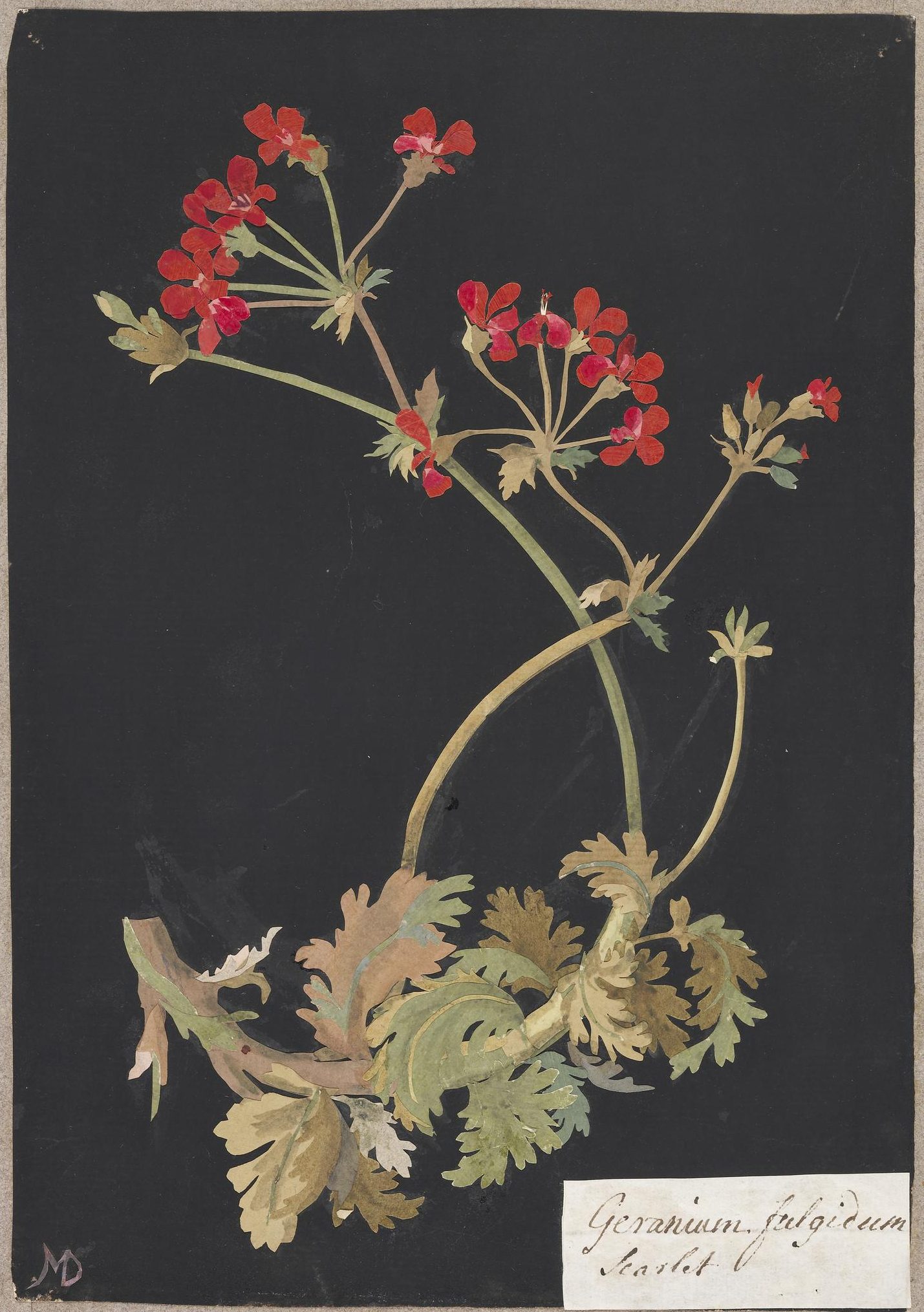
Geranium Fulgidum (Monodelphia Decandria), from an album (Vol.IV, 91); Scarlet geranium. 1775

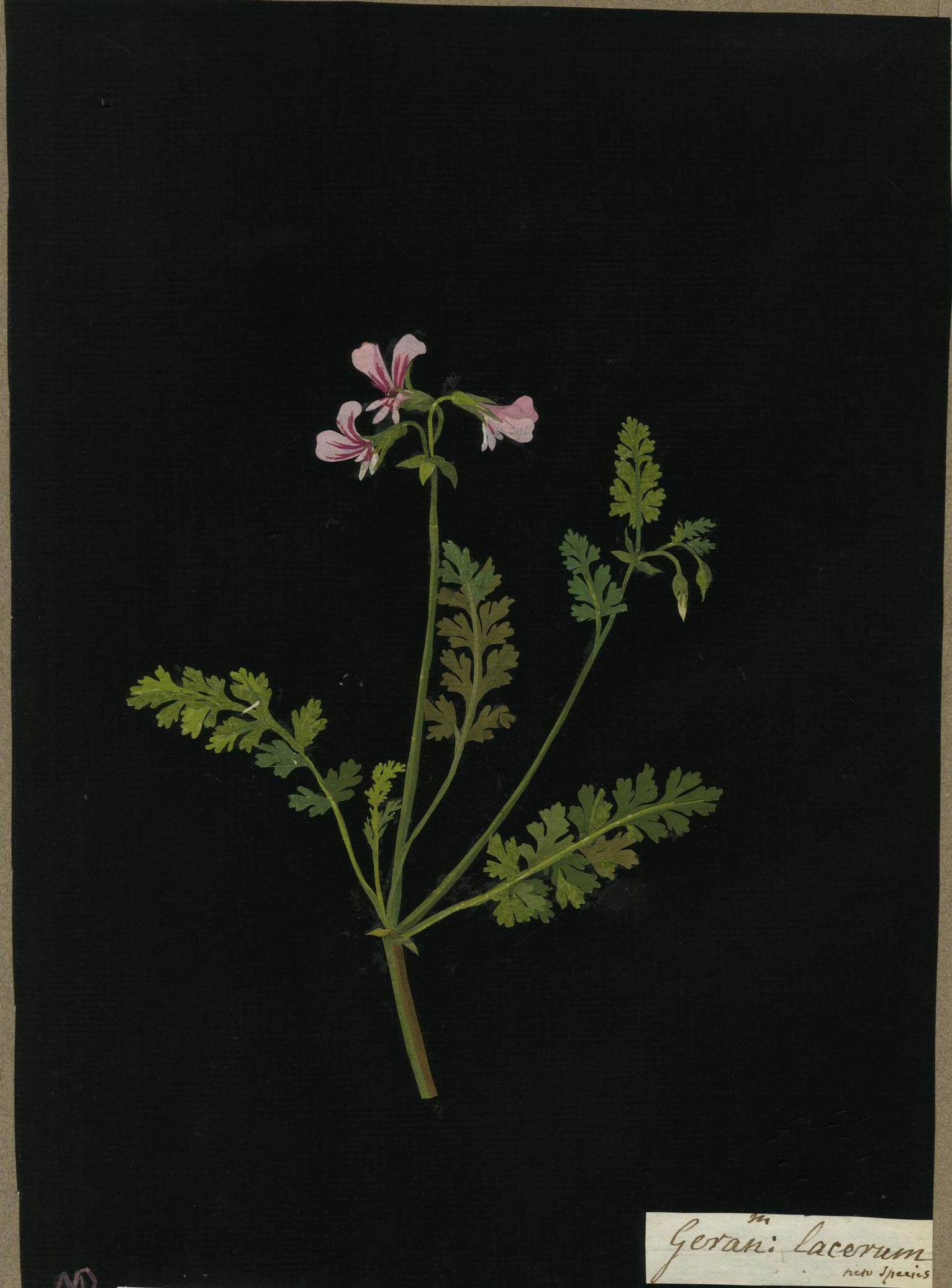
Geranium Lacerum (Monodelphia Decandria) new sepcies Solandri, from an album (Vol.IV, 74). 1778

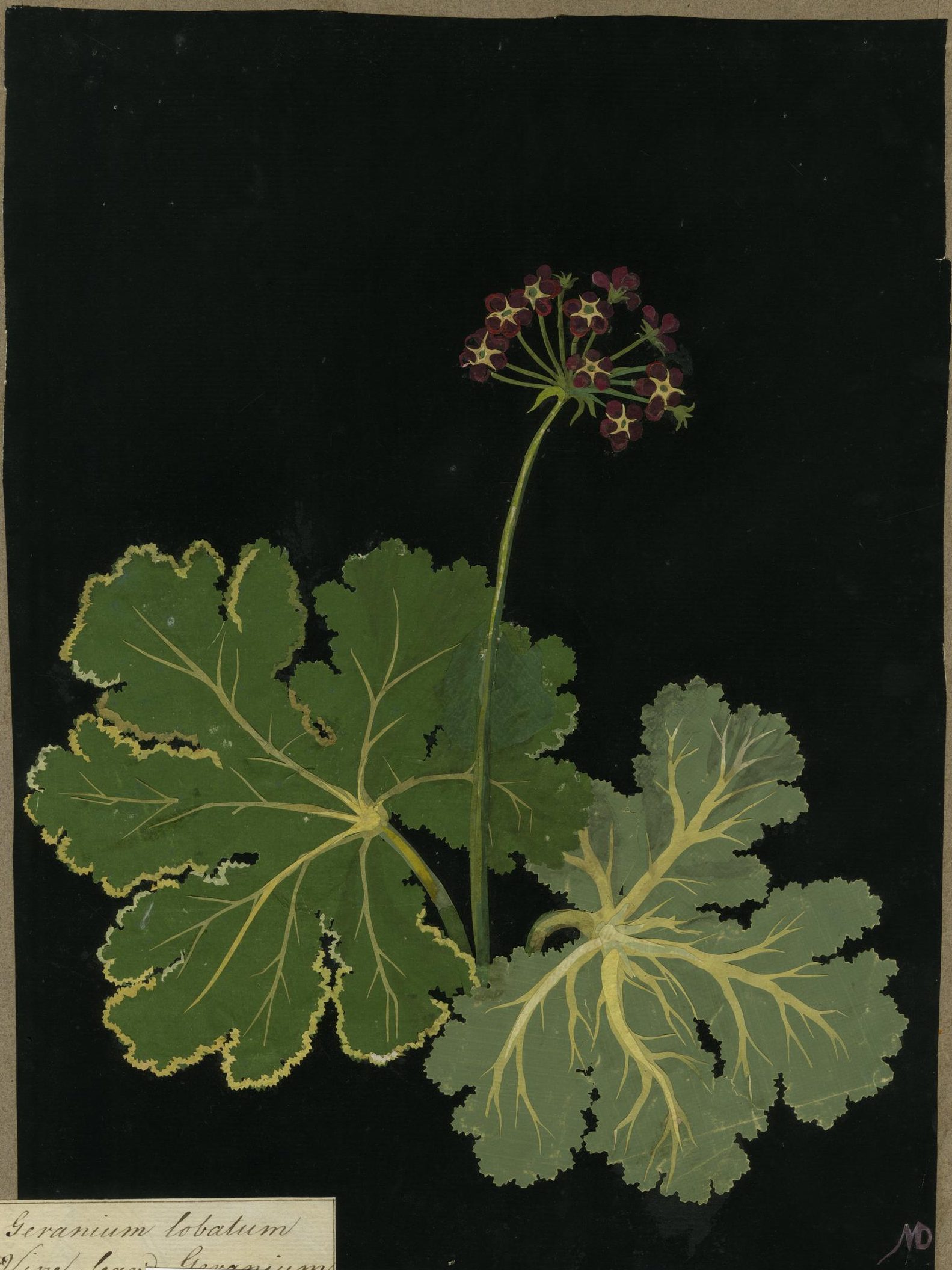
Geranium Labatum, from an album (Vol.IV, 76); Vine-leaved geranium. 1780

Geranium Scabrum, from an album (Vol.IV, 78); Rough geranium. 1779

Geranium Papilionaceum (Monodelphia Decandria), from an album (Vol.IV, 70). 1778

Geranium Hermanifolium (Monodelphia Decandria), from an album (Vol.IV, 69); Hermania-leaved geranium. 1777

Geranium Myrrhifolium (Monodelphia Deccand.), from an album (Vol.IV, 67); Knotty geranium. 1774

Geranium Radula (Monodelphia Decandria) of Solander new species, from an album (Vol.IV, 73). 1778

Geranium Inquinans, from an album (Vol.IV, 72). 1778

Geranium Peltatum, from an album (Vol.IV, 71). 1778

Geranium Gibbosum, from an album (Vol.IV, 93); Gouty geranium. 1779

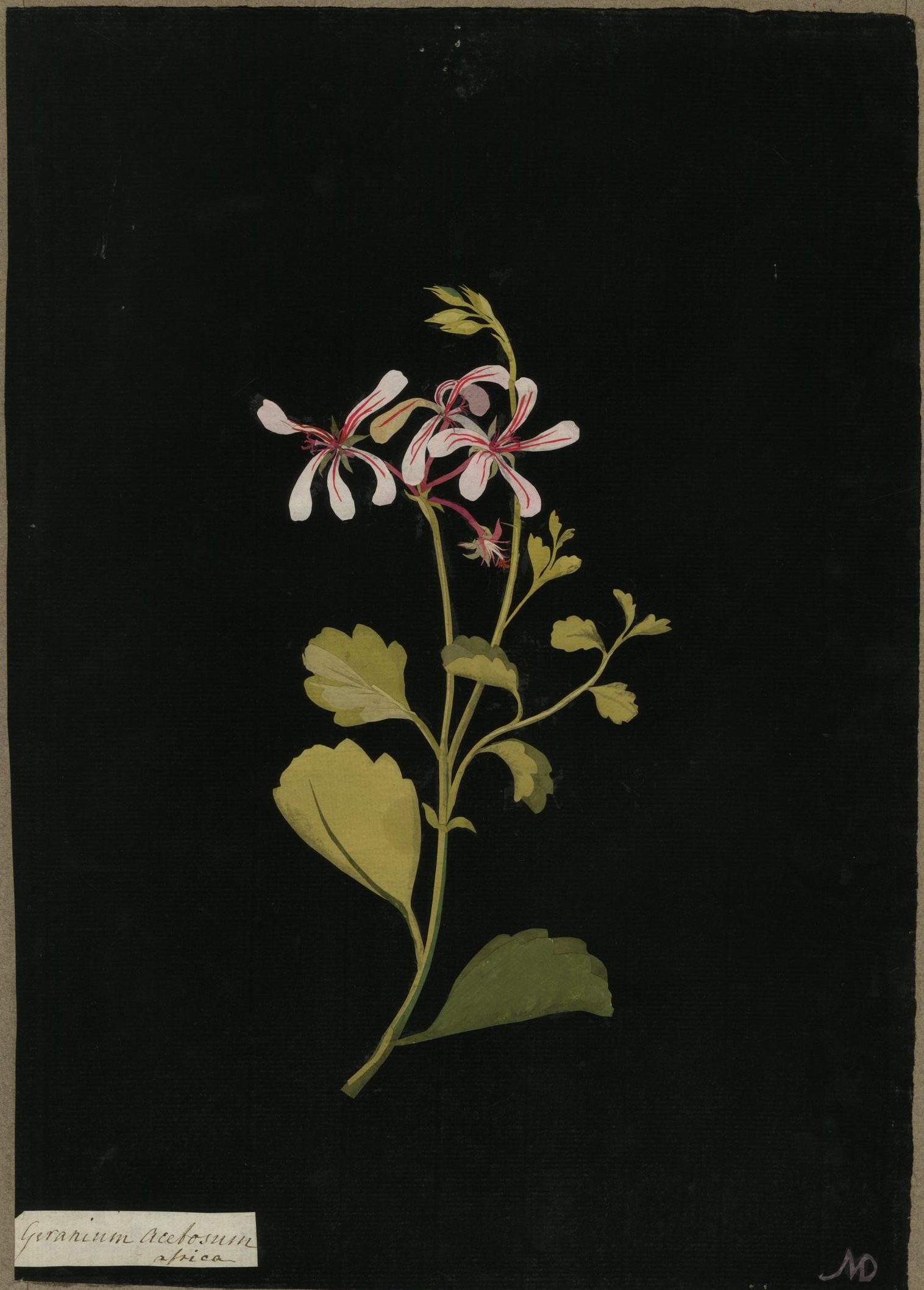
Geranium Acetosum (Monodelphia Decandria), from an album (Vol.IV, 90); Sorrel leaved geranium. 1777

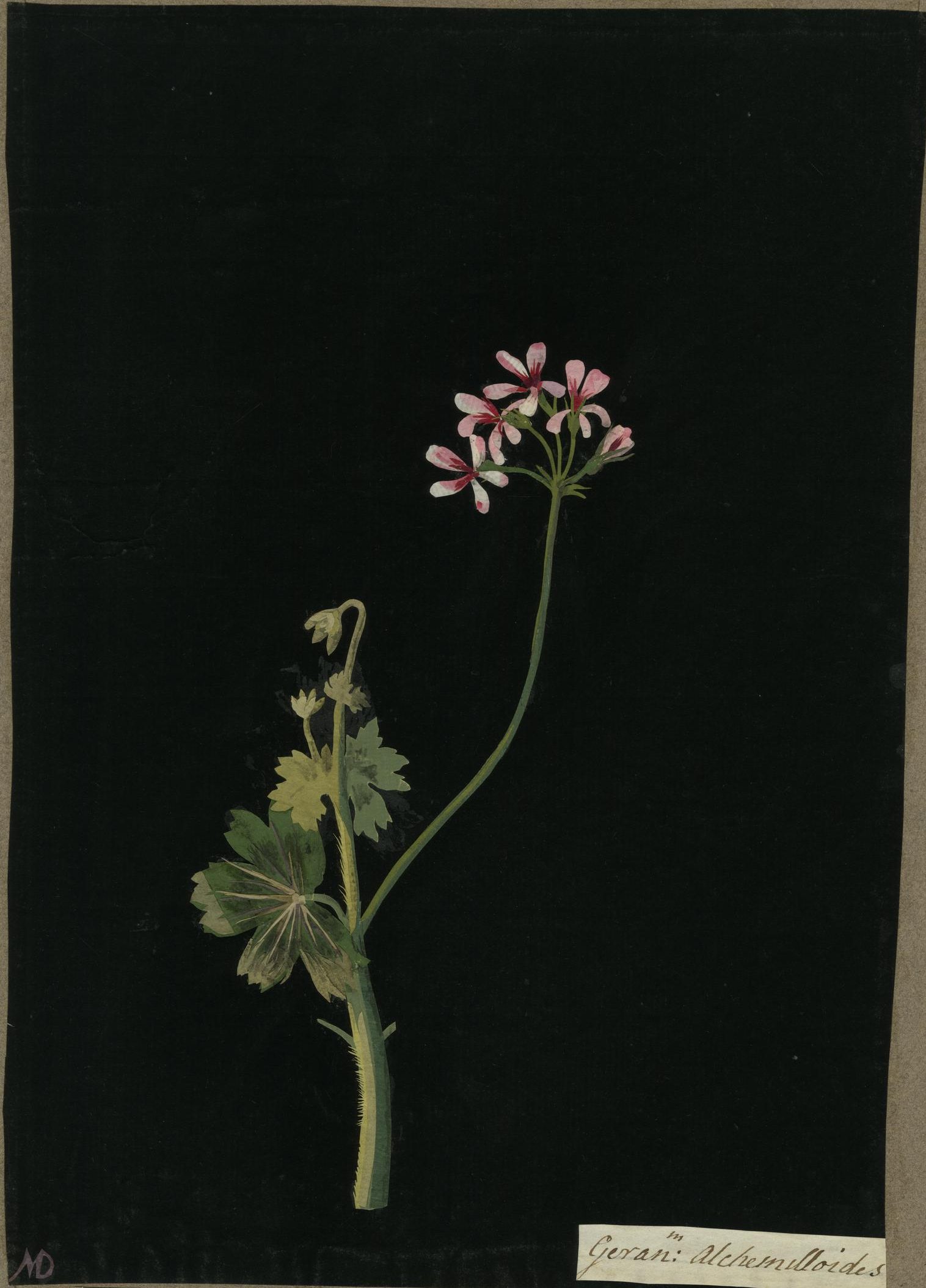
Geranium Alchemilloides, from an album (Vol.IV, 89). 1778

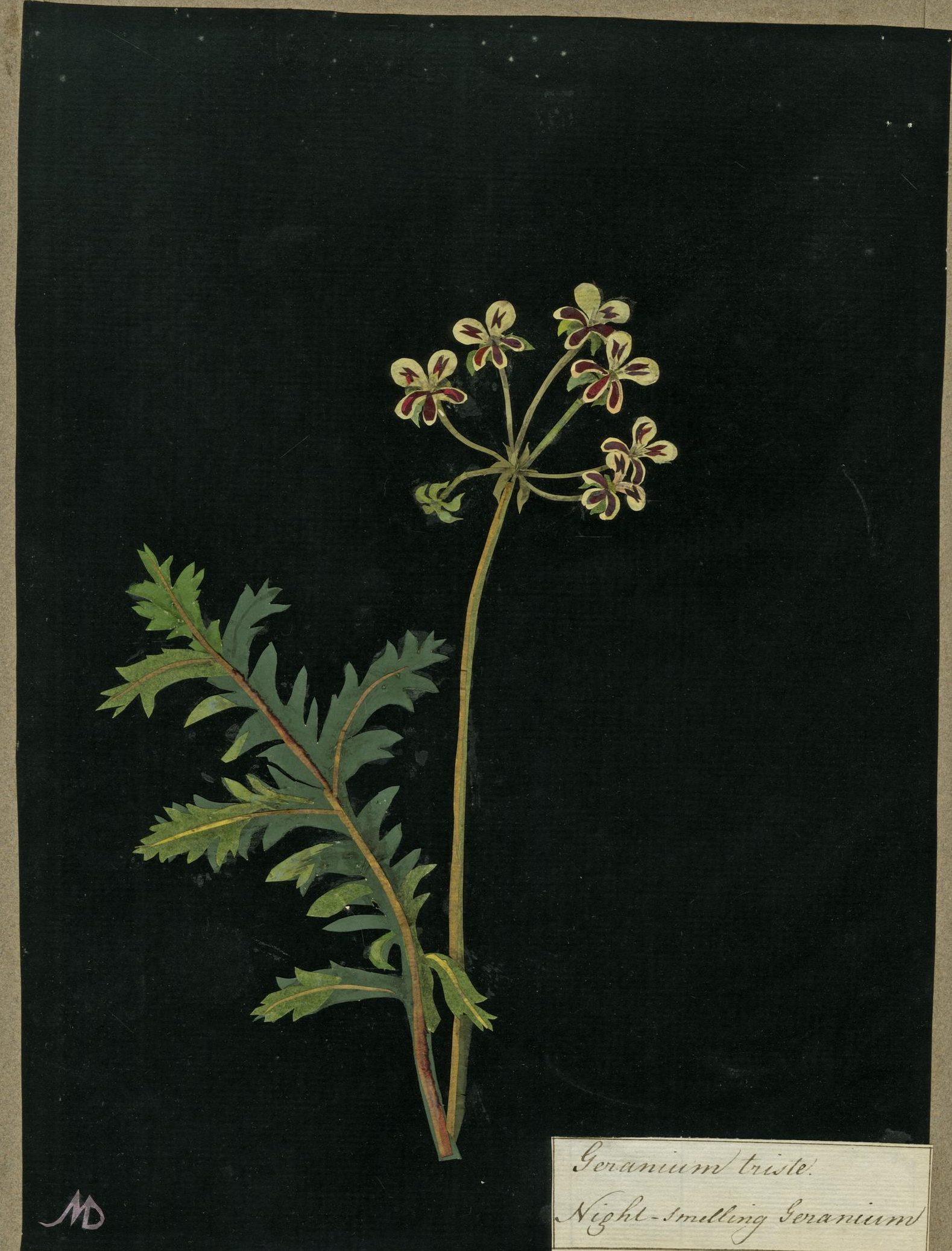
Geranium Triste, from an album (Vol.IV, 83); Night-smelling geranium. 1779

Geranium African terebinthinum (Monodelphia Decandria), from an album (Vol.IV, 81). 1776

Geranium Odoratissimum (Monodelphia Decandria), from an album (Vol.IV, 68); Allspice Geranium. 1777
Collage of coloured papers, with bodycolour and watercolour, and with leaf sample, on black ink background

Geranium Lanceolatum (Monodelphia Decandria), from an album (Vol.IV, 75). 1777

Geranium Capitatum (Monodelphia Decandria), from an album (Vol.IV, 88). 1776

Geranium Zonale (Monodelphia Decandria), from an album (Vol.IV, 85). 1778
Collage of coloured papers, with bodycolour and watercolour, on black ink background.
All images © The Trustees of the British Museum

Further reading:

Mary Delany Wikipedia here

Mary Delany, British Museum Online Collection here

Kew Plants of the World Online here

Pelargonium Wikipedia here

At Cerne Abbas Open Gardens

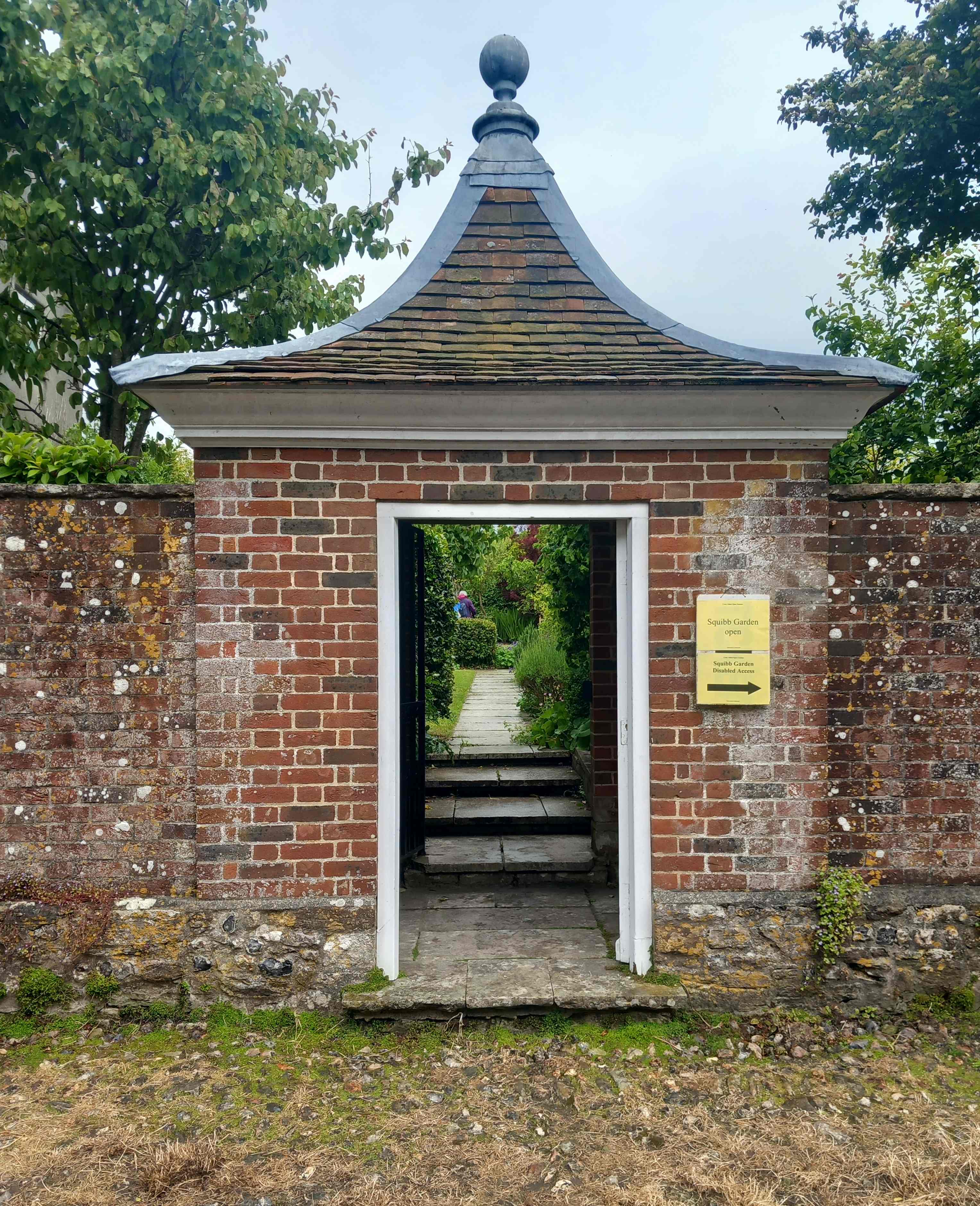
Entrance to the Squibb Garden next to St Mary’s Church, Cerne Abbas. This garden is maintained by volunteers for the benefit of the village community.

One of the pleasures of summer in the UK is visiting gardens that open to raise funds for charity.  For a nominal sum we are admitted to places usually closed to the public, where we can examine planting schemes and gain inspiration for our own gardens.  Many open as part of the National Garden Scheme, while others have a long tradition of independence, relying on posters in shop windows, village halls and social media to spread the word locally.

Now in its forty eighth year, Cerne Abbas Open Gardens is one such independent opening. On the third weekend in June, green fingered residents in this historic village issue an invitation to visit their gardens, with teas served at the vicarage garden in Back Lane and a plant stall on Long Street.  This year a total of thirty three gardens, both large and small, opened over the weekend – a feast indeed for the garden visitor.

Cerne Abbas is situated in the chalk downlands of Dorset a few miles to the north of Dorchester.  Famous for the mysterious Cerne Abbas Giant, carved into the hillside and now managed by the National Trust, it’s also home to Cerne Abbey, a Benedictine monastery founded in 987, and from which the village takes its name.  Beautifully clear chalk streams fed by the river Cerne run through some of its streets and gardens.

Below, I share impressions of this wonderful event.  Despite being an avid garden enthusiast, I was unequal to the challenge of seeing all twenty nine gardens open on the Saturday afternoon when we visited, but all those we saw were a delight.

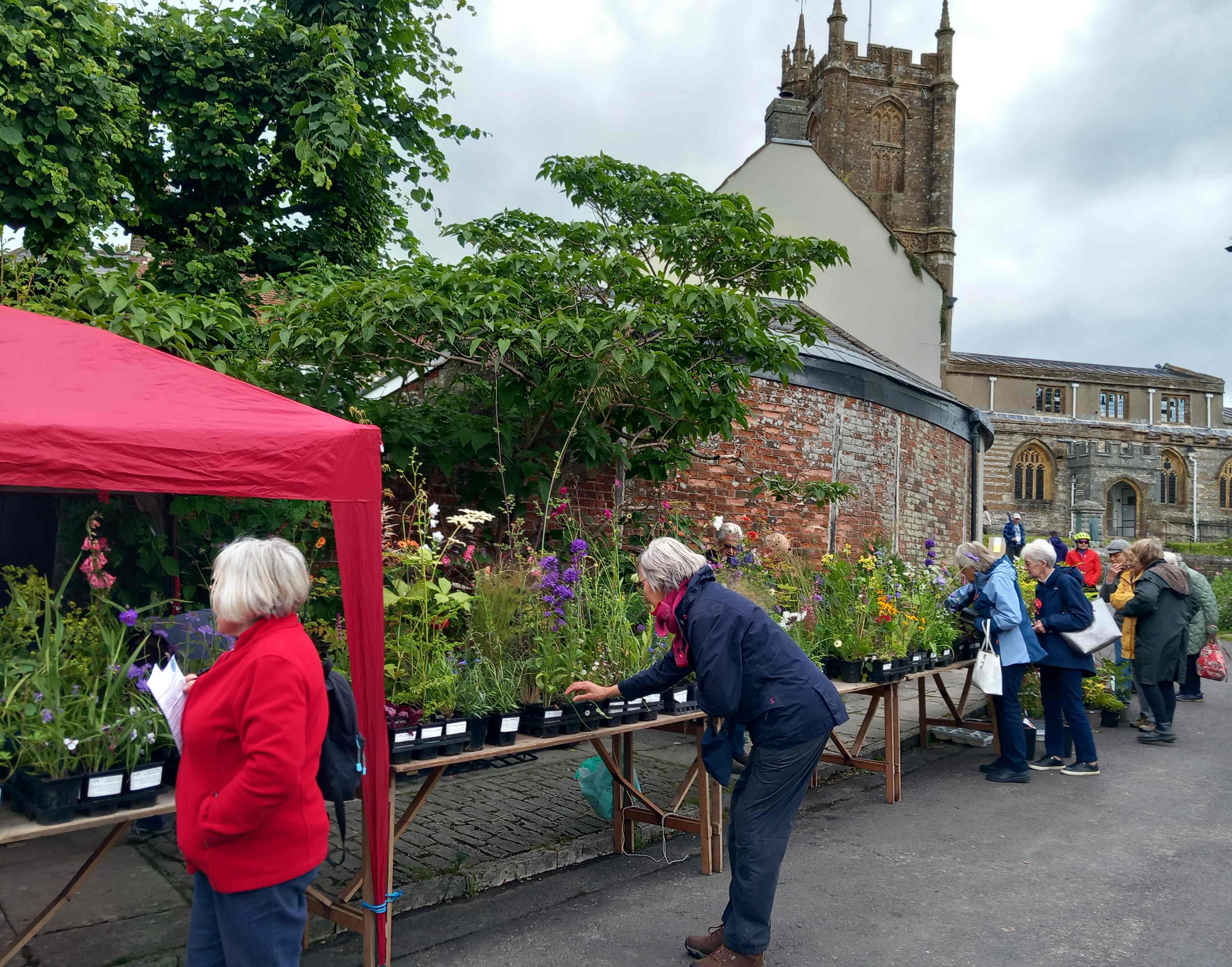
Plant stall on Long Street packed with tempting perennials

On arrival we purchased tickets and were provided with a map of the open gardens, and the all important tea venue, with further information about each garden listed on the Cerne Abbas Open Gardens website.

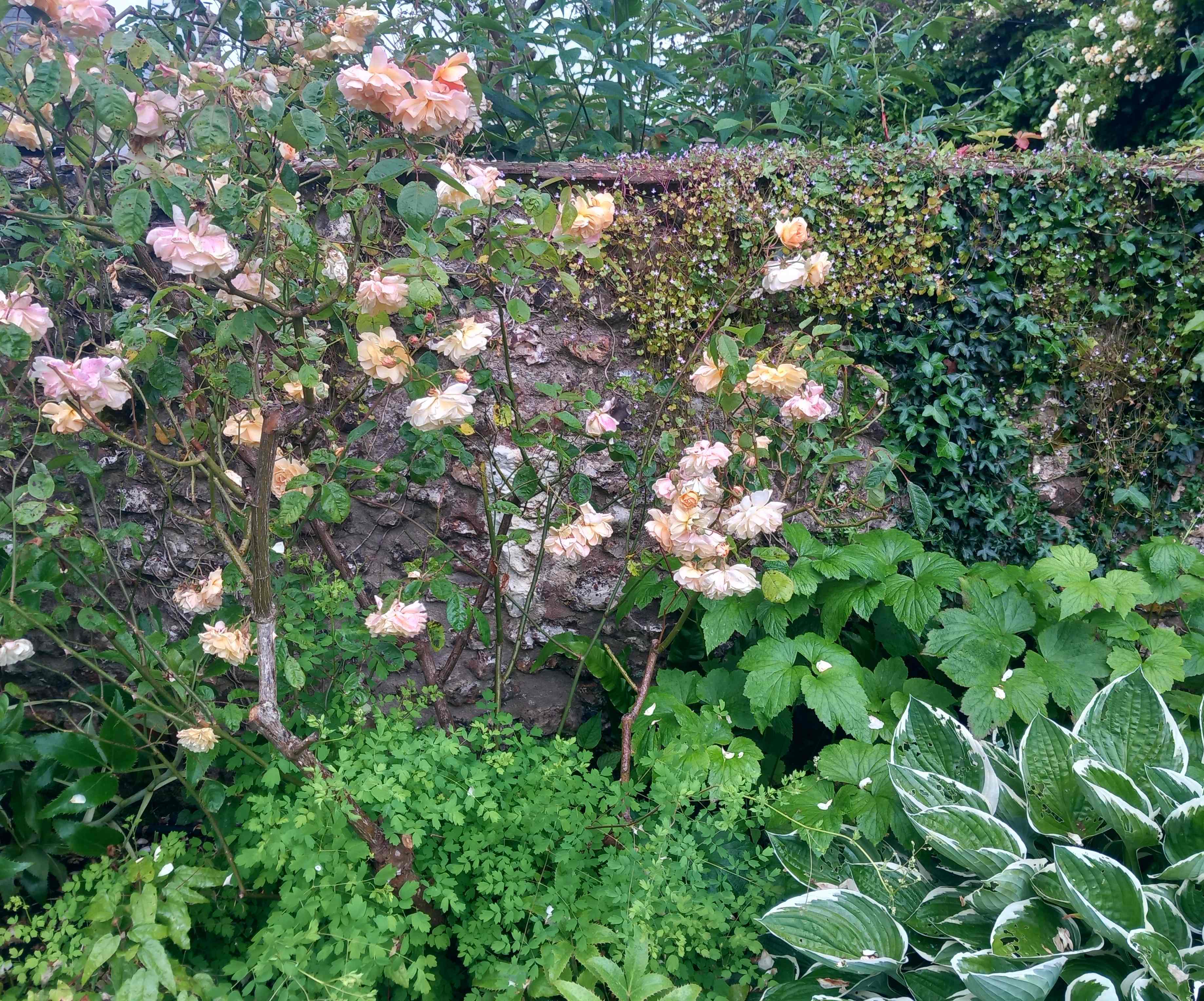
Deciding to start our journey in Abbey Street, we discovered the villagers’ love of roses, and how these plants thrive here in the local soil.  At Barnwells the gardens behind the house are unexpectedly extensive.  According to the owners, they cover approximately one third of an acre, and were designed by the artist Joseph Benwell Clark when he was a resident here in the 1920s.  Using hedges of various heights, the space has been skillfully divided into rooms, the English garden style popularised by Lawrence Johnson at Hidcote and Harold and Vita Sackville West at Sissinghurst in the early part of the 20th century.

The current owners have preserved the structural bones of Clark’s layout, and although the planting has evolved over time, the garden retains the distinctive character of the age when it was created.  The planting in each section has been expertly chosen and maintained, and never feels regimented.  Directly behind the house are borders generously planted with heritage roses and perennials.

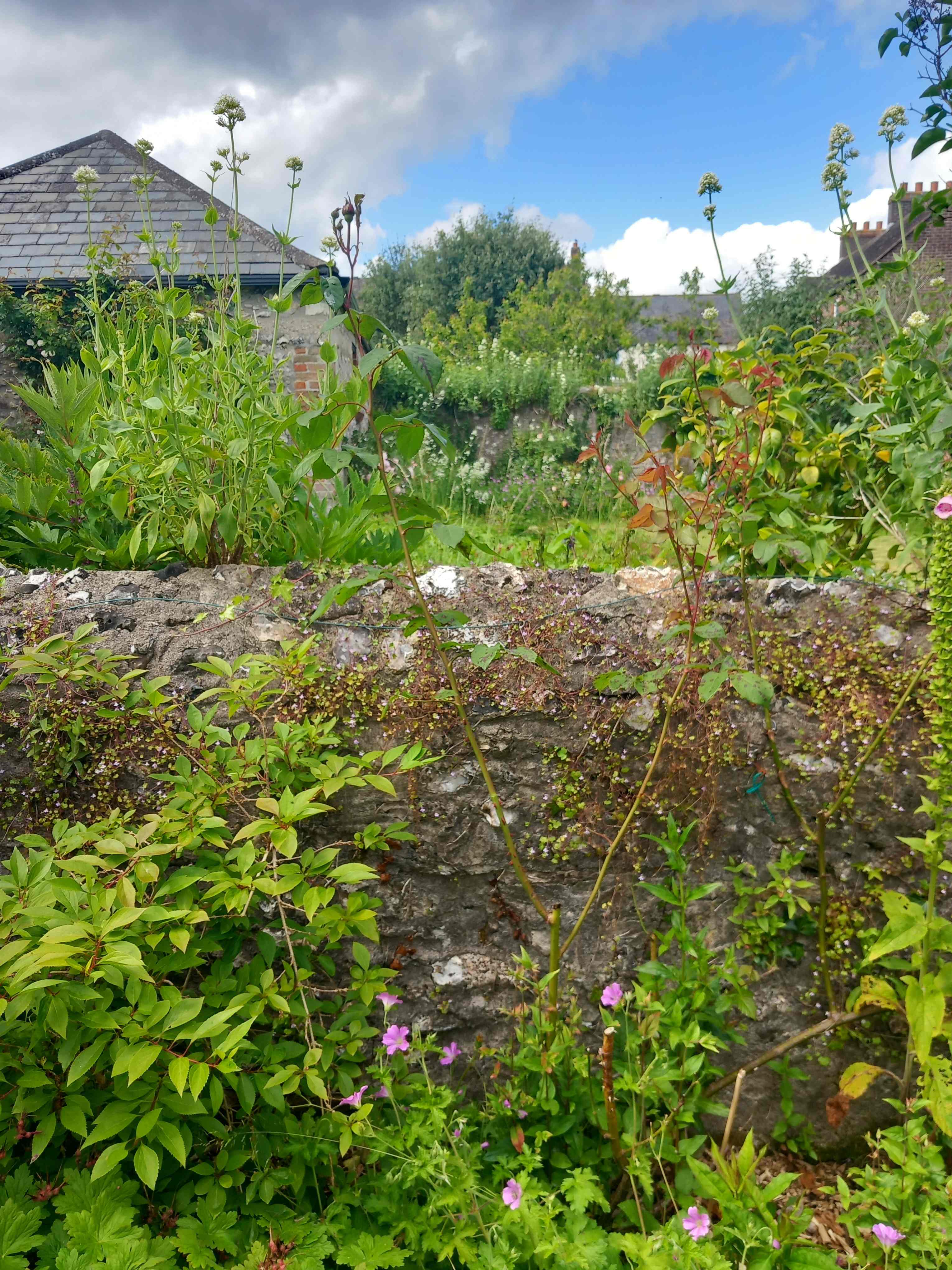
Flint knapped wall at Barnwells in Abbey Street.  Many of the gardens in Cerne Abbas have garden walls like this one.

Topiary and lavender hedge

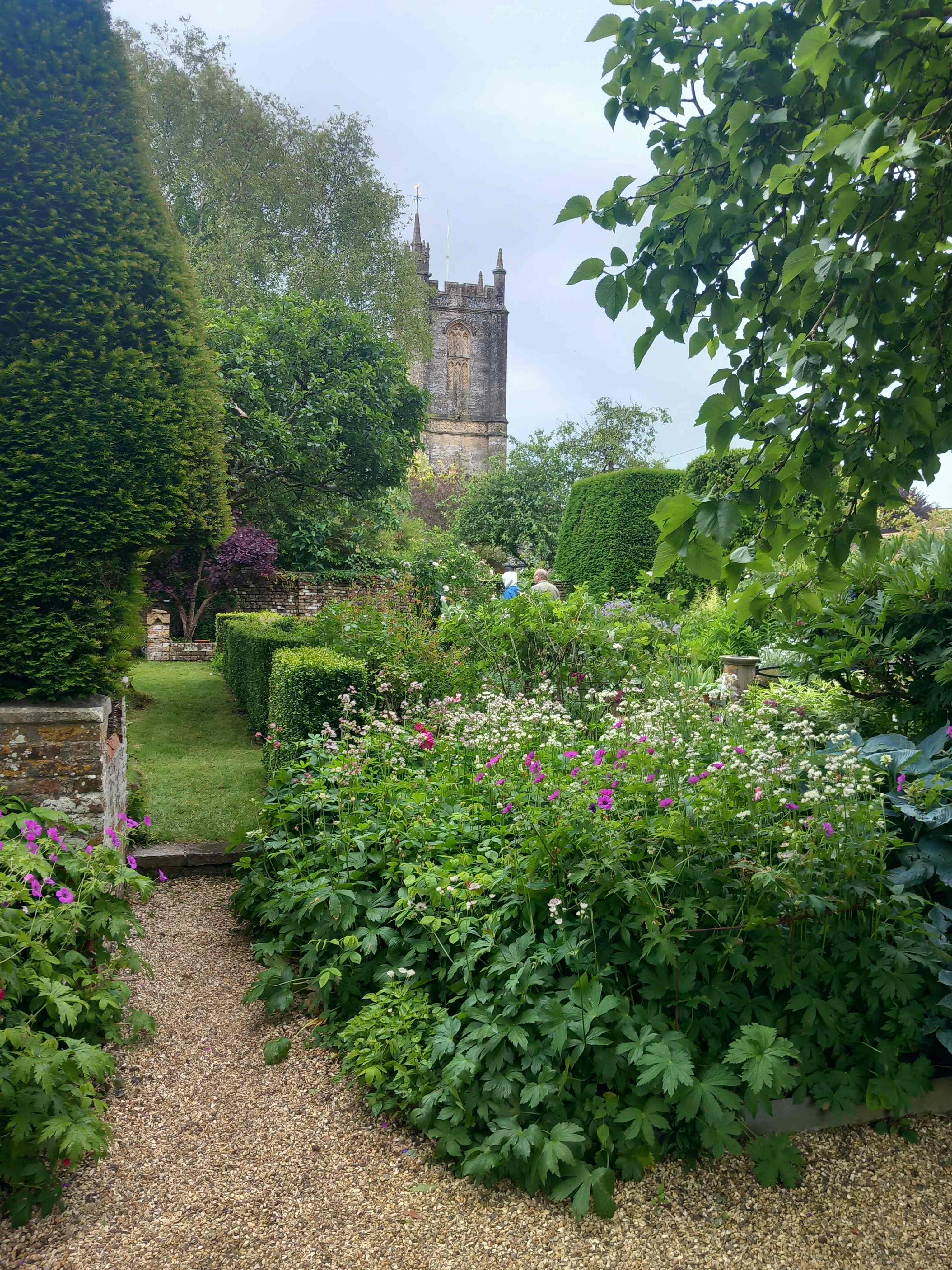
Passing through an opening in a tall beech hedge, gravel paths lead past the spreading canopy of a Magnolia soulangeana to an area enclosed by a box hedge and planted with flowers and roses.  This was formerly the vegetable patch, until the 1980s.  Beyond this is a knot garden with herbs, and topiary frames a view of St Mary’s church.

Coalbrookdale garden bench

Garden on Abbey Street with views of St Mary’s Church

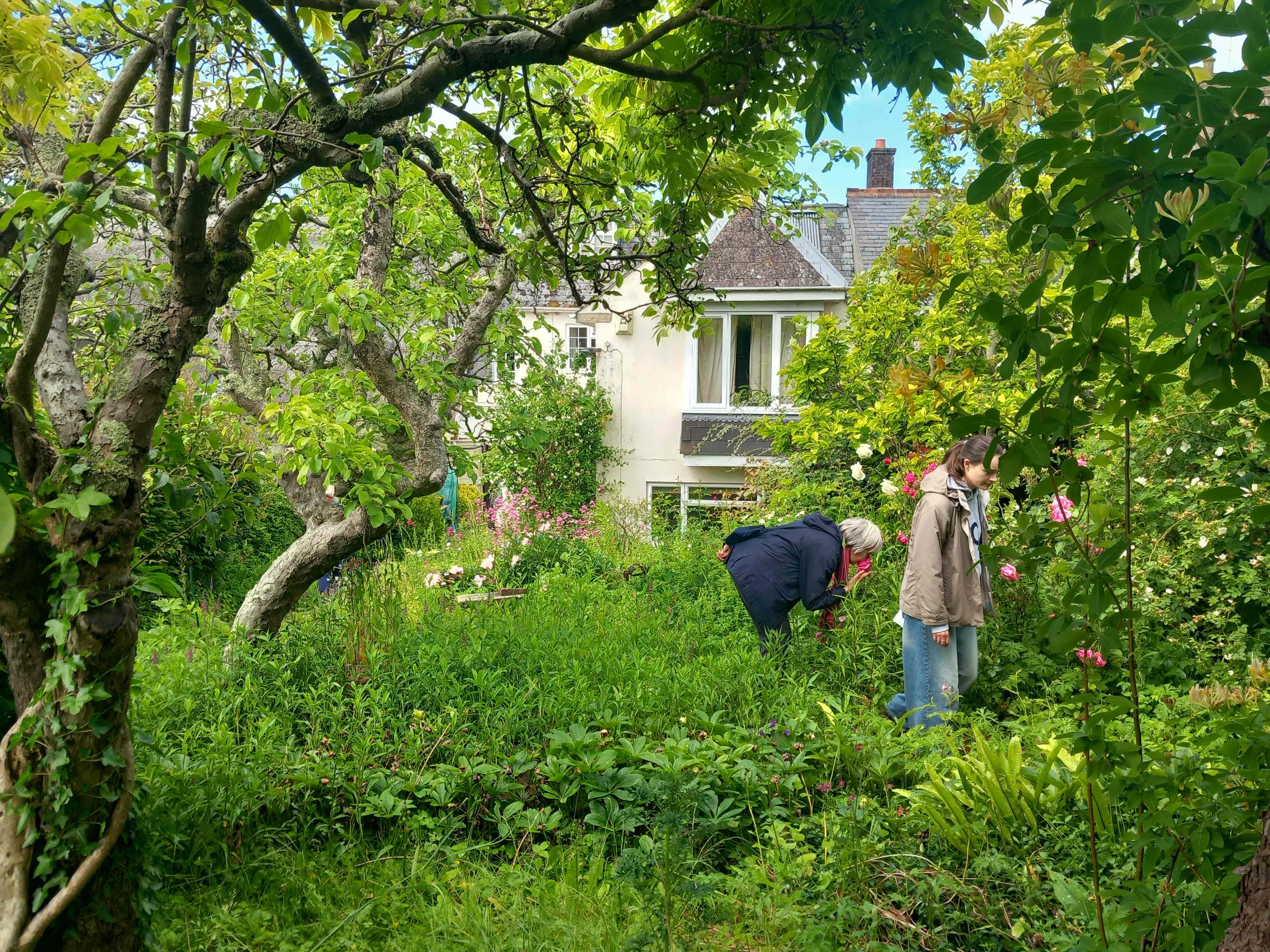
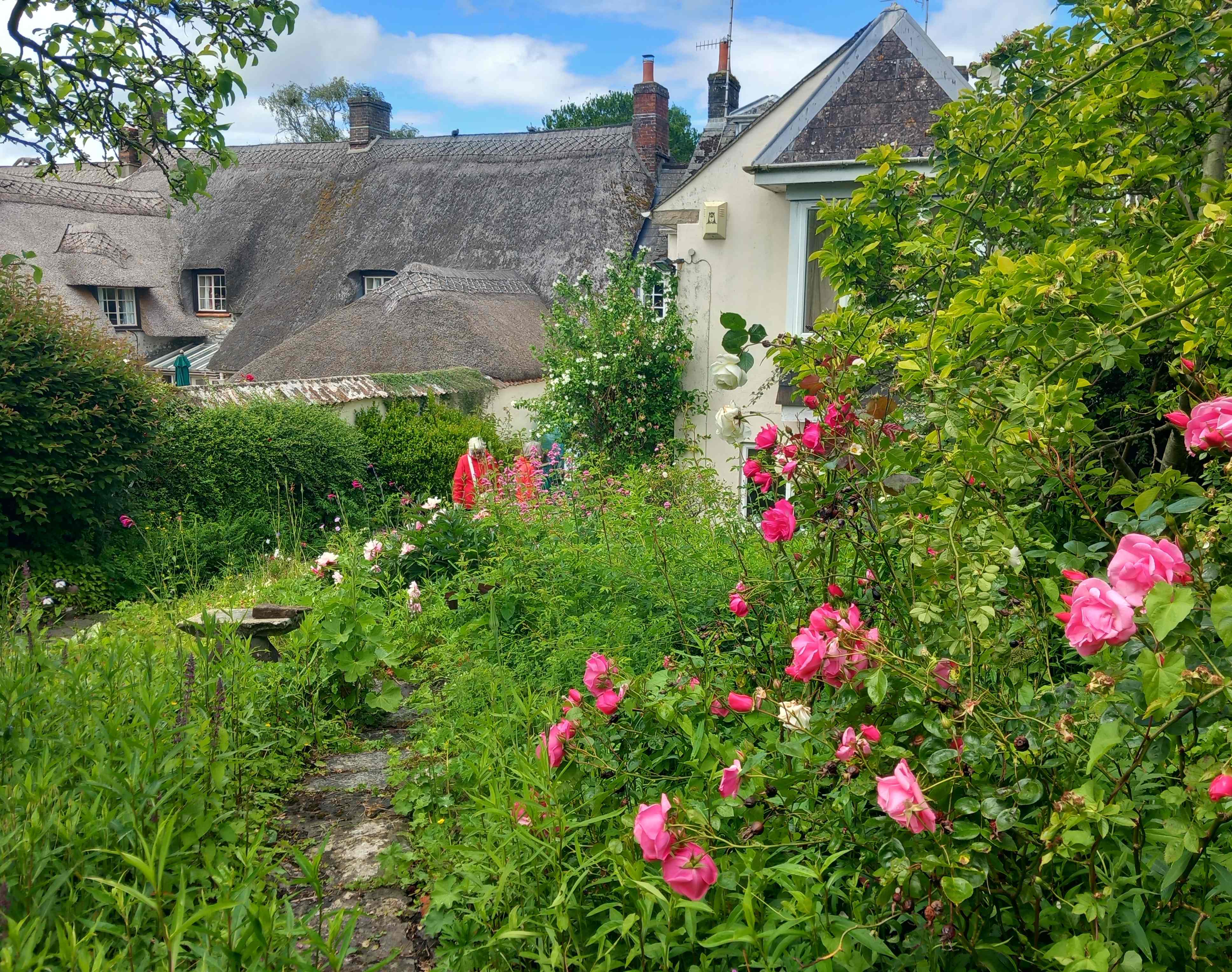
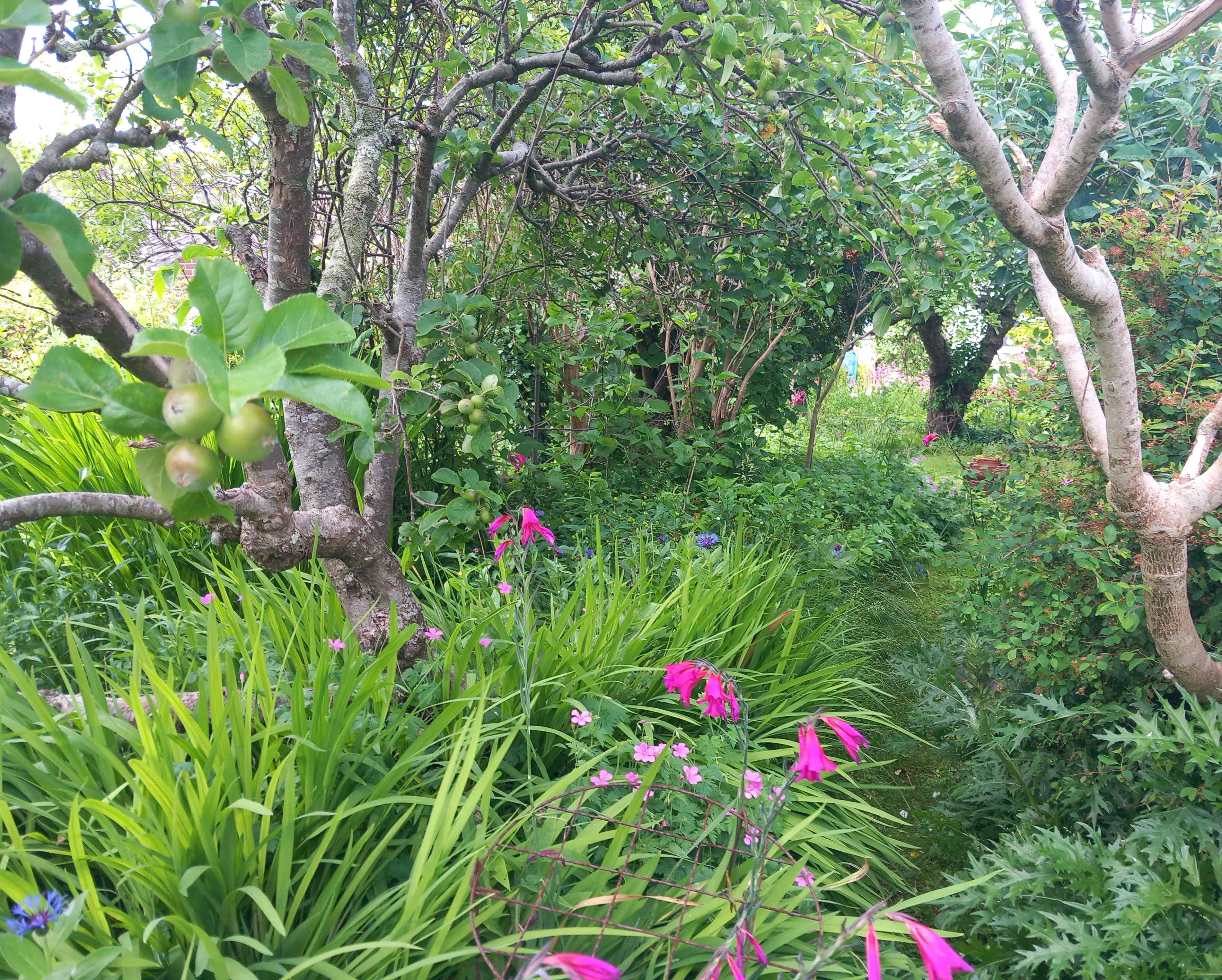
Behind Middle House on Long Street lies a garden belonging to Patricia Vale, a long time resident of this village.  A intensely peaceful place, this abundant garden slopes upwards from the house towards Back Lane, its narrow paths leading through beds of roses and other cottage garden favourites, beneath apple trees, and arriving finally at a vegetable and fruit garden.  According to Patricia, the garden layout has been largely unchanged for a century and she remembers how the previous owners, Mr and Mrs Thorne, grew vegetables and flowers for the church.

Last year Patricia was interviewed for the Cerne Historical Society Magazine on the occasion of her one hundredth birthday.  Recounting her remarkable life, serving with the RAF in World War II and afterwards working as a teacher, she speaks about the ongoing importance of the garden to her today.  Sadly, the weather wasn’t warm enough for Patricia to be outside, but her friends told us she still works in the garden, assisted by her gardener and family.

Patricia Vale’s garden, Long Street

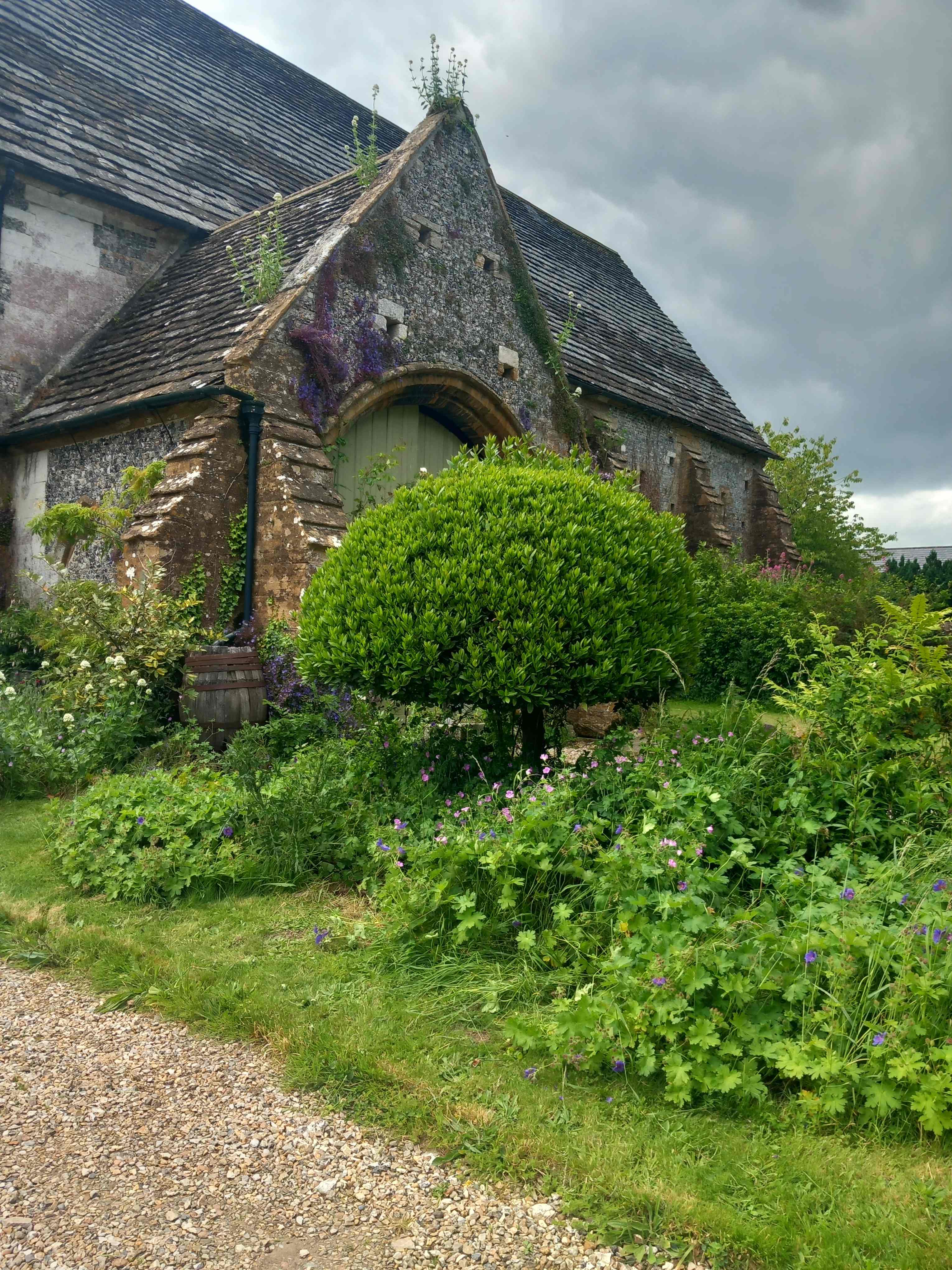
After a restorative cup of tea and excellent fruit scones at the vicarage we passed an open garden notice on the gate to Barton Farm.  At the end of this ordinary looking driveway we were astonished to discover a large medieval tithe barn, constructed by monks in the 14th century and now partly converted into a private residence.

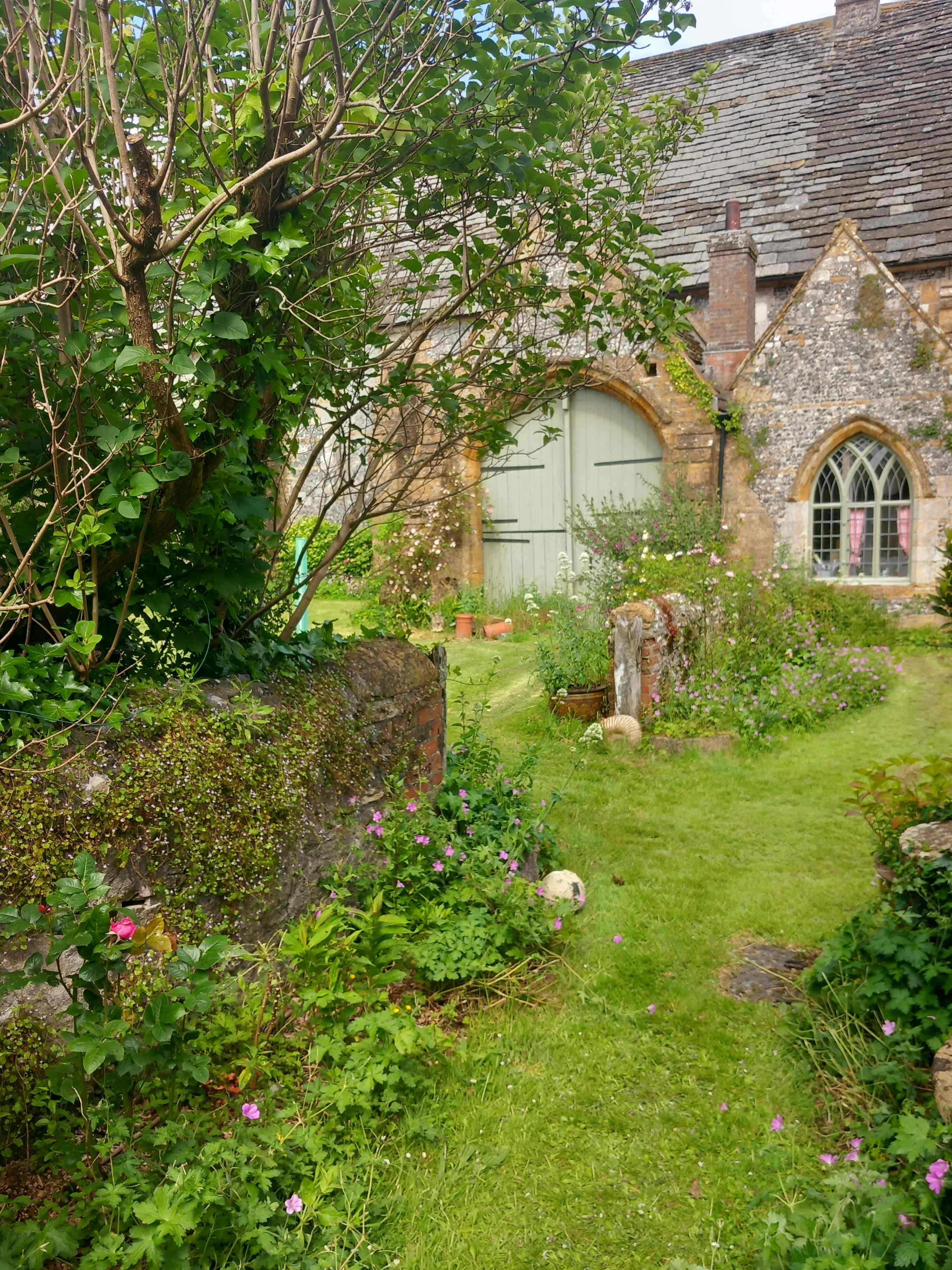
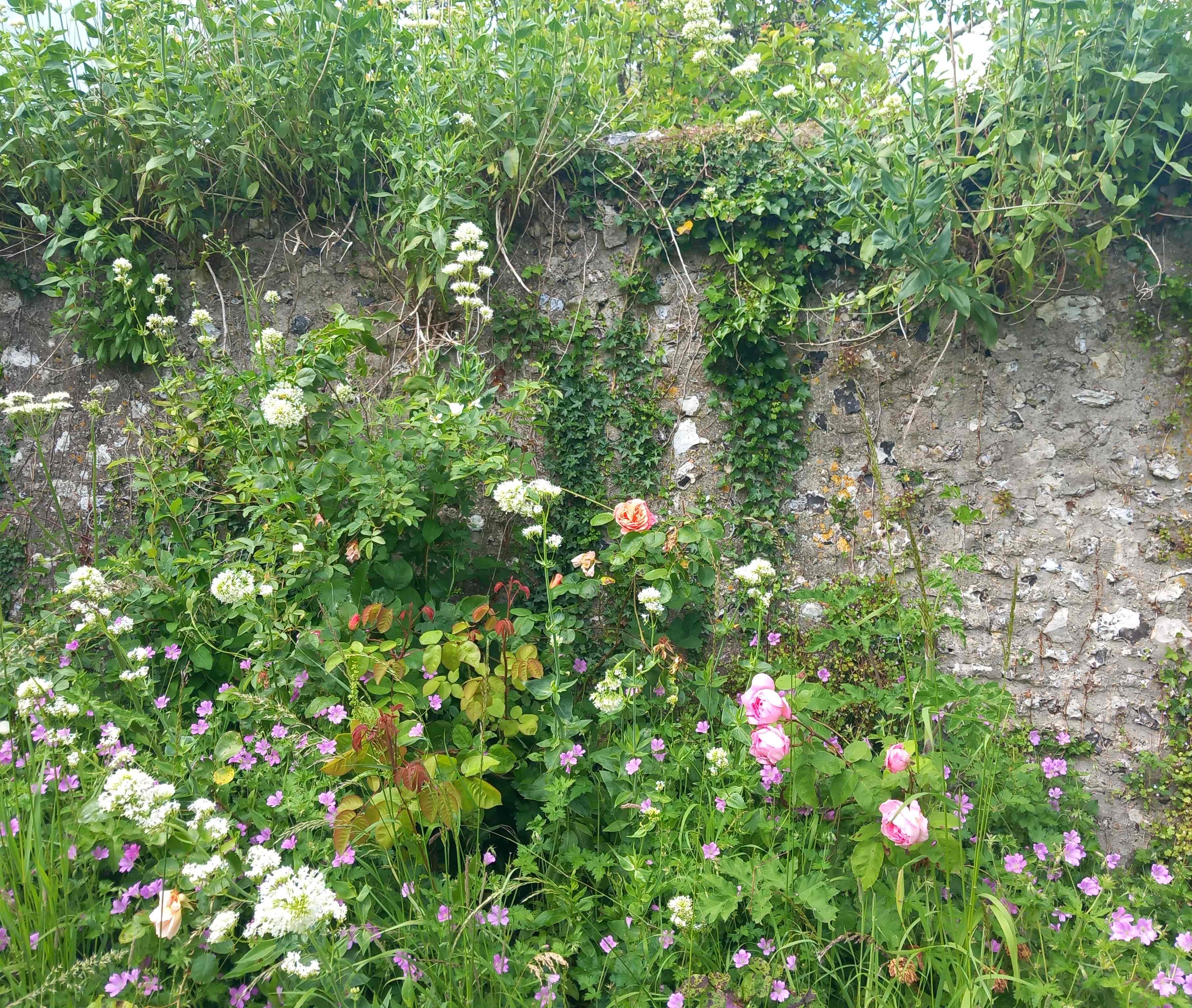
With its ancient walls clothed with climbing roses, honeysuckle and self-seeded white centranthus, the loose, relaxed planting style softens the outline of this vast building, making its presence less austere.  Behind the barn, through a pale green painted doorway, lies the courtyard garden, where this planting style is continued with more roses and borders of geranium, herbs and the Mexican daisy, Erigeron karvinskianus.  Full of atmosphere, this is a magical place.

The Tithe Barn at Barton Farm, Cerne Abbas

Throughout the afternoon it was great to explore the lanes and pathways of the village and have a chance to chat to some of the owners about their gardens.  Over the weekend the Cerne Abbas Open Gardens welcomed over one thousand visitors and over £9,000 was raised which will be divided between Godmanstone Church Restoration Fund and Cerne Historical Society.  An enormous effort goes into planning an event like this, so a special thank you to everyone involved for giving their time and making it such an enjoyable day.

Further reading:

Cerne Abbas Open Gardens Website here

Cerne Historical Society – Interview with Patricia Vale here

Historic England Tithe Barn, Cerne Abbas here

Open Gardens: The UK National Directory – a very useful list of independently organised open gardens arranged by county here

Jan van Huysum’s Flower Studies

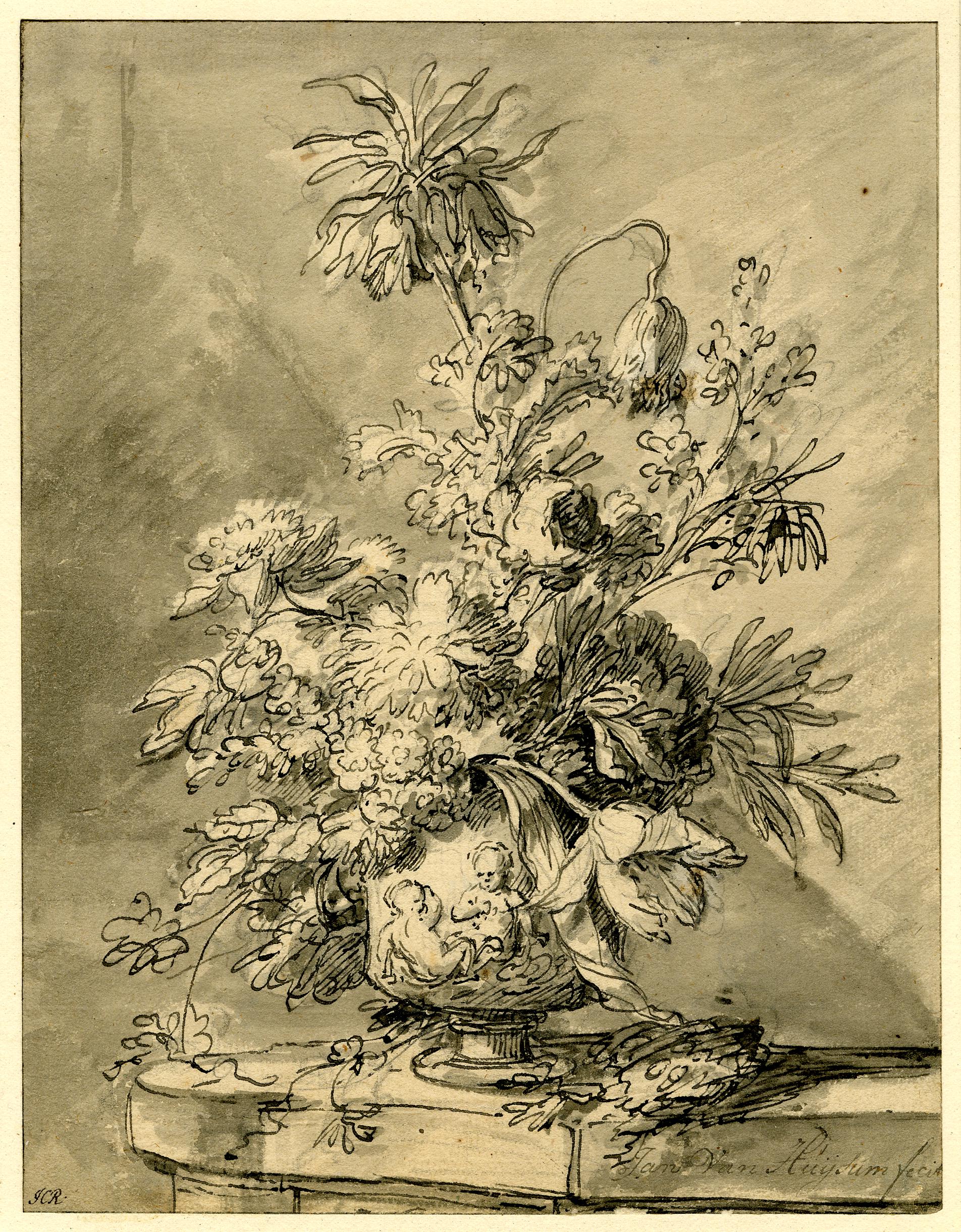
Study of flowers in a vase; with wrestling putti on the vase and roses tumbling out, a poppy lying across the base. 1720  Captions and images © The Trustees of the British Museum

Jan van Huysum (1682 – 1749) is considered amongst the finest Dutch painters of still life arrangements of fruit and flowers.  Based in Amsterdam, his work was highly sought after by collectors all over Europe in the 18th century and remains well represented in museums and galleries worldwide today.  Van Huysum was born into an artistic family, with three brothers also working as painters, and his father Justus noted for his skill in flower painting and decorative arts.

The illusion created by van Huysum’s flower paintings, of abundant flowers and foliage recorded before their freshness fades, has much to do with the artist’s apparent suspension of time.  When we consider the vase life of the flowers we might expect them to last perhaps a few days before they begin to deteriorate.  But this timeframe seems too short to produce the fine detail in a painting containing dozens of blooms.

Another clue that the arrangements are more complex than might appear at first glance is that they frequently contain flowers that belong to different seasons.  Tulips which should finish flowering in May, appear alongside hollyhocks and French marigolds which bloom later, in June or July.  Flowers with short stems are blended seamlessly into these arrangements, although in reality they would wilt very quickly, unable to reach a source of water.

All these anomalies seem to suggest the paintings are composite works, and demonstrate the formidable skill of the still life artist, the creator of a moment of floral profusion beyond what is practically possible.

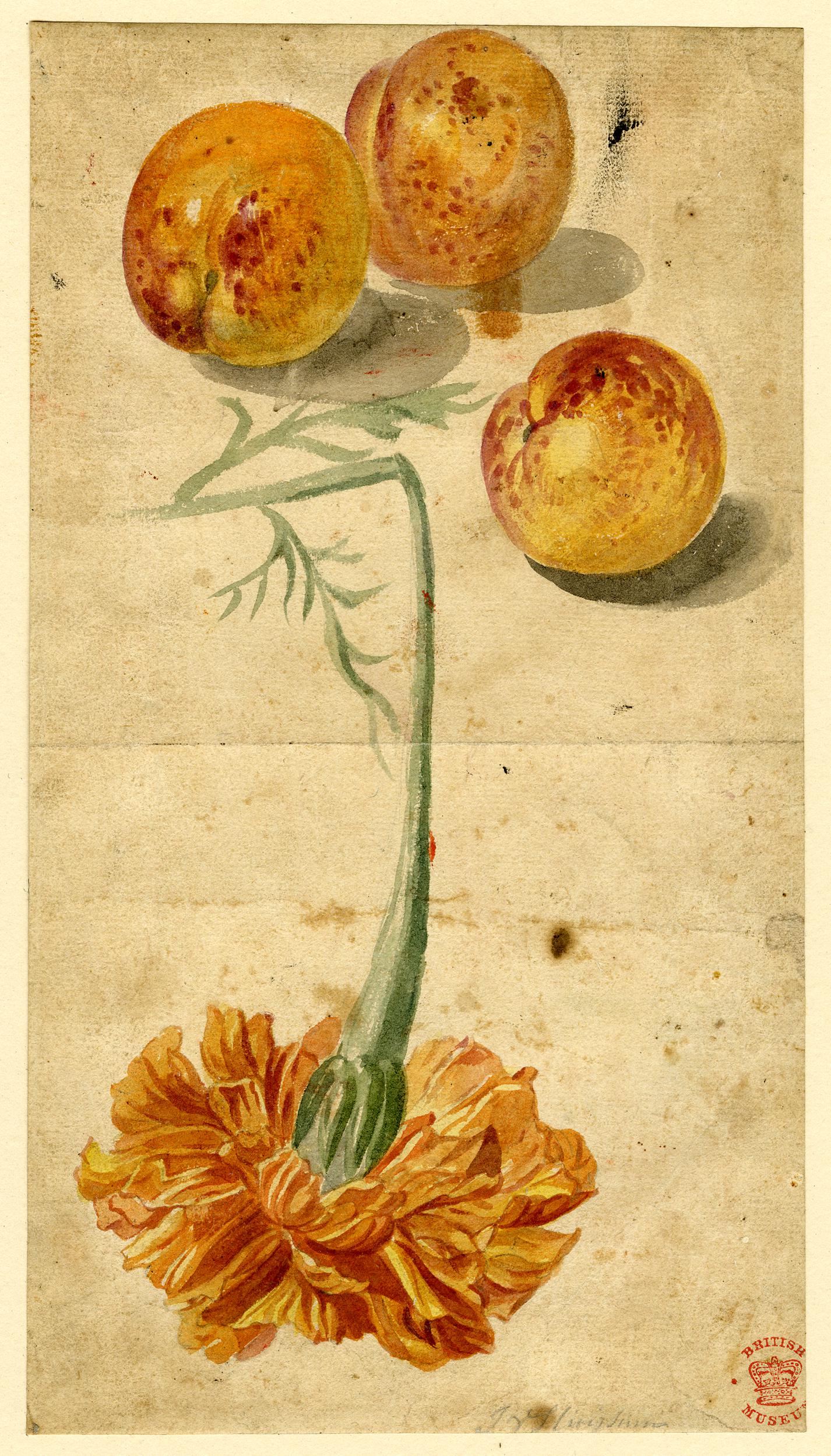
Perhaps with the aim of preserving the mystique of his artistry, or discouraging the prospect of competition in a lucrative market for still life works, Jan van Huysum was said to be protective of his painting techniques.  So this collection of flower studies, bequeathed to The British Museum in 1753 by Sir Hans Sloane, provides helpful insights into the process of planning his elaborate paintings.

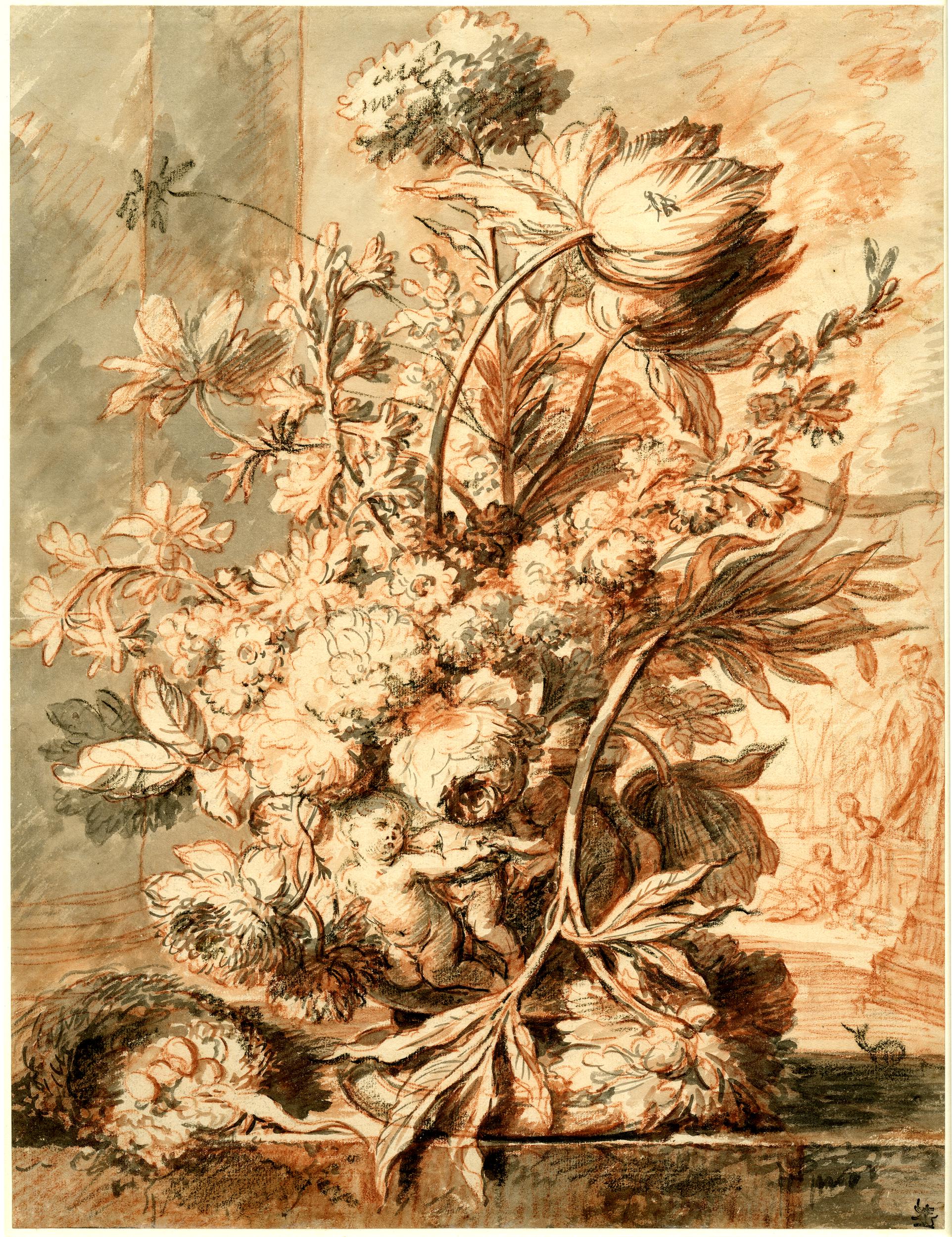
Loose, fluent sketches of magnificent arrangements of flowers, foliage and fruit show individual specimens carefully placed, with the largest, structural stems and blooms used to form a framework, into which smaller flowers could be inserted later.

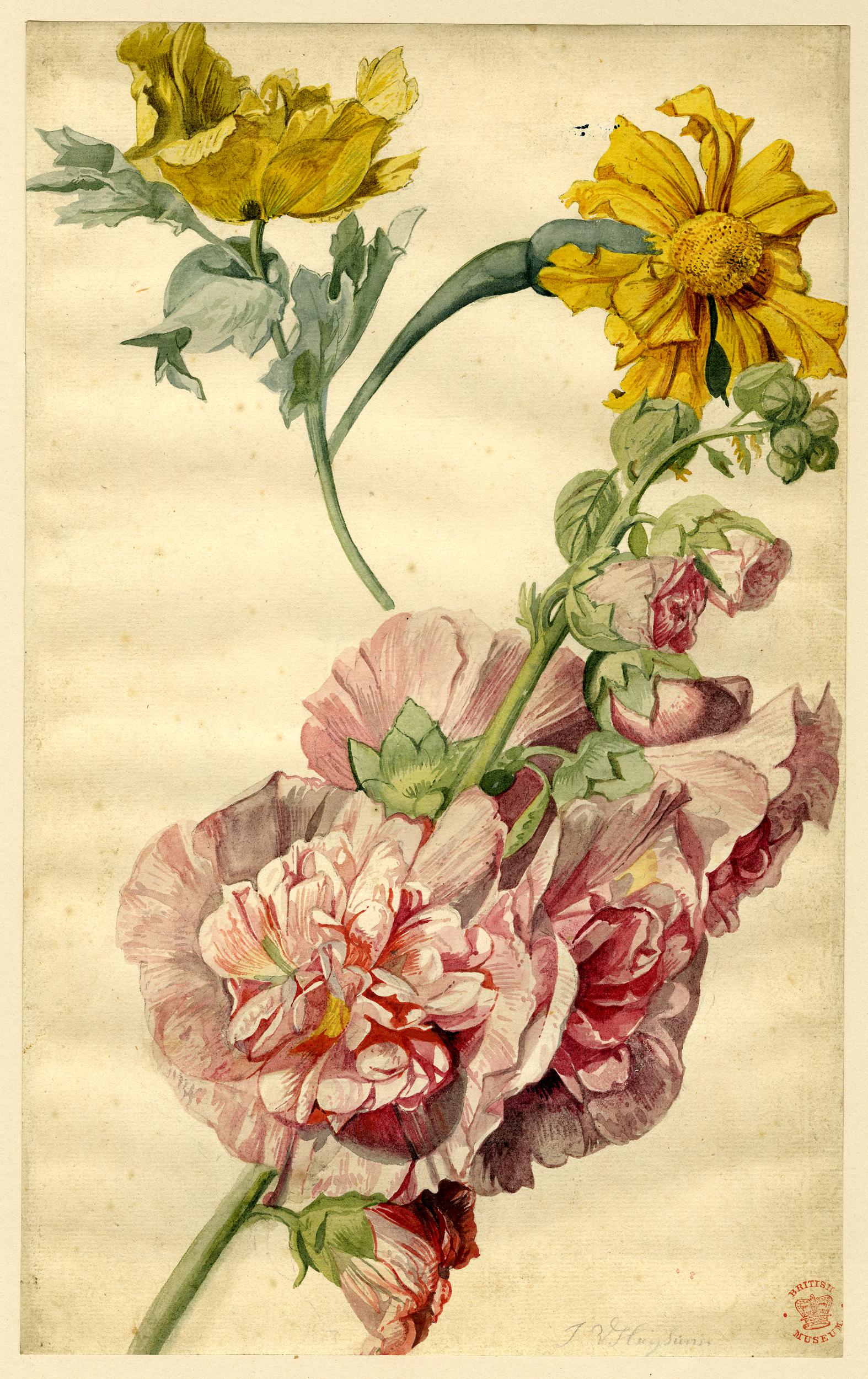
Detailed flower studies demonstrate how different plant stems behave when cut and the shapes they make, how they arch or trail, or how the weight of double flowers pull a stem downwards.  Tulips, which continue to grow after cutting, appear full of movement, their stems twisting and bending as their mature flowers open fully.  Hollyhocks are chosen for their height and volume in the composition of an arrangement as well as for their beautiful flowers.

Textures of both flowers and foliage are closely observed.  Van Huysum seems to delight in the coarse, glaucous leaves of the opium poppy, its robust foliage a useful contrast with delicate plants.  He often chooses to paint flowers facing away from the viewer, capturing the slightly waxy sheen of the undersides of tulip and poppy petals.

Some of van Huysum’s naturalistic studies record imperfections; a few rose leaves are damaged, perhaps by caterpillars, and a trailing nasturtium stem shows some dying leaves, with a papery texture.  In this way, details in Dutch flower paintings allude to themes of vanitas, the suggestion that life in all its beauty is but a fleeting moment, soon to disappear.

Van Huysum’s image library of flowers in full bloom must have been a valuable reminder of their forms and scale, in the months when these plants were unavailable to draw from life.  Each study possesses a contemplative stillness, reflecting the quiet grace of each plant.

His flower studies also provide an overview of the fashionable and collectable flowers cultivated in the gardens of his wealthy clients.  Flowers with variegated petals, like the striped or broken tulips and pinks were highly prized, as were double roses like Rosa centifolila.  Sometimes known as the cabbage rose, or the Provence rose, this plant with its large, pink flowers was developed by growers in The Netherlands in the 17th century and later grown extensively in southern France for use in the perfume industry.

Thanks to the success of Jan van Huysum’s work in his lifetime, there are many examples of his flower paintings on view in public collections in the UK – Art UK has a useful list.  Strawberry Hill House in Twickenham is currently hosting an exhibition of two works from a private collection, until 8th September 2024.  The British Museum has fifty three of van Huysum’s flower studies in its collection some of which appear here – link to all of them below.

Flower study; a yellow parrot tulip

Flower study; a Cornflower and a Tulip

Flower study; a variety of Tulip, red and white stripes

Flower study; an open Tulip, pink-red and white stripes

Flower study; a variety of Rose, two pink and white flowers

Flower study; two pink rose buds starting to open

Flower study; two pink Roses in full bloom, with two buds and foliage

Flower studies; pink roses in full-bloom and an orange flowerhead below

Flower study; a variety of Iris

Flower study; Pinks, two red and white striped flowerheads with buds

Flower study; flowerhead of a Pink with red and white stripes, twigs of a tree above with leaves and berries

Flower studies; including two Pansy flowers and a ragged red and white Tulip (?)

Flower and fruit study; an orange flower, and three peaches (?)

Flower study; trailing foliage with an orange flower

Flower study; shades of pink with two yellow flowers above

Flower study; four open red blooms and five buds on a stem

Flower study; a ragged red Poppy and a trailing stem with small red and pink flowers

Study of foliage

Study of flowers in a vase; two putti on the vase

Study of flowers in a vase; putti wrestling on the vase

Study of flowers in a vase; with wrestling putti on the vase and a fly on one of the flowers, a statue and two figures beyond

Vase of flowers; the vase decorated with an image of two seated children or putti

Further reading:

Exhibition of two paintings by Jan van Huysum at Strawberry Hill House here

Art UK’s listing of works by Jan van Huysum here

Jan van Huysum on Wikipedia here

Jan van Huysum’s flower studies at The British Museum here

Keith Arnatt’s Gardeners

Gardeners 1978-9 Keith Arnatt 1930-2008 Tate Gallery © Keith Arnatt Estate

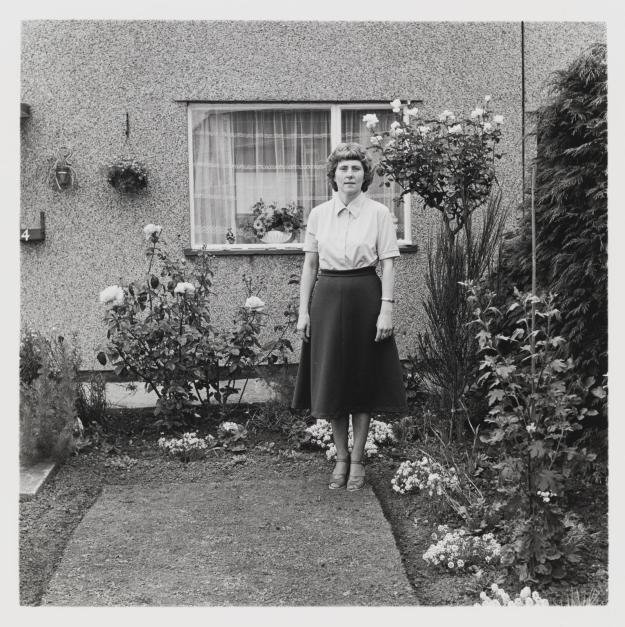
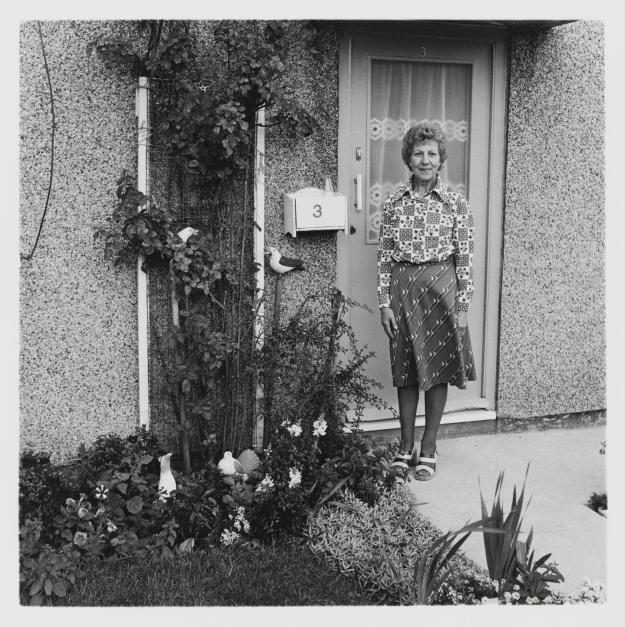
Posed in a front garden, this gardener stands as stiffly upright as the standard rose tree behind her.  Dressed in a dark skirt and crisply laundered white shirt, her garden seems to reflect a similar preference for order and neatness, with its straight edged lawn and borders of roses and chrysanthemum, underplanted with regularly spaced clumps of the popular bedding plant, alyssum.   This gardener’s love of flowers is further indicated by hanging containers adorning the pebble dashed wall of the house and a ceramic bowl of flowers placed in the centre of the living room window.

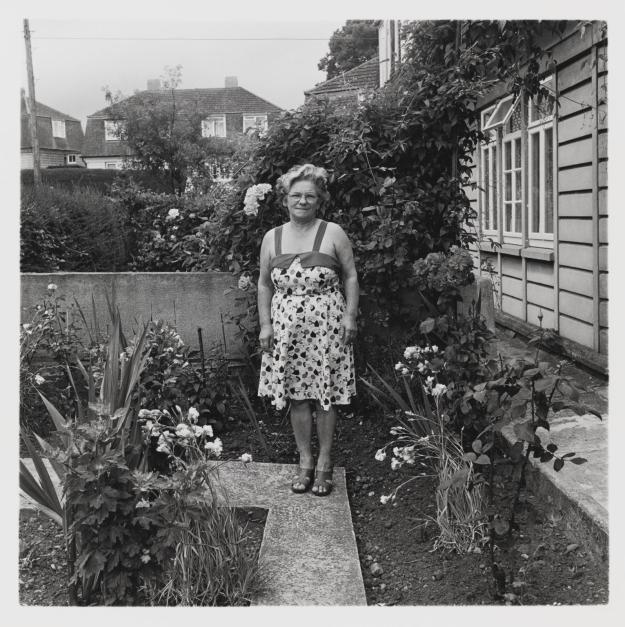
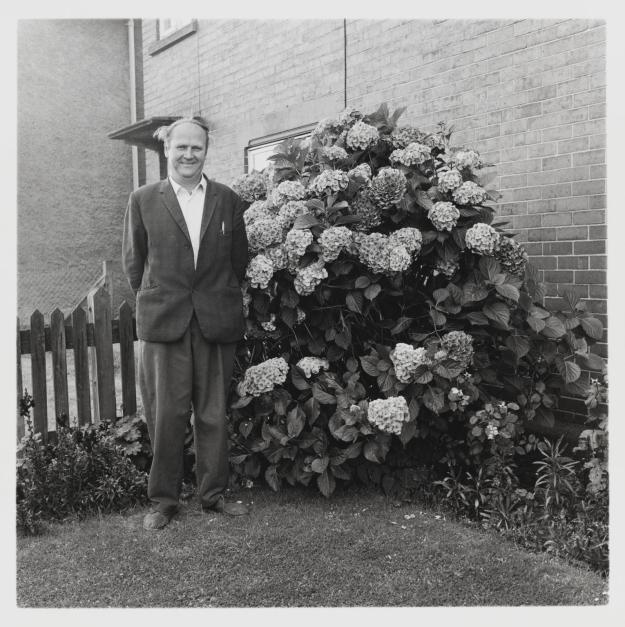
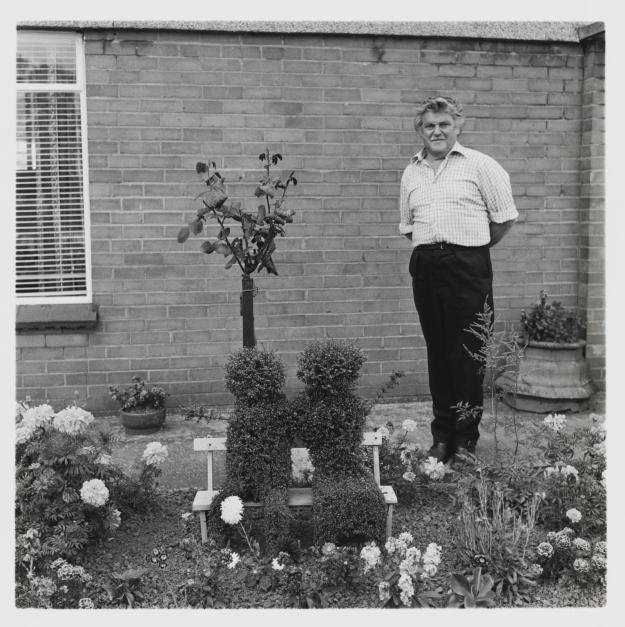
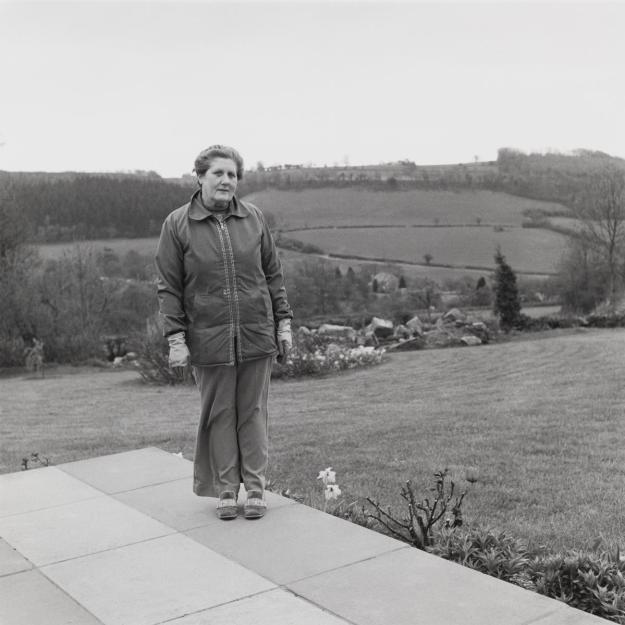
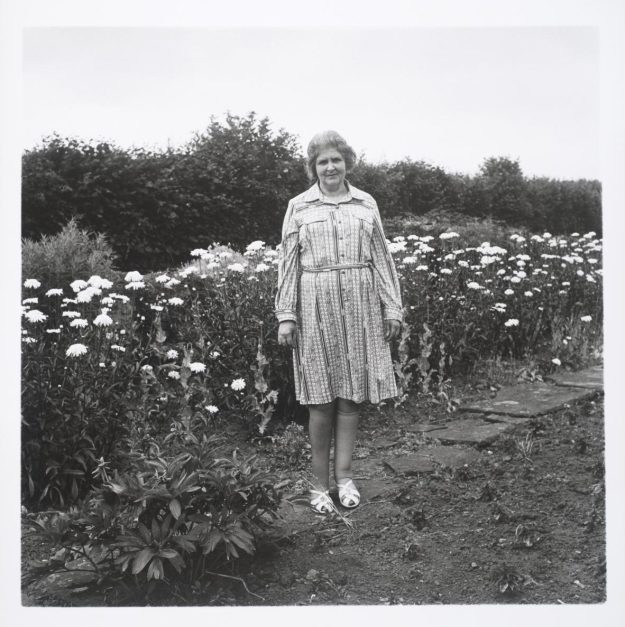
Gardeners (1978-79) is a series of forty black and white photographs by the conceptual artist Keith Arnatt (1930 – 2008), taken close to where he lived in Tintern, Monmouthshire.   Arnatt’s odyssey in search of the vernacular garden records ordinary people in their gardens, ranging from rural plots and allotments to post war housing developments.  As part of this process Arnatt also examines the connection between gardens and their owners, their relationship to the wider landscape, and what the domestic garden represents in our culture.

Trained at the Oxford School of Art and the Royal Academy, Arnatt’s performance based work was exhibited internationally in the 1960s.  Characterised by wit and humour, his work included Self Burial (1969), where a sequence of photographs shows the artist gradually disappearing into the ground and Trouser – Word Piece (1972) where the artist is photographed with a sign hung from his neck, bearing the words ‘I’m a real artist’.

Arnatt began teaching at Newport College of Art in 1969, and from the mid-1970s he completed several photographic projects documenting people engaged in everyday activities.  These included tourists visiting places of interest The Visitors (1974-76), taking their dogs for a walk, Walking the Dog (1976-79), and gardening Gardeners (1978-79).

Suburban gardens exist within a framework of uniformity, where rows of identical houses might typically have a square of ground at the front, and a rectangular plot at the back.  Some of the gardens recorded by Arnatt sit comfortably within this convention, with their clipped hedges dividing each plot from those of the neighbours, furnished with lawns, flower beds and ornaments.  Pictured with their owners, these well -tended gardens seem to echo the cottage gardens so admired by Gertrude Jekyll and Vita Sackville West.

Gardeners 1978-9 Keith Arnatt 1930-2008 Tate Gallery © Keith Arnatt Estate

Gardeners 1978-9 Keith Arnatt 1930-2008 Tate Gallery © Keith Arnatt Estate

Gardeners 1978-9 Keith Arnatt 1930-2008 Tate Gallery © Keith Arnatt Estate

Gardeners 1978-9 Keith Arnatt 1930-2008 Tate Gallery © Keith Arnatt Estate

Gardeners 1978-9 Keith Arnatt 1930-2008 Tate Gallery © Keith Arnatt Estate

Arnatt also examines those who depart from these conventions, like the man pictured with a pond made out of an old bath tub, its rim decorated with plastic storks and pot plants.  Ornaments of animals and birds seem to interest Arnatt, perhaps a reminder that domestic gardens have replaced the natural landscape and displaced nature.  He also seems to enjoy their incongruity.  In one photograph, a woman poses in her garden holding a tiny dog, standing close to an outsize model of a frog placed on a tree stump and plastic ducks placed underneath the canopy of a diminutive tree.

Gardeners 1978-9 Keith Arnatt 1930-2008 Tate Gallery © Keith Arnatt Estate

Gardeners 1978-9 Keith Arnatt 1930-2008 Tate Gallery © Keith Arnatt Estate

Gardeners 1978-9 Keith Arnatt 1930-2008 Tate Gallery © Keith Arnatt Estate

Semi-rural gardens allow Arnatt to explore their relationship with the wider landscape.  The boundaries between the rather wild looking garden of an older man and the woodland beyond are completely blurred, with no visible barrier between his roses and chrysanthemums, and the distant trees.  However, at the very top of the frame, Arnatt has included washing hanging up to dry, a reminder we are viewing a cultivated space.

Gardeners 1978-9 Keith Arnatt 1930-2008 Tate Gallery © Keith Arnatt Estate

A tiny garden, dominated by a homemade rockery, is bordered by a wire fence to keep out sheep and rabbits from the adjoining field.  Here, the fence represents a battle line, and gardener’s foot, planted firmly on the rockery, seems to indicate both pride in his collection of alpine plants, and a sense of victory over the forces that would attack his garden.

By way of contrast, a large garden, its lawn stretching out towards a field, seems adrift in the landscape.  The hard edge of the patio and woman’s slightly awkward posture seems to amplify the sense of dislocation.

Gardeners 1978-9 Keith Arnatt 1930-2008 Tate Gallery © Keith Arnatt Estate

Gardeners 1978-9 Keith Arnatt 1930-2008 Tate Gallery © Keith Arnatt Estate

Some of Arnatt’s photographs reveal gardens with a more harmonious relationship with nature. By filling the frame with flowers, the man posed next to an expanse of daffodils is transported into a world that is almost bucolic.

A woman posed next to an open garden gate has repeated the planting of roses and other flowers on both sides of the stone wall, creating a pleasing sense of unity and flow between the cultivated space and the landscape beyond.

Gardeners 1978-9 Keith Arnatt 1930-2008 Tate Gallery © Keith Arnatt Estate

Gardeners 1978-9 Keith Arnatt 1930-2008 Tate Gallery © Keith Arnatt Estate

Perhaps it’s on the allotment where Arnatt’s gardeners seem most relaxed, preparing for the growing season, digging over the soil, or tending a bonfire.  These gardeners are wearing clothes appropriate for gardening, but others in the series appear to have dressed up smartly for the occasion.

Gardeners 1978-9 Keith Arnatt 1930-2008 Tate Gallery © Keith Arnatt Estate

Gardeners 1978-9 Keith Arnatt 1930-2008 Tate Gallery © Keith Arnatt Estate

Gardeners 1978-9 Keith Arnatt 1930-2008 Tate Gallery © Keith Arnatt Estate

Gardeners 1978-9 Keith Arnatt 1930-2008 Tate Gallery © Keith Arnatt Estate

Gardeners 1978-9 Keith Arnatt 1930-2008 Tate Gallery © Keith Arnatt Estate

Gardeners 1978-9 Keith Arnatt 1930-2008 Tate Gallery © Keith Arnatt Estate

The success of Gardeners hinges on the people selected by Arnatt.  Carefully placed in their gardens by the photographer, they anchor each composition and their presence creates a sense of substance and cohesion across the series.  By their very nature, gardens are impermanent places, so forty five years after Gardeners was produced, these photographs also provide an important cultural record of ordinary gardens, and the people who made them, that could so easily have been lost and forgotten.

Further reading:

Keith Arnatt estate here

Keith Arnatt’s work at the Tate Gallery here

Rousham in Late November

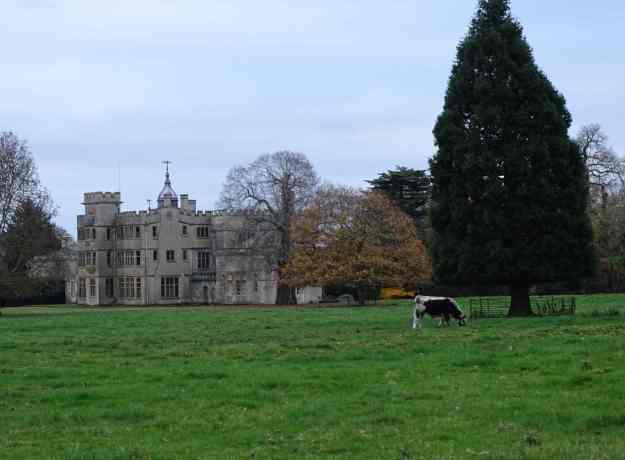
Rousham House from the park, with a member of its herd of longhorn cattle

On a chilly November afternoon almost exactly two years ago, I was fortunate enough to visit Rousham for the first time.  Suitably wrapped up against the cold and damp, myself and three gardening friends explored these iconic gardens for a happy couple of hours, until the fading light brought our journey to a close.

Arriving at Rousham, there’s no trace of commercialisation, such as a café or gift shop, and tickets are purchased from a rather lonely looking machine in an adjacent outbuilding.  Visitors then make their own way around the gardens, guided by a simple yellow leaflet.  This low key approach feels disconcerting at first, but once acclimatised, contributes to the astonishing sense of calm that attends this special place.

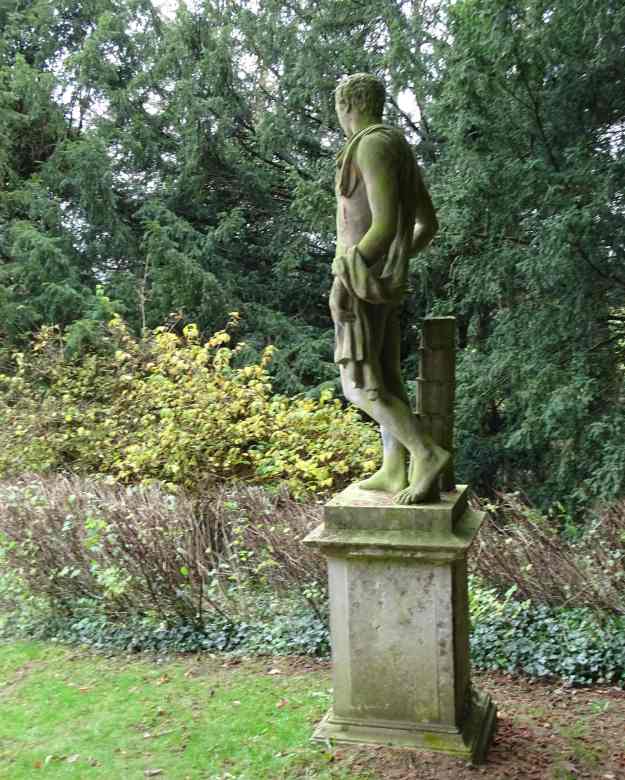
Rousham House was constructed in the 1630s by Sir Robert Dormer, whose descendants continue to live here, managing the gardens and surrounding estate.  The gardens at Rousham were laid out by Charles Bridgeman (1690 – 1738) in the newly fashionable English ‘naturalistic’ style.  Beginning in 1719, this first phase of the landscaping was completed in 1737, after which the celebrated architect and designer William Kent (1685 – 1748) developed the house and gardens further, adding Classical features such as cascades, bridges and statuary for which Rousham is now famous.

The new ‘naturalistic’ garden landscapes of the 18th century England departed radically from previous garden styles by abandoning the symmetry and straight lines of the formal parterre garden in favour of curves that echoed the organic forms of nature.  However, these gardens are not naturalistic in a modern sense, retaining many elements of formality and control.

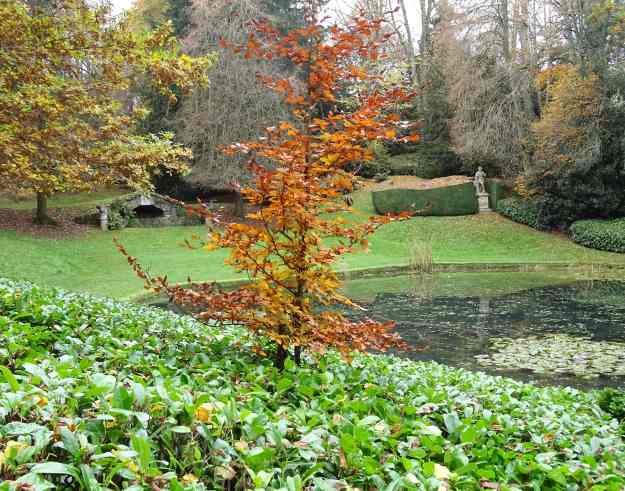
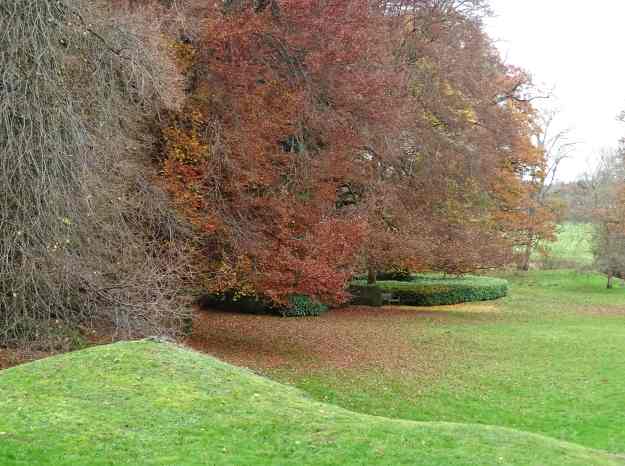
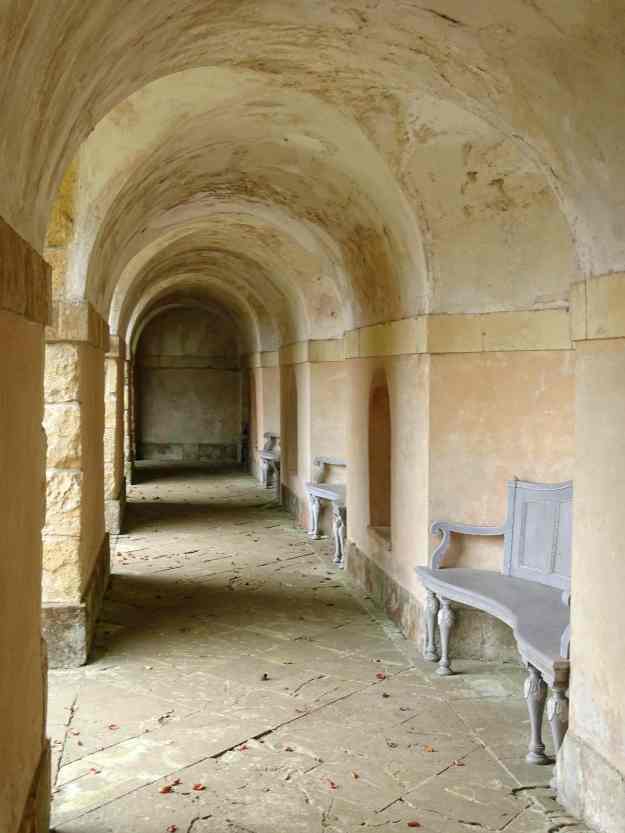
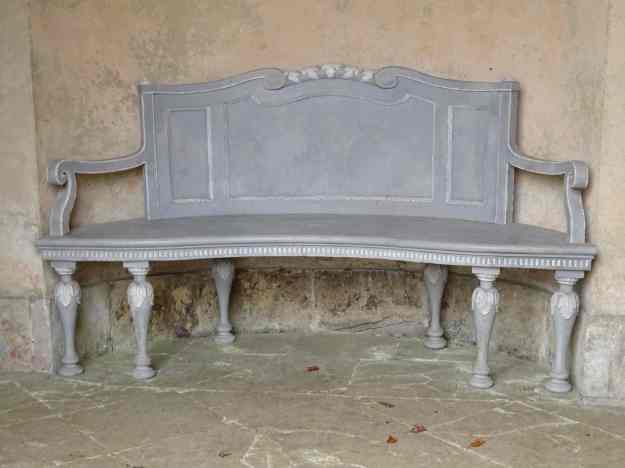
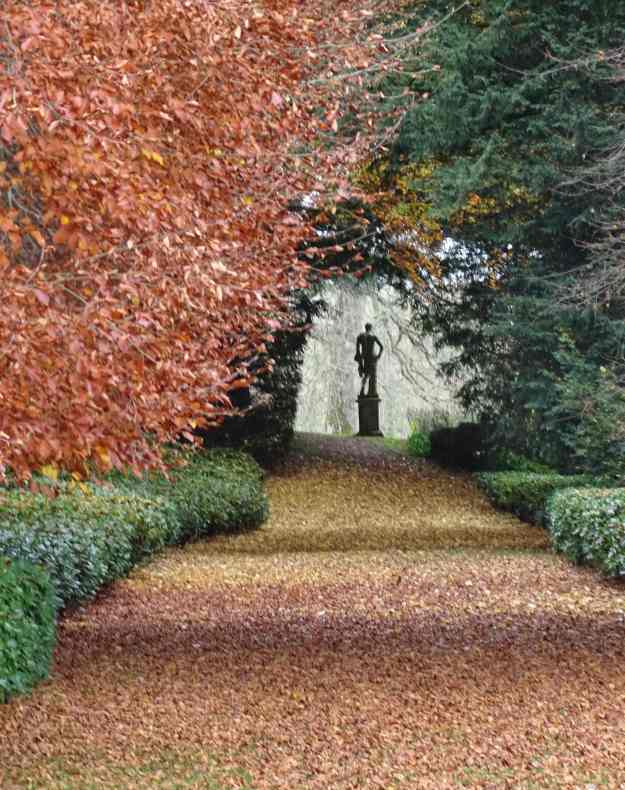
With fallen leaves carpeting the broad pathways in shades of bronze and gold, the colours of late autumn seemed to glow with an almost luminous intensity in the soft light.  The river Cherwell  meanders through the gardens, and views of this ancient waterway are framed by the elegant stone arches of Kent’s Praeneste, or arcaded garden loggia.  A set of 18th century wooden benches also designed by Kent, painted in a heavenly shade of grey, invite visitors to pause and enjoy the landscape vistas.

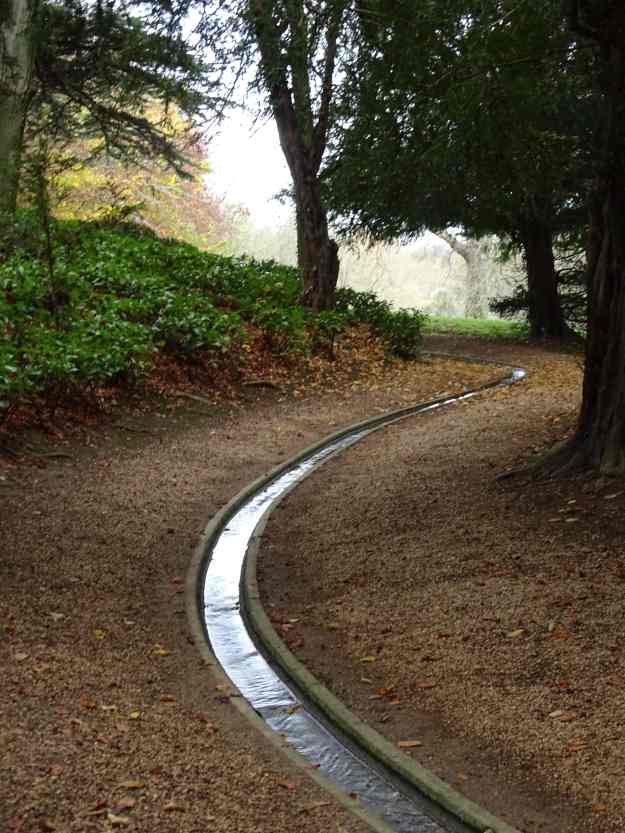
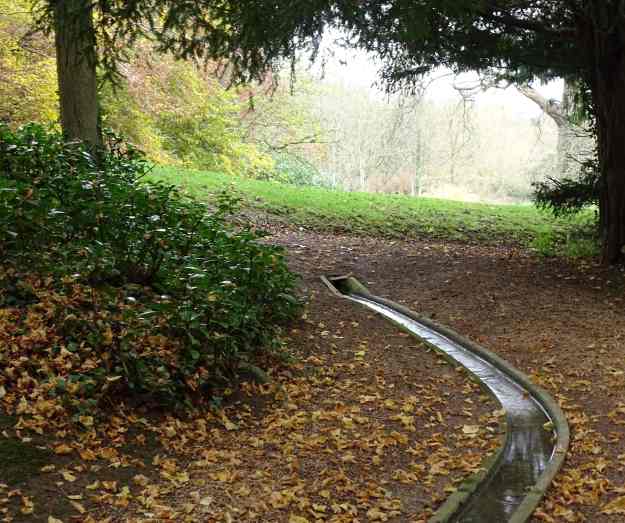
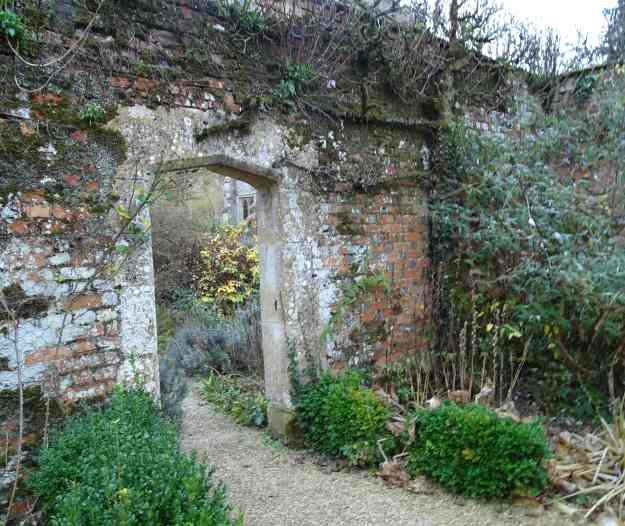
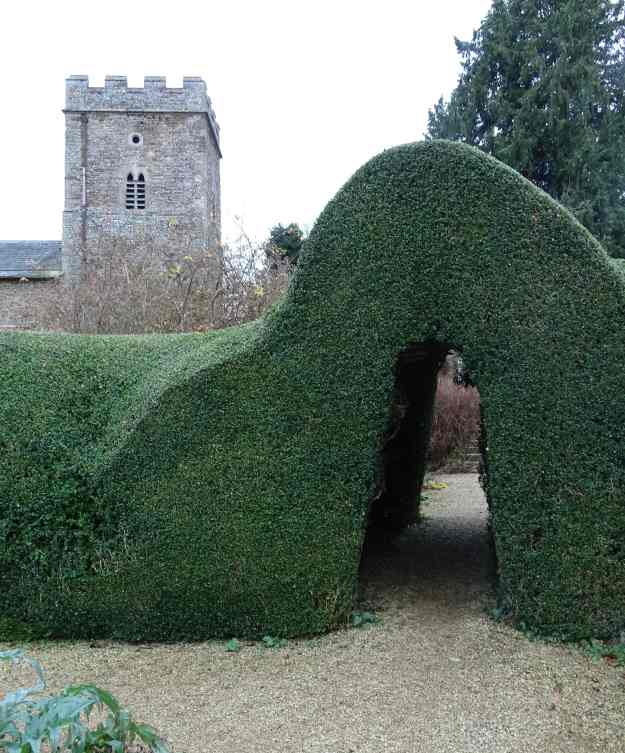
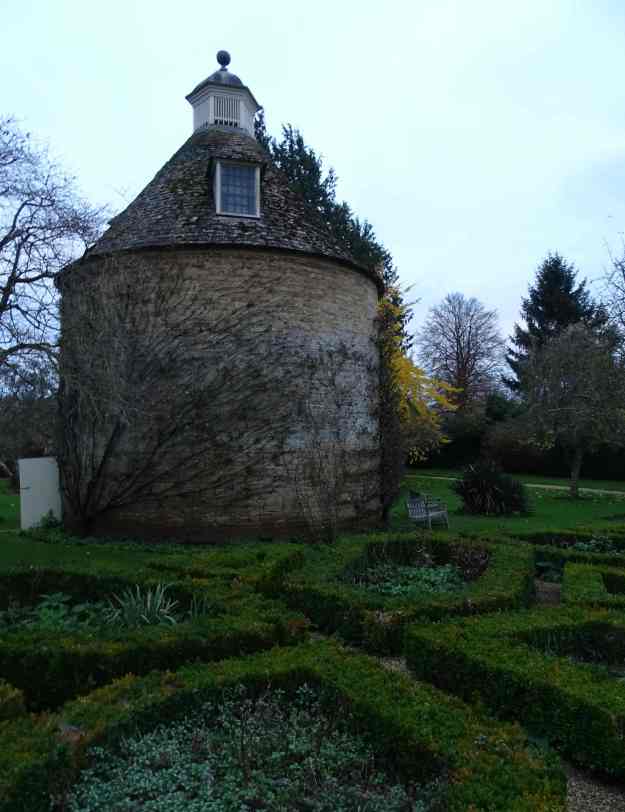
Silvery and shimmering, a rill winds its way through the trees, punctuated at one point along its course by a deep stone clad pool of clear water, the Cold Bath.  From the bowling green next to the house we passed through an archway cut through an enormous yew hedge to the gateway of the walled garden.  Planted with fruit trees and wide, generous herbaceous borders, the very last of the roses were still flowering.  Beyond is the 17th century dovecote and the parterre garden.

The gardens are meticulously maintained.  Fallen leaves on the lawns and pathways at Rousham are allowed to remain while they retain their colour, and massed evergreen shrub plantings are pruned carefully to the same height, creating large organic forms that complement the overall landscape design.  Precise judgements like these are fundamental to preserving the particular atmosphere of these gardens.

According to Historic England, the gardens at Rousham are ‘the most complete surviving example of Kent’s landscape work.’  Largely untouched since they were completed in the 18th century these gardens are both a rarity and a delight.

Late autumn colour and the octagonal pond

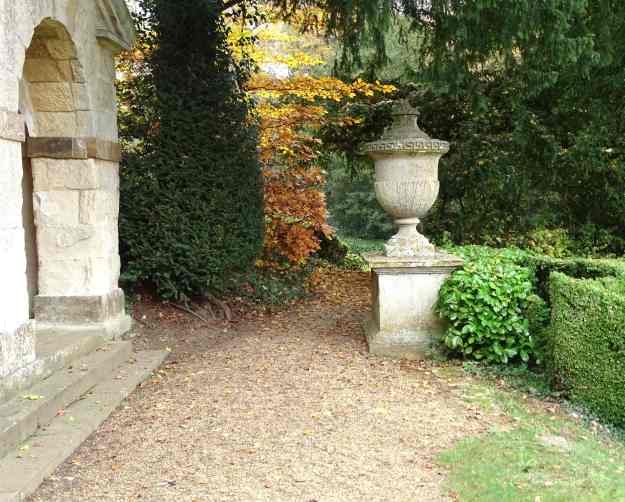
Decorative urn outside William Kent’s arcade

William Kent’s Praeneste and benches

The famous rill winds its way through the trees

The source of the rill

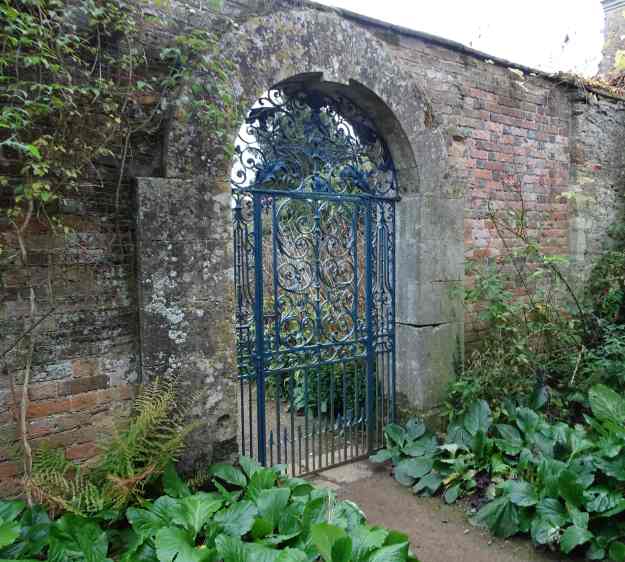
Gateway to the walled garden

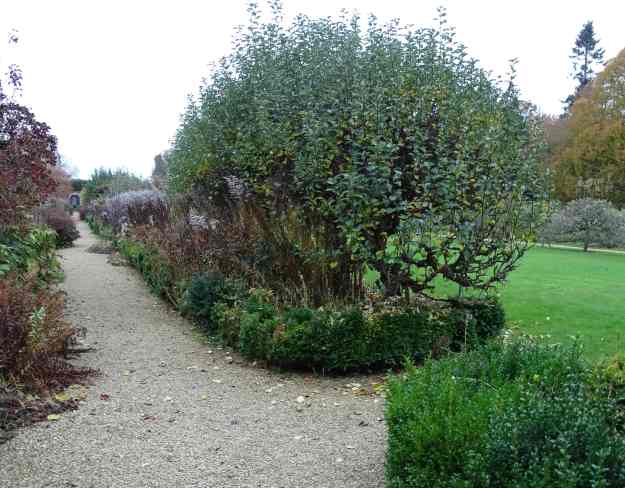
Fruit trees and herbaceous borders in the walled garden

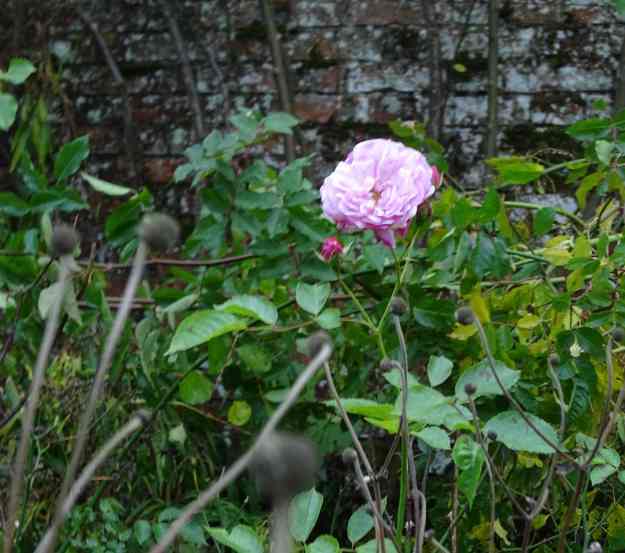
One of the last of the roses in the walled garden

Topiarised yew archway leading to the church

Dovecote and parterre garden

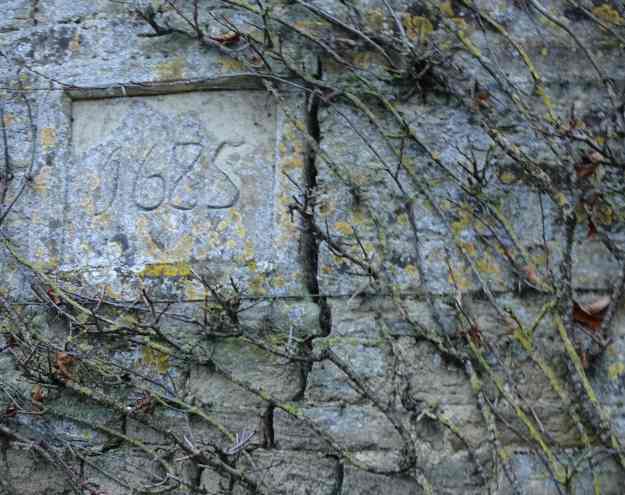
Wall of the dovecote

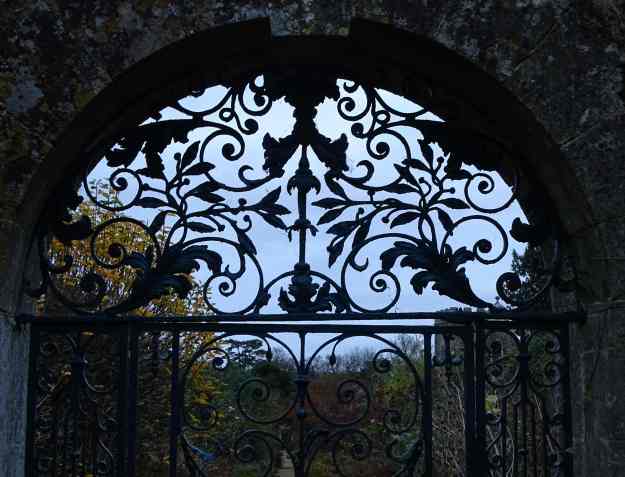
Beautiful ironwork of the walled garden gate against the fading November light

Further reading:

Rousham House and Gardens here

Historic England’s entry for Rousham here

The V&A’s biography of William Kent here

We stayed at Potato Town, on the Great Tew estate in north Oxfordshire, a perfect base for exploring the gardens of the Cotswolds here