Author Archives: plantingdiaries

Cuckoo Flowers

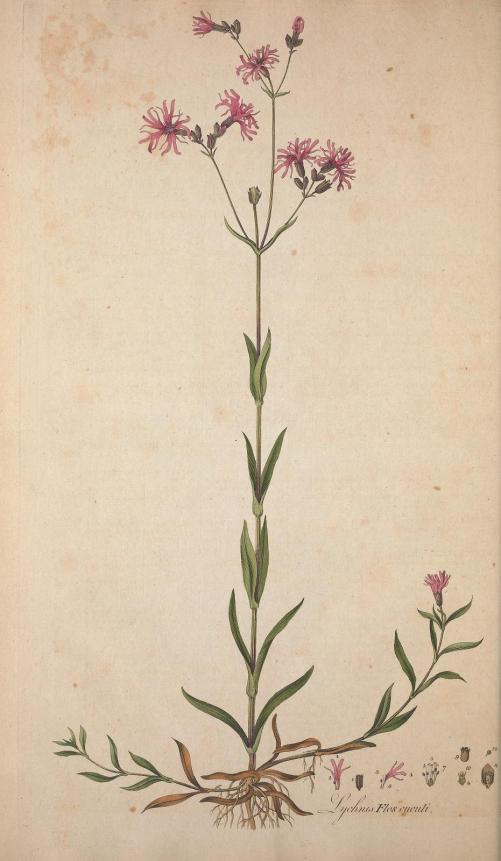
Lychnis flos-cuculi from Flora Londinensis by William Curtis

The arrival of the cuckoo in April remains a popular sign of spring, even for the majority of us now living in towns or cities who might not actually hear the call.  The unmistakable sound of the cuckoo is embedded in our creative culture – in music, poetry and in the common names of some of the UK’s native wild flowers, all of which help us preserve a link with the natural world and the changing seasons.

Flora Londinensis, written by William Curtis and published in six volumes between 1777 – 1798 is an illustrated survey of all the wild plants that could be found within a ten mile radius of London.  Curtis sheds some light on the reason why Lychnis flos-cuculi is known as the cuckoo flower observing that, ‘from the earliest ages’ people have made a connection between the flowering of certain plants and ‘the periodical return of birds of passage’.

Before the return of the seasons was exactly ascertained by Astronomy, these observations were of great consequence in pointing out stated times for the purposes of Agriculture; and still, in many a Cottage, the birds of passage and their corresponding flowers assist in regulating “The short, and simple Annals of the Poor.” 

Curtis points out that  ‘we have several other plants that, in different places, go by the name of Cuckow Flower’ including cardamine, arum, orchids and wood sorrel.  He talks about a double form of the lychnis flower being cultivated in gardens.

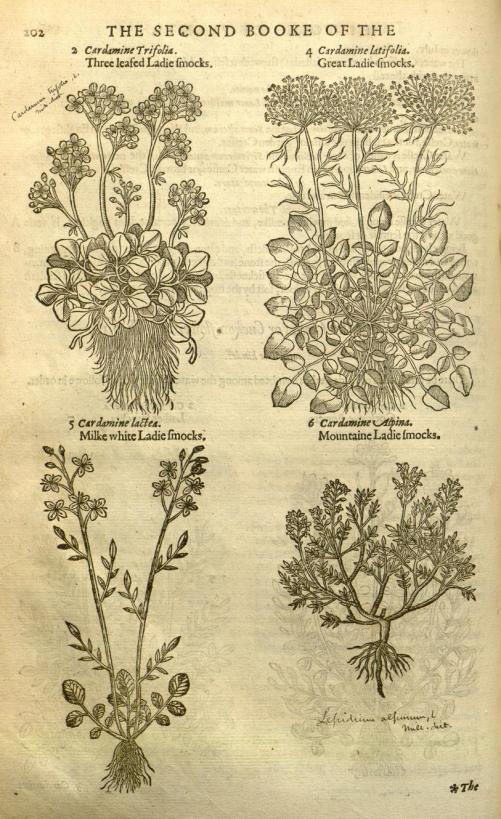
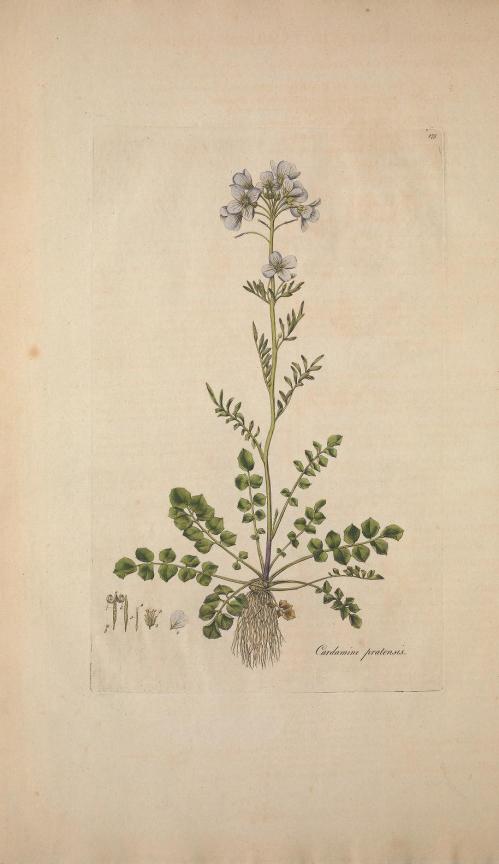
Gerard’s Herball, or, Generall Historie of plantes (1597) contains many examples of local plant names.  He confirms that cardamines are commonly known as Cuckow flowers, while noting that in Norfolk they are called Caunterburie bels and in Cheshire (his place of birth, in Nantwich), Ladie smockes.  

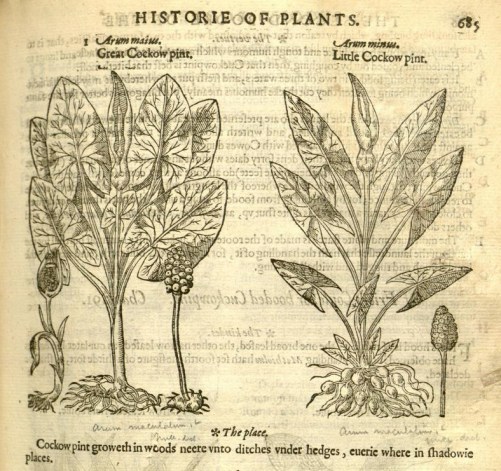
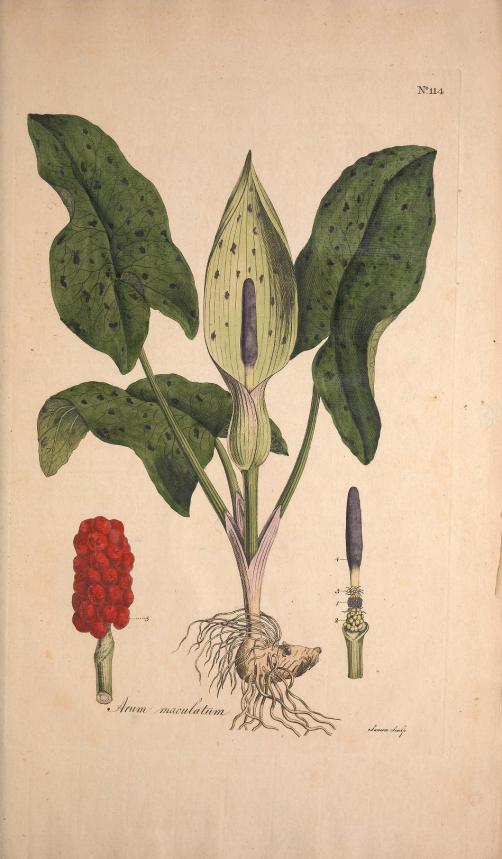
Another cuckoo flower mentioned by Gerard is the common woodland plant Arum maculatum.  He lists the plant’s common names:

The common Cockow pint is called in Latin Arum: in English Cockow pint and Cockow pintle, wake Robin, Priest’s pintle, Aron, Calfes foote, and Rampe, and of some Starch woort.

According to Wikipedia, ‘pint’ is a shortening of the word ‘pintle’, meaning penis, derived from the shape of the spadix. 

from The Herball, or, Generall historie of plantes John Gerard 1597

from The Herball, or, Generall historie of plantes John Gerard 1597

Cardamine pratensis from Flora Londinensis by William Curtis

from The Herball, or, Generall historie of plantes John Gerard 1597

Arum maculatum from Flora Londinensis by William Curtis

A double form of Lychnis flos-cuculi ‘Jenny’ (photo Wikimedia Commons)

In the eighteenth century it was understood that cuckoos left the country to overwinter in warmer places, but not known that they travelled as far as Africa.  While we know more about the cuckoo’s migratory patterns now, fewer of us experience the cuckoo first hand, so may not know about the changing call of the cuckoo over the season.  Gerard talks about the time in April and May when ‘the Cuckowe doth begin to sing her pleasant notes without stammering’.  In his poem The Cuckoo John Clare also observes a loss of voice, but in summer:

When summer from the forest starts
Its melody with silence lies,
And, like a bird from foreign parts,
It cannot sing for all it tries.
‘Cuck cuck’ it cries and mocking boys
Crie ‘Cuck’ and then it stutters more
Till quick forgot its own sweet voice
It seems to know itself no more. 

This alteration in the cuckoo’s call is described as a ‘change of tune’ in Jane Taylor’s poem, memorably and beautifully set to music by Benjamin Britten in his collection of twelve songs entitled Friday Afternoons.  Do listen on the link below.

Cuckoo, Cuckoo!
What do you do?
“In April
I open my bill;
In May
I sing night and day;
In June
I change my tune;
In July
Far far I fly;
In August
Away I must.”

Jane Taylor, 1783-1824

from History of British Birds by Thomas Bewick 1797 – 1804

Cuckoo! by Benjamin Britten

Flora Londinensis

Arum maculatum entry Wikipedia

(images from the Biodiversity Heritage Library, unless otherwise stated)

Ribbon Grass

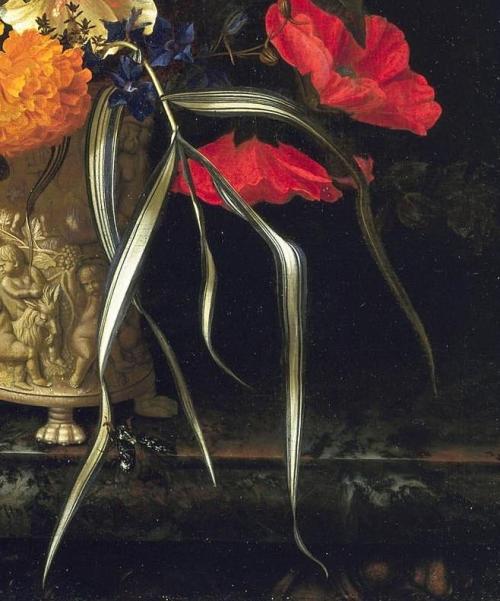
Still Life with Flowers in a Decorative Vase 1670 – 75 Maria van Oosterwijck  (Wikimedia Commons)

We tend to think of grasses used as decorative garden plants as a new development in planting design.  Pioneered by Karl Foerster in Germany in the 1930s, his naturalistic planting schemes used grasses and late flowering perennials, a style which has been embraced and developed by Dutch designer Piet Oudolf, and many others, and remains very influential today.  So it may come as a surprise that long before the current fashion for prairie style planting, grasses were grown in European gardens as far back as the sixteenth century.

At the front of the arrangement in the painting above by Maria van Oosterwijck (1630 – 1693) there is a strand of boldly striped green and white ribbon grass, contrasting with the dark background and the pink flowers of a hollyhock.  The long leaves make contact with marble surface upon which the vase of flowers stands and seem to be reaching out further, almost to the edge of the canvas, inviting us to touch them.  One of a pair of beetles is starting to climb a leaf.

If we believe that the blooms depicted in the Dutch flower paintings of the seventeenth and early eighteenth centuries represent those most valued by horticulturalists and collectors, it is interesting to see this grass given such a prominent place among the roses, carnations and poppies.

The RHS lists ten common names for Phalaris arundinacea var. picta including gardener’s garters, bride’s laces, and lady grass as well as the more familiar ribbon grass. The number of names would seem to indicate that the plant has a long history of cultivation and was well known in the UK.

John Gerard in The Herball, or, Generall Historie of Plantes (1597) describes the grass as being, ‘like to laces of white and greene silke, very beautiful, and faire to behold’ and explains it is ‘kept and maintained in our English gardens, rather for pleasure than for vertue’, (meaning that ribbon grass had no known practical or medicinal qualities).  We know that ribbon grass was cultivated in ordinary gardens in the nineteenth century as it is mentioned by John Clare in a list of cottage garden plants alongside wallflowers, pinks and lavender.

Ladie Lace Grasse from The Herball, or, Generall Historie of Plantes 1597 (Biodiversity Heritage Library)

Ribbon grass is quite tall (approx 60cm) so too high to fit into the standard rectangular illustration frame size for the Herball.  In the 1597 version the whole plant has been shrunk to fit the frame, but in the updated Herball of 1633 the artist has indicated scale more accurately by cutting the grass stem and placing the roots, stalk and flowering head together.

Lady-lace Grasse from The Herball, or, Generall Historie of Plantes 1633 (Biodiversity Heritage Library)

Ribbon grass is a very easy plant to grow.  An ideal site would be sunny with a damp soil; it will tolerate some shade and a dry soil, but the seedheads will not form unless it receives a few hours of sun each day.  At its best in spring and summer, the stems collapse in winter, so it doesn’t make good winter structure like miscanthus or calamagrostis.

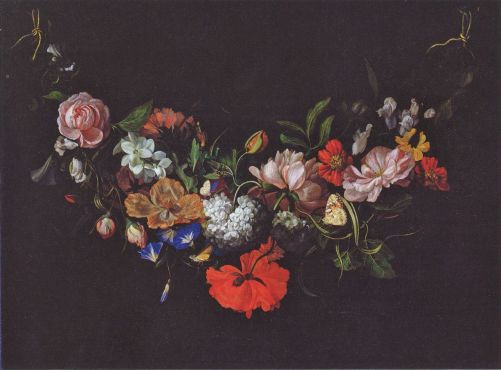
It would be good to see more ribbon grass grown in historical planting schemes, as it was clearly a valued garden plant in the past.  It associates well with herbaceous plants and creates pools of brightness next to evergreens.  Rachel Ruysch (1664 – 1750), a contemporary of Oosterwijck, also uses ribbon grass in her compositions –  the National Gallery and the Fitzwilliam Museum have examples of her paintings in their collections.  Well worth checking out on their websites (or better still, visit the galleries if you can).

Garland with blossoms 1683 Rachel Ruysch (Wikimedia Commons)

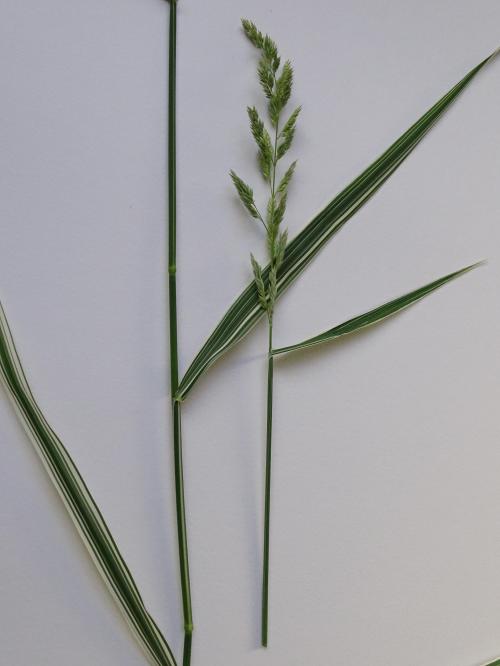
Phalaris arundinacea var. picta or Ribbon grass

Further Reading:

The Herball, or, Generall Historie of Plantes

Maria van Oosterijck

Rachel Ruysch

Rachel Ruysch at the National Gallery

Alistair Sooke on Dutch Flower Paintings

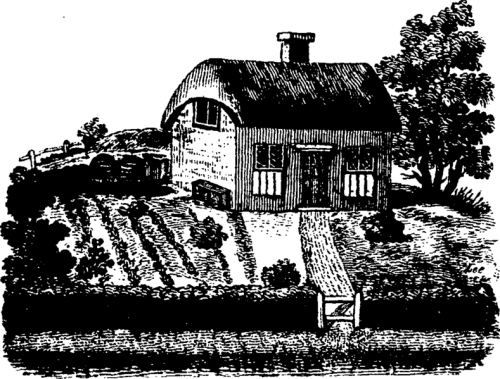
A Cottage and Garden

from An Account of a Cottage and Garden in Tadcaster. Sir Thomas Bernard, 1797 (Wikimedia Commons)

Picturesque cottages might be so disposed around a park, as to ornament and enliven the scenery with much more effect, than those misplaced gothic castles, and those pigmy models of Grecian temples, that perverted taste is so busy with: but it is the unfortunate principle of ornamental buildings in England that they should be uninhabited and uninhabitable.

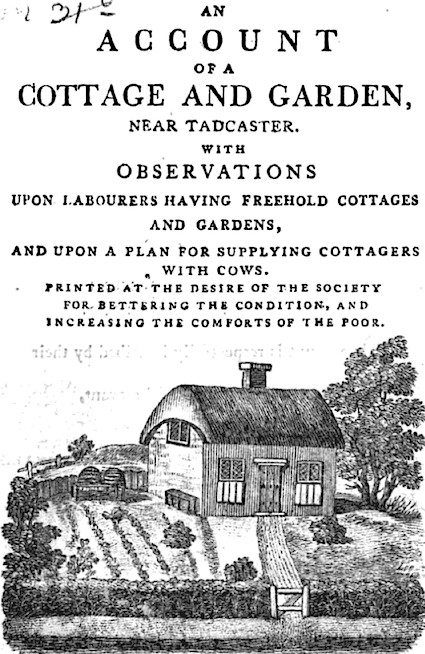
This impassioned call for landowners to reject the fashion for ornamental garden structures and build cottages on their estates instead, to address a rural housing shortage caused by inclosure, comes from the social reformer Sir Thomas Bernard’s fascinating text An Account of a Cottage and Garden in Tadcaster (1797).  It was published for the Society for Bettering the Condition and Increasing the Comforts of the Poor, a charity which Bernard helped to found.

The picturesque cottage garden is a powerful motif in English garden history.  The cottage garden represents a modest beauty, simplicity, a place of domestic production, supplying fruit, flowers and vegetables to the owners; perhaps some eggs, or honey.  It is unpretentious, a sanctuary, in harmony with nature and its surroundings; it possesses an essential integrity born out of hard work and self-reliance.  All these qualities are attractive, of course, and the cottage garden style is one many aspire to re-create today.

The first garden Bernard discusses belongs to Britton Abbot.  At the age of 67 Abbot is still working as an agricultural labourer.  The interview with Abbot takes place on a Saturday afternoon – his wife is sent to fetch him from a field where he is working a mile or so away.  Abbot’s fortunes had nearly collapsed when his previous house and land were enclosed.  He appealed to a local landowner, who gave him a strip of land upon which he was able to build his current house and establish the garden.  Without this generous assistance, it is likely Abbot and his family would have faced ruin.

Abbot’s garden is about a quarter of an acre and has a hedge enclosing the garden.  Cultivated by his wife and noted for its neatness, the garden contains, ‘fifteen apple-trees, one green gage, and three winesour plum-trees, two apricot-trees, several gooseberry and currant bushes, abundance of common vegetables, and three hives of bees’.

The produce the Abbots would expect to harvest annually from the garden amounts to, ‘about 40 bushels of potatoes, besides other vegetables; and his fruit, in a good year, is worth from £3 to £4 a year.  His wife occasionally goes out to work; she also spins at home, and takes care of his house and garden’.

Bernard appeals to other landowners to give land to working people to be used in the same way:

The quarter of an acre that Britton Abbot inclosed was not worth a shilling a year. It now contains a good house and a garden, abounding in fruit, vegetables, and almost every thing that constitutes the wealth of the cottager.  In such inclosures, the benefit to the country, and to the individuals of the parish, would far surpass any petty sacrifice of land to be required.  FIVE UNSIGHTLY, UNPROFITABLE, ACRES OF WASTE GROUND WOULD AFFORD HABITATION AND COMFORT TO TWENTY SUCH FAMILIES AS BRITTON ABBOT’S.

The second case study, contained in an Account of the produce of a Cottager’s Garden in Shropshire (1806) features Richard Millward’s garden.  Millward is a collier, and his wife Jane cultivates agricultural land, and a garden, which together amount to just over an acre.

The wife has managed the ground in a particular manner for thirteen years with potatoes and wheat, chiefly by her own labour; and in a way which has yielded good crops, and of late fully equal, or rather superior, to the produce of the neighbouring farms, and with little or no expense; but she has improved her mode of culture during the last six years.

Jane Millward has introduced the new cultivation method after becoming frustrated waiting for local farmers to have the time to plough the larger part of the garden for her.  Now she and her husband do all the work themselves.  In October, she sows wheat straight into the ground where potatoes have been, so the wheat over-winters in the ground.  Then the ground which has grown wheat in the previous year is dug for planting potatoes the following spring.  This excerpt gives an impression of the sheer hard work involved planting the potatoes:

The ground is dug for potatoes in the month of March and April, to the depth of about nine inches.  This digging would cost sixpence per pole, if hired.  After putting in the dung, the potatoes are planted in rows, about twelve or fourteen inches distant.  The dung is carried out in a wheelbarrow and it takes a great many days to plant the whole, generally ten days.  Her husband always assists in digging, after his hours of ordinary labour.

In the vegetable garden Jane plants peas, beans, cabbages and early potatoes for the family plus turnips which she boils for their pig.  Both accounts give us an unusual amount of detail about the gardens and the way they were arranged and used.

Sir Thomas Bernard (1750 – 1818) spent much of his working life on social projects to improve conditions for the poor.  He helped to establish the Society for Bettering the Condition and Increasing the Comforts of the Poor and was treasurer of the Foundling Hospital in London.  He also established a school for the blind.  He was an advocate of vaccination, rural allotments and was instrumental in obtaining consents for the building of the Regent’s Canal.

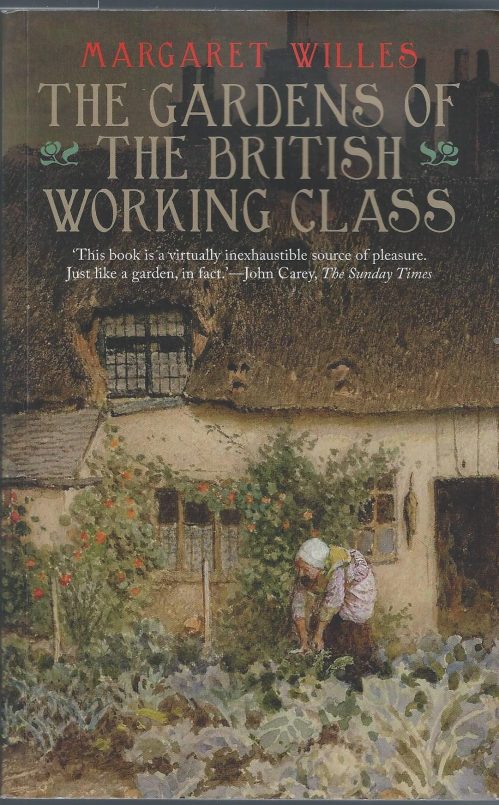
Below is a link to the 1806 version of Bernard’s text which is very short and well worth reading.  Also some contemporary images of rural scenes and cottage gardens and a link to Margaret Willes’s The Gardens of the Working Classes – an extraordinary survey of gardens belonging to ordinary working people in the UK.

An Account of a Cottage and Garden in Tadcaster. Sir Thomas Bernard, 1797 (Wikimedia Commons)

Account of Britton Abbot’s cottage and garden : and of a cottager’s garden in Shropshire : to which is added Jonas Hobson’s advice to his children, and the contrast between a religious and sinful life. 1806 (Biodiversity Heritage Library)

The Natural History of Selborne 1789 (The Wellcome Library)

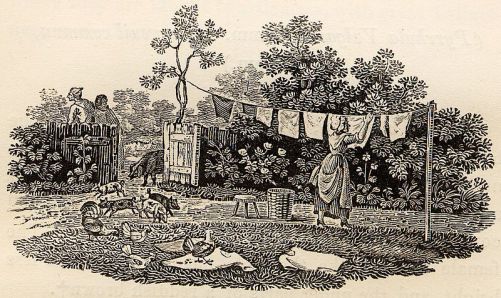
Hanging Washing with Pigs and Chickens 1797 Thomas Bewick (Wikimedia Commons)

Wheat, beans, peas

published by Yale University Press

Account of Britton Abbot’s Cottage and Garden 1806

(from the Biodiversity Heritage Library)

Sir Thomas Bernard

The Gardens of the British Working Class

Some English Trees

from The Herball, or, Generall historie of plantes John Gerard 1597

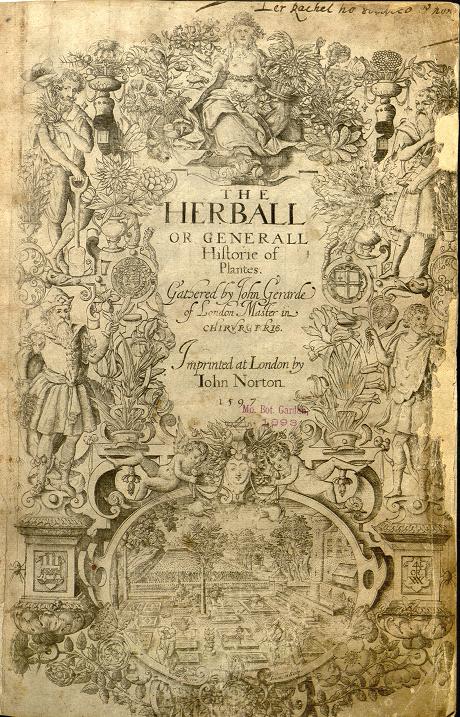
Early March is when we anticipate blossom and the unfurling of new leaves, marking the arrival of spring.  With snow now covering the trees and the landscape, spring is some way off.  But as trees begin their new cycle of growth, it still feels like a good time to revisit John Gerard’s Herball, or, Generall Historie of Plantes (1597), to renew our acquaintance with our native trees and appreciate their place in England’s cultural history.

According to the Woodland Trust more than four fifths of us can’t identify an ash tree from its leaves and almost half cannot recognise an oak, underlining our profound disconnection from the natural world.  The close connection between plants and people is inescapable in  Gerard’s Herball.  Pre-industrial society’s knowledge of local plants is linked to dependence on them for immediate needs, such as building materials, technology, food and medicine.

Amongst Gerard’s entries for trees we discover the wood of the alder tree was used for guttering because it is slow to rot and elm was used for making arrows and wheels.  The boughs of the common willow were brought into the sick chamber for those suffering from fevers and oak apples were ‘read’ to divine the future.

Gerard’s Herball is a survey of the plants known in England in the late 16th century and is quite unlike a scientific book published today.  Gerard’s commentary on each plant is delivered in a personal, anecdotal manner, mentioning plants growing in his own garden and reporting observations of other plant enthusiasts and growers.

The stylised illustrations generally show a branch of each tree with detail of the leaves, flowers and fruits, representing the tree in all the stages of its growing season.  The overall shape of the tree is not usually depicted, although some illustrations show a trunk with roots, and one over-large branch as the canopy, which is actually a twig, showing detail of the plant.  The rectangular illustrations are without a border, but are filled to their corners with a profusion of closely observed foliage, flowers and fruits.

Here are Gerard’s observations of some of our most common tree species.  I’ve included the elm tree which was once common in the UK, but now largely absent as a result of Dutch elm disease.  Recently I read the elm has returned to London as a street tree in Bond Street, so perhaps one day this tree will once more take its place in the English landscape?

The Birch Tree  Betula

from The Herball, or, Generall historie of plantes John Gerard 1597 (images via Biodiversity Heritage Library)

The common Birch tree waxeth likewise a great tree, having many boughes beset with many small rods or twigs, very limber and pliant: .. the rinde of the body or trunke is harde without, white, rough, and uneven, full of chinkes or crevices: under which is founde another fine barke, plaine, smooth, and thinne as paper, which heeretofore was used insteede of paper to write upon, before the making of paper was knowne; in Russia & those colde regions, it serveth insteede of Tiles and Slate to cover their houses withall:

in times past the magistrates rods were made heerof: and in our time also the scholmasters and parents do terrifie their children with rods made of Birch.

The Common Oke  Quercus vulgaris.
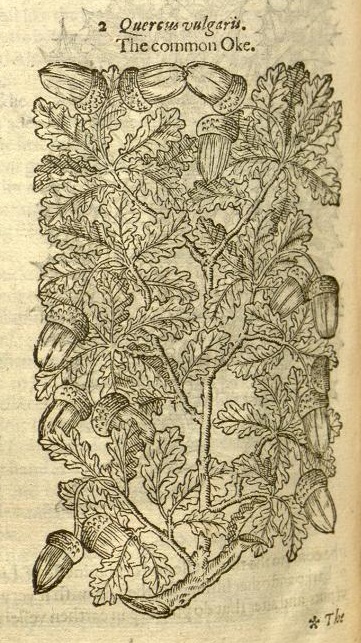
from The Herball, or, Generall historie of plantes John Gerard 1597

Gerard records oak apples being used as a means of predicting events in the coming year:

The Oke Apples being broken in sunder about the time of their withering, do foreshewe the sequell of the yeere, as the expert Kentish husbandmen have observed by the living things founde in them: as if they finde an Ant, they foretell plentie of graine to insue; if a white worm like a Gentill or a Maggot, then they prognosticate murren of beasts and cattle; if a Spider, then (saie they) we shall have a pestilence or some such like sicknes to followe amongst men: these things the learned also have observed and noted; for Mathiolus writing upon Dioscorides saith, that before they have an hole thorough them, they conteine in them either a flie, a spider, or a worme; if a flie, then warre ensueth, if a creeping worme, then scarcitie of victuals; if a running spider then followeth great sicknes or mortalitie.

The Beech Fagus.
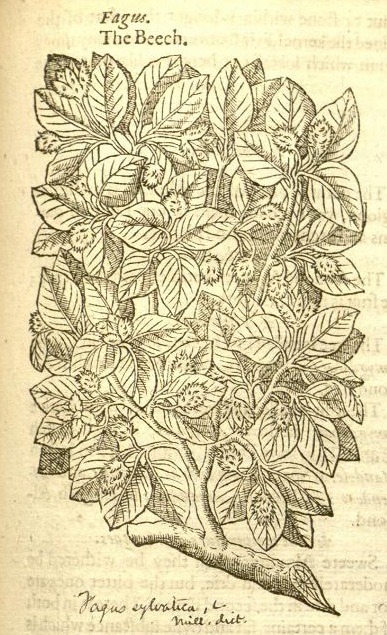
from The Herball, or, Generall historie of plantes John Gerard 1597

The Beech is an high tree, with boughes spreading oftentimes in maner of a circle, and with a thick body, having many armes: the barke is smooth; the timber is white, harde, and very profitable: the leaves be smooth, thinne, broad .. the catkins, or blowings be also lesser and shorter then those of the Birch tree, and yellow: the fruite or Maste is contained in a huske or cup that is prickly, and rough bristled; .. the rootes be fewe, and grow not deepe, and little lower then under the turfe.  

The Beech flowereth in April and May, the the fruit is ripe in September, at what time the Deere do eate the same very greedily, as greatly delighting therein, which hath caused forresters and huntsmen to call it Buckmast.

The Alder Tree  Alnus
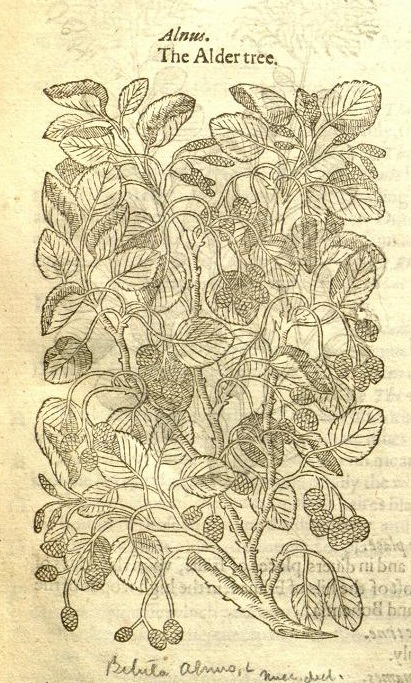
from The Herball, or, Generall historie of plantes John Gerard 1597

The Alder tree or Aller, is a great high tree having many brittle branches, and the barke is of a browne colour, the wood or timber is not hard, and yet it will last and endure very long under the water, yea longer than any other timber whatsoever: wherefore in the fennie and soft marrish grounds, they do use to make piles and posts thereof, for the strengthening of the wals and such like.  This timber doth also serve very well to make troughes to convey water in steade of pipes of Lead.

The Ash Tree  Fraxinus
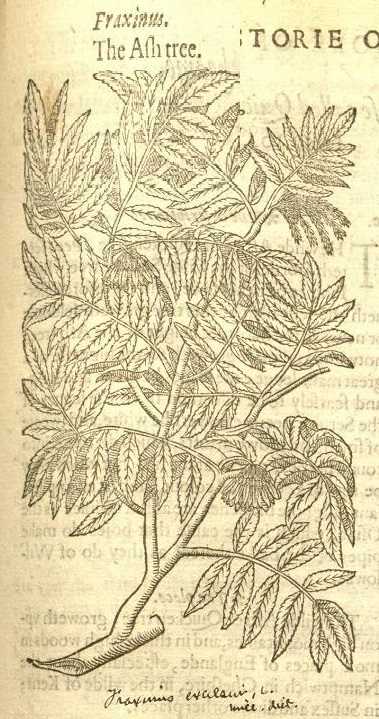
from The Herball, or, Generall historie of plantes John Gerard 1597

The Ash also is an high and tal tree; it riseth up with a straight body, and then of no smal thicknesse, commonly of a middle size, and is covered with a smoothe barke: the woode is white, smooth, hard, and somewhat rough grained:

The fruite .. is termed in English Ashkeies, and of some Kitekeies.  The seede or Kitekeies of the Ash tree provoke urine, increase naturall seede, and stirreth up bodily lust, especially being powdred with nutmegs and drunke.

The common Willow  Salix
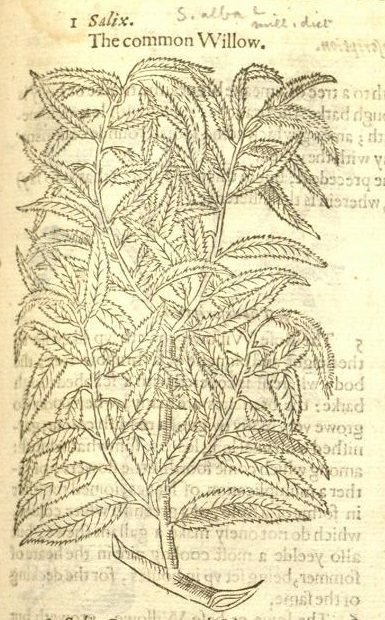
from The Herball, or, Generall historie of plantes John Gerard 1597

The common Willow is an high tree, with a body of a meane thicknes, and riseth up as high as other trees do if it not be topped in the beginning , soon after it is planted; the bark thereof is smooth, tough, and flexible; the wood is white, tough and hard to be broken: the leaves are long, lesser, and narrower, than those of the Peach tree, somewhat greene on the upper side and slipperie, and on the neather side softer and whiter;

The greene boughs with the leaves may very well be brought into chambers, and set about the beds of those that be sicke of agues; for they do mightily coole the heate of the aire, which thing is a woonderful refreshing to the sicke patients.

The Elme tree and the Elme with broad leaves Ulmus, Ulmus latifolia.
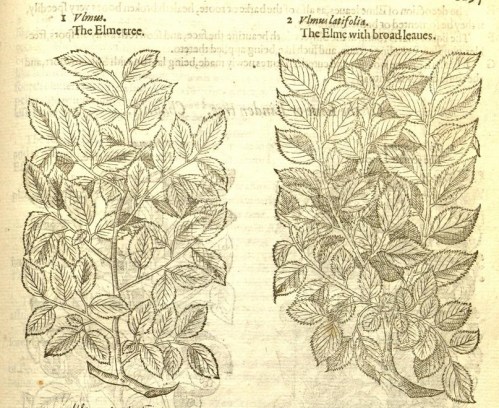
The first kinde of Elme is a great high tree, having many branches spreading themselves largely abroad: the timber of it is hard, and not easie to be cloven or cut in sunder.  The leaves are somewhat wrinkled and snipt about the edges .. This tree is very common in our countrie of England: the leaves of this Elme are pleasant fodder for divers fowerfooted beasts, and especially for kine and oxen.

The second kinde of Elme groweth likewise unto a great stature, with very hard and tough timber, whereof are made arrowes, wheeles, mill pullies and such other engins for the carriage of great waights and burthens.

The common Elder tree  Sambucus.
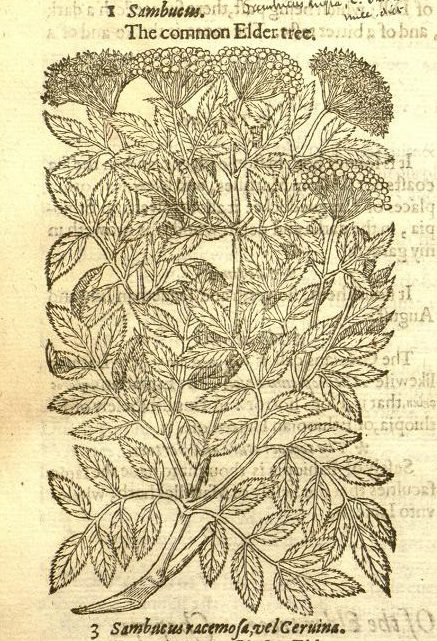
from The Herball, or, Generall historie of plantes John Gerard 1597

The common Elder groweth up now and then to the bignes of a meane tree, casting his boughs all about, and oftentimes remaineth a shrub;  .. little berries, greene at the first, afterwards blacke, whereout is pressed a purple juice, which being boyled with Allom and such like things doth serve very well for the Painters use,

The Hawthorne tree Oxyacanthus.

from The Herball, or, Generall historie of plantes John Gerard 1597

The Hawthorne groweth in woods, & in hedges neer unto high waies almost everie where.  .. many do call the tree it selfe the May bush, as a chiefe token of the comming in of May:  .. the fruite is ripe in the beginning of September, and is a food for birdes in winter.

Herball, or, Generall Historie of Plantes  via the Biodiversity Heritage Library  (Trees begin at around page 1146)

Wikipedia John Gerard

The Woodland Trust tree identification quiz


Camellias from Curtis’s Botanical Magazine

from Curtis’s Botanical Magazine Vol 2, 1788  (illustration 42)  Camellia japonica (Rose camellia)  ‘This most beautiful tree .. is a native of both China and Japan.  Thunberg, in his Flora Japonica, describes it as growing every where in the groves and gardens of Japan, where it becomes a prodigiously large and tall tree, highly esteemed by the natives for the elegance of its large and very variable blossoms, and its evergreen leaves; it is there found with single and double flowers, which also are white, red and purple, and produced from April to October.’  (All images via the Biodiversity Heritage Library)

February and March is the time when camellias start to bring colour and glamour to the spring garden.  Native to southern and eastern Asia, the camellia was grown as an ornamental plant in China and Japan for centuries before it was collected and introduced to England in the 1730s.  Robert James Petre (1713 – 42) is said to have raised the first camellia to flower in his hothouses at Thorndon Hall, Essex.

In the late 18th and early 19th century cultivation in glasshouses was the typical method of growing these plants.  The conservatory at Chiswick House houses a camellia collection grown in this way.  As camellias were rare and expensive plants, no one wanted to take any risks with their hardiness by planting them outside.  As William Curtis observes in the second volume of his Botanical Magazine published in 1788,

With us, the Camellia is generally treated as a stove plant, and propagated by layers; it is sometimes placed in the greenhouse; but it appears to us to be one of the properest plants imaginable for the conservatory.  At some future time it may, perhaps, not be uncommon to treat it as a Lauristinus or Magnolia: the high price at which it has hitherto been sold may have prevented its being hazarded in this way.  

As well as correctly predicting that the camellia was probably hardier than it might have looked, Curtis also discusses the way that camellias often drop their flowers in their entirety before they are fully finished and records the practice of collecting these blooms and re-attaching them to the plants.

The blossoms are of a firm texture, but apt to fall off long before they have lost their brilliancy; it therefore is a practice with some to stick such deciduous blossoms on some fresh bud, where they continue to look well for a considerable time.

Seems strange to us now, but maybe not the worst February garden job for the 18th century gardener?

The similarity of the shape of the camellia flower to that of the rose is noted by Curtis in his list of synonyms for the plant which is listed as Rosa chinensis.

William Curtis (1746 – 1799) started his career as an apothecary, but his interest in botany and natural history soon caused him to change direction and focus on botany and horticulture full time.  He was the director of the Chelsea Physic garden from 1771 – 77 and then established his own botanic garden in Lambeth in 1779.  He published Flora Londinensis in six volumes between 1777 – 1798.  Illustrated in colour, the book records all the wild plant life then growing in the environs of London.

Flora Londinensis was not a commercial success, but provided a model for Curtis’s Botanical Magazine, which Curtis launched in 1787.  Using broadly the same format as his book, the magazine features a full page colour illustration of an exotic plant with a page of botanical information written in a scientific but accessible style that a non-specialist audience could understand.  The magazine was very popular, the public showing greater appetite for curious and rare specimens than the wildflowers and weeds on their doorsteps.  The magazine is also a fascinating record of when plants were introduced to England and which nurseries, gardens or individuals were cultivating them.  The magazine is still published today by Kew Gardens.

A long line of distinguished botanical artists have supplied illustrations to the magazine.  Sydenham Edwards and James Sowerby were early contributors, and from the mid 1820s Walter Hood Fitch was the principal artist for some forty years.

There is still a belief today that camellias can be rather tender and tricky to cultivate, when in fact these plants are pretty tough garden characters.  In the City of London where I garden the tall buildings generate strong localised gales which can shred broad leaved plants.  The camellias, however, take this battering in their stride with their dark waxy leaves impervious to dessicating winds.  Passers by always admire the largest camellia in the garden (possibly Camellia japonica ‘Governor Mouton’) with its red and white double flowers which begin in late January.

Although still popular with the public, camellias don’t seem to be favoured by today’s garden designers.  I wonder if this is because the dark green foliage creates a rather formal effect together with the waxy flowers which don’t fit easily into the current fashion for naturalistic looking planting schemes?  It’s a shame as they do have advantages.  As evergreen shrubs they provide all year round structure and do well in shade, making them especially useful in town gardens shadowed by neighbouring buildings and trees.  They also grow well in containers.  Some of the white, single flowered varieties could be integrated into a naturalistic planting scheme, such as Camellia rosthorniana ‘Elina’ which has a pink tinge to the flowers, like apple blossom.

On the minus side, the red and pink flowered varieties can be problematic in the spring garden, as they clash with yellow flowers like daffodils.  Also, not all camellia varieties shed their flowers, so to keep the plants looking fresh, they need to be dead headed regularly.

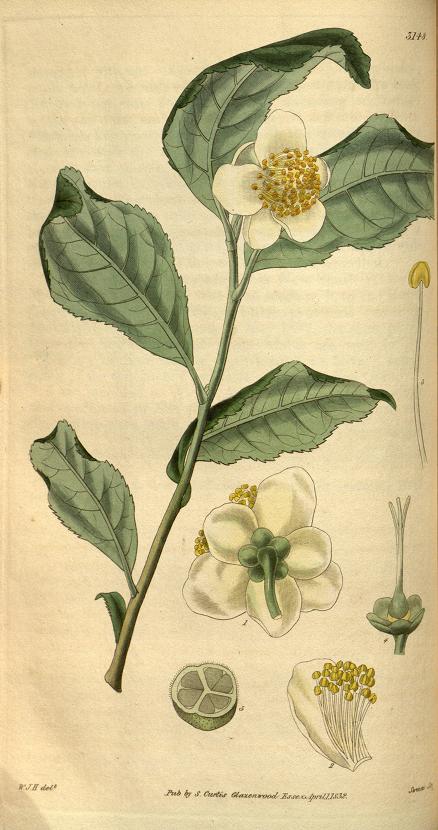
A world without camellias would be a sad place, however, as it would mean life without tea, that essential drink derived from the leaves of Camellia sinensis.  An entry in the magazine for 1832 shows the tea plant accompanied by a discussion about tea production in China and tea consumption around the world.

I particularly like the details about the growers of camellias attached to the illustrations in the Magazine – a few samples appear below:

from Curtis’s Botanical Magazine 1814 (illustration 1670) Camellia japonica var myrtifolia (myrtle leaved red camellia)  ‘For this very rare and beautiful variety of camellia we are indebted to Messrs. Chandler and Buckingham, Nurserymen at Vauxhall.  The flower is round and compact, with the inner petals gradually diminishing in size; approaching, except in colour, to the Bourbon or double white variety.’

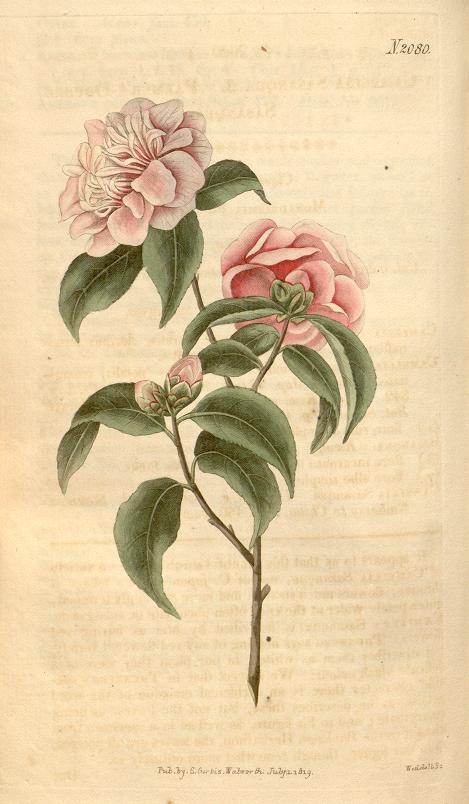
from Curtis’s Botanical Magazine 1817 – 19 (illustration 2080) Camellia sasanqua (Palmer’s Double Sasanqua) ‘Our drawing, as well as a living specimen of the blossom and foliage, was kindly communicated by Mrs T Palmer, of Bromley, in Kent, in whose greenhouse the original flowered last spring.  It was brought from China by Captain Rawes, together with several other curious and rare plants.’

from Curtis’s Botanical Magazine 1825 (illustration 2571) Camellia japonica var. Chandler’s New Camellia  ‘This variety was raised from seed by Messrs. Chandler and Buckingham at their nursery, Vauxhall.’

from Curtis’s Botanical Magazine 1825 (illustration 2577)  Camellia japonica var. Knight’s New Warratah Camellia  ‘This variety of Camellia japonica was raised, by Mr Joseph Knight, by seeds procured from the Warratah, or Anemony-flowered variety, impregnated probably by the pollen of of semi-double variety, at the Exotic Nursery, in the King’s Road.’

from Curtis’s Botanical Magazine 1832  Thea virdis (Green Tea) (now named Camellia sinensis) (illustration 3148)  ‘A shrub, rising to the height of eight to ten feet in the conservatory of the Botanic Garden of Glasgow.’  ‘Flowers .. upon a short peduncle, drooping, so that the flower is scarcely to be seen but by looking at the underside of the branches.’

Camellia Show at Chiswick House 22nd February – 25th March 2018

Camellia Show at Chiswick House

William Curtis

(NB. images from Curtis’s Botanical Magazine can be found on the Biodiversity Heritage Library’s Flickr Collection – link below)

Biodiversity Heritage Library


Blood Oranges

The beginning of February is the height of the season for citrus fruits.  My favourite of these is the blood orange and part of the attraction as well as the taste is the paper that some of these fruits are wrapped in.  Typically a box of oranges will contain a few wrapped fruit, adding to the overall attractiveness of the container.  The wrapping also turns an orange into a small gift.

I’m heartened to see that Pinterest has many collectors of these vernacular advertising artworks.  Mark Denton Esq has some particularly beautiful examples and I include a link to these at the end of this post.  The papers in my own collection are mostly from Sicily which is a traditional centre for cultivation of the blood orange and are often (but not always) red like the flesh of the fruit they enclose.  The central image is always circular so when wrapped around the fruit the roundness of the orange is emphasised.

The first design shows a luscious looking orange, against a golden sunburst design – suggesting the rays that ripened the fruit or maybe the burst of flavour experienced from the first mouthful of the orange itself.  Other designs include an antelope, a red heart set in a golden sunburst and a red rose.  Agri Etna’s wrapper shows a view of the great volcano with images of strawberries and prickly pear fruits – presumably also produced by these growers.

The red tinged flesh of the blood orange is caused by the presence of anthocyanin which is an anti-oxidant found in many fruits, but unusual in the orange family.  The red colour develops when the fruits are exposed to low night temperatures.  I wonder if this might explain why some of the fruits are unevenly coloured inside – perhaps the side of the fruit most exposed to cold on the tree develops a deeper coloured flesh?

In the UK most of our blood oranges are from Valencia or Sicily, but they are also widely grown in California.  These are not always the largest or sweetest oranges – but have a pleasing intensity to their flavour.  When we stayed in Venice a few years ago the hotel served blood orange juice for breakfast that was dark – almost beetroot coloured.  This juice may well have been from the Moro blood orange – a relatively new variety with the deepest colour and a sharp taste.

Not always the easiest fruit to find in supermarkets, our local Turkish grocer is currently selling three for a pound.  Bargain!

Mark Denton’s Fruit Wrappers

(See also Mark’s potato sack collection!)

The Blood Orange – Wikipedia

English Garden Style in 18th century Paris

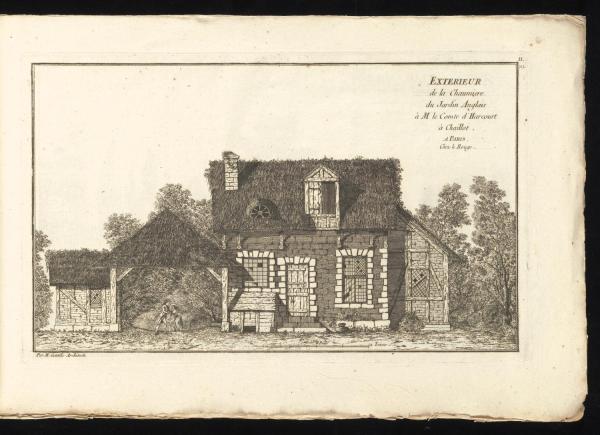
From Des Jardins Anglo-Chinois à la mode. Exterieur de la Chaumiere du Jardin Anglais.  Le Rouge 1784  (from the Getty Research Institute via the Biodiversity Heritage Library)

This tumbledown 18th century English cottage, from Des Jardins Anglo-Chinois à la mode published in 1784, a few years before the beginning of the French Revolution, is not actually in England at all, but in France.  A constructed feature in a fashionable English style garden in Paris, it belonged to one M Le Comte d’Harcourt.

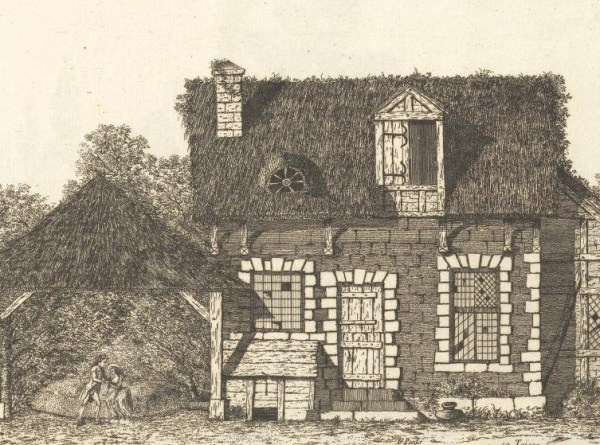
At first glance the building looks like it might be authentic; the stone surrounds around the door, windows and side of the building could be English, but the windows (artfully broken in places) are an unlikely patchwork of different sized leaded lights. The jumble of outbuildings don’t seem to match the central cottage and the round window in the roof that might be made from a wheel doesn’t look convincing as an example of English vernacular style.

And who is the couple in front of this structure?  Their pose seems too romantic for them to be children, but if they are adults they are strangely out of scale with the buildings.  These little people are scarcely as tall as the dog house next to the front door.

detail from Des Jardins Anglo-Chinois à la mode.  Exterieur de la Chaumiere du Jardin Anglais. Le Rouge 1784 (from the Getty Research Institute via the Biodiversity Heritage Library)

Des Jardins Anglo-Chinois à la mode is, as the title suggests, a pattern book of fashionable garden plans from all over Europe, consisting of both existing gardens and generic plans from a range of designers, and an array of features such as temples, kiosks, Chinese buildings, mosques, lakes, etc from which wealthy clients could select ideas.

The author George-Louis Le Rouge (1707 – 1790) developed and collated this vast project over many years from 1770 – 1787 as a series of 21 cahiers.  The V&A has an almost complete set of these in their collection (see below for link).  Biographical details for Le Rouge are somewhat sketchy, but as well as his work as a cartographer and engraver, he appears to have been employed as a civil engineer (ingénieur géographe) for Louis XV.

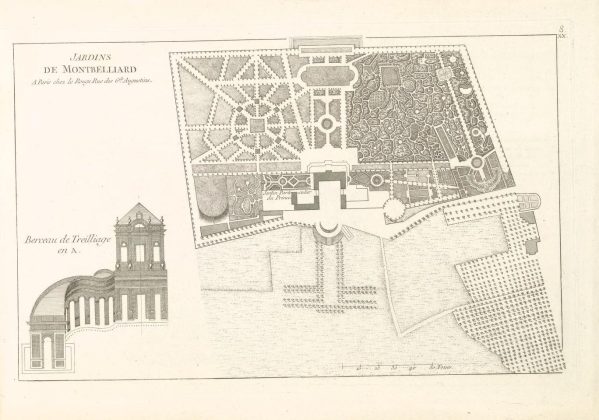
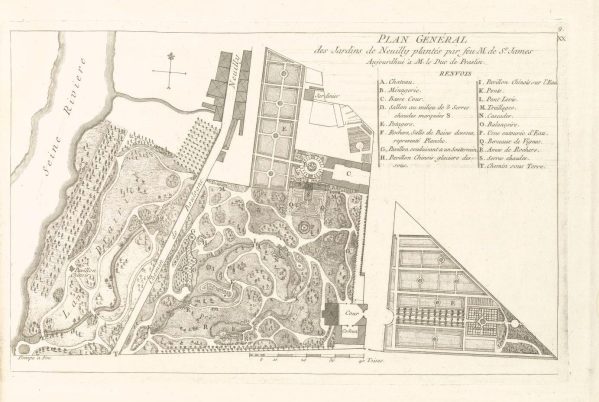
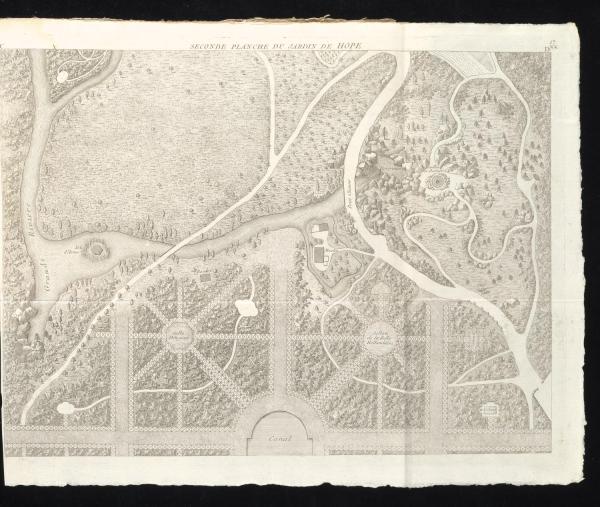
Des Jardins Anglo-Chinois à la mode shows how fashionable the English landscape garden had become in France, and in other parts of Europe.  A selection of plans for Jardins Anglais in Paris and Amsterdam shows a range of ways in which the English garden style was implemented.  Some gardens adopt the English style wholesale throughout the garden while others retain their formal French parterre gardens close to the house with the rest of the grounds divided to sections for an English garden, Chinese garden, and so on.  One garden design by le Rouge at Montbelliard has half of the garden in English style with the other half in formal style.

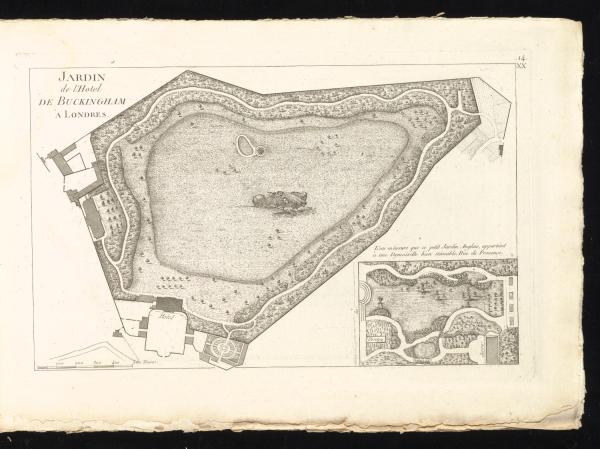
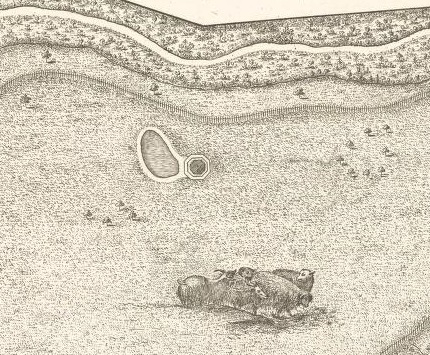
One of the examples of English gardens included in the book is the Jardin de l’Hotel Buckingham à Londres (which it took me some time to realise is Buckingham Palace).  The plan shows a relatively simple garden design with a perimeter path winding through a planting of shrubs and trees.  The central area is a fenced field for sheep with a pond and shelter.  As with the people outside the cottage, these sheep are also curiously out of scale with their surroundings, this time being too large.

Jardin de l’Hotel Buckingham à Londres from Des Jardins Anglo-Chinois à la mode. Le Rouge 1784  (from the Getty Research Institute via the Biodiversity Heritage Library)

Megafauna roaming the Jardin de l’Hotel Buckingham à Londres from Des Jardins Anglo-Chinois à la mode. Le Rouge 1784  (from the Getty Research Institute via the Biodiversity Heritage Library)

Whatever the individual style of these gardens, it’s hard to avoid a unifying thread of ostentation and the conspicuous show of wealth.  Studded with exotic buildings, plants, bridges, rocky caves, and temples these are luxurious theme parks.  What did they represent to ordinary people?  Another very visible example of the gulf between the super-rich and the poor?  It’s a reminder that grand gardens aren’t neutral spaces – they have a political context.

There’s a link to Des Jardins Anglo-Chinois à la mode at the end of this post via the Biodiversity Heritage Library.  It’s an incomplete version, but well worth viewing to see these (and many more) images in a larger format than is possible here.

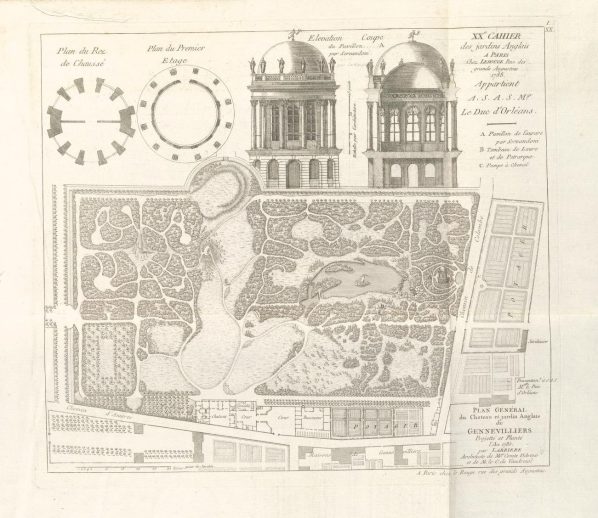
Plan Général du Chateau et Jardin Anglais de Gennevilliers l’An 1785 par Labriere (from the Getty Research Institute via the Biodiversity Heritage Library)

Jardin Anglais Utile et Agréable  de l’Hotel de Cassini rue de Babilone   (from the Getty Research Institute via the Biodiversity Heritage Library)

Superbe Jardin Anglais  Projetté par Bettini, pour être executé dans l’Environs de Paris  (from the Getty Research Institute via the Biodiversity Heritage Library)

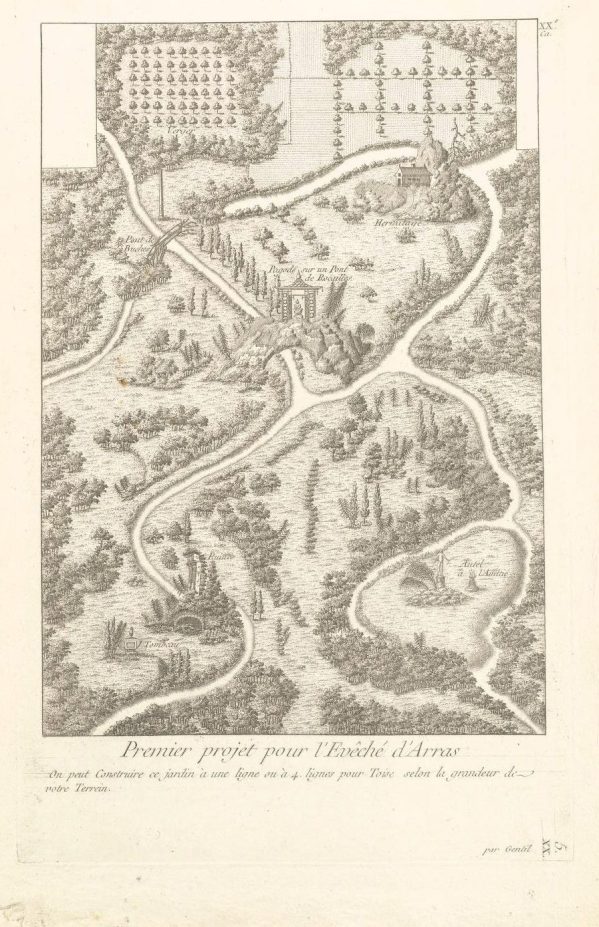
Premier Projet pour l’Evêché d’Arras   (from the Getty Research Institute via the Biodiversity Heritage Library)

Jardin Episcopal d’Arras  (from the Getty Research Institute via the Biodiversity Heritage Library)

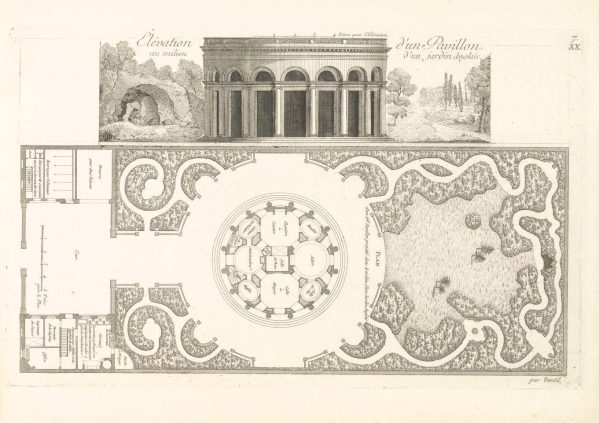
Élévation d’un Pavillion au millieu d’un Jardin Anglais  (from the Getty Research Institute via the Biodiversity Heritage Library)

Jardins de Montbelliard a Paris chez le Rouge, Rue des Gds. Augustins  (from the Getty Research Institute via the Biodiversity Heritage Library)
Plan Général des Jardins de Neuilly  (from the Getty Research Institute via the Biodiversity Heritage Library)

Projet de Jardins Anglais pour M. Hope d’Amsterdam   (from the Getty Research Institute via the Biodiversity Heritage Library)

Projet de Jardins Anglais pour M. Hope d’Amsterdam   (from the Getty Research Institute via the Biodiversity Heritage Library)

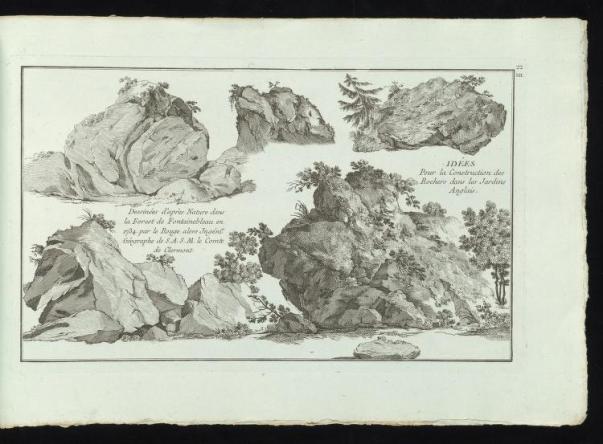
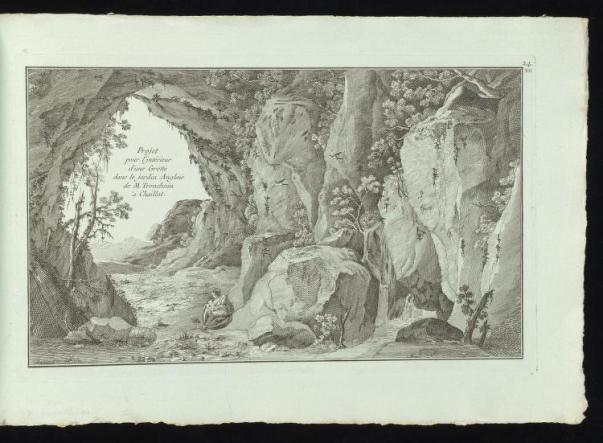
Idées Pour la Construction des Rochers dans les Jardins Anglais   (from the Getty Research Institute via the Biodiversity Heritage Library)

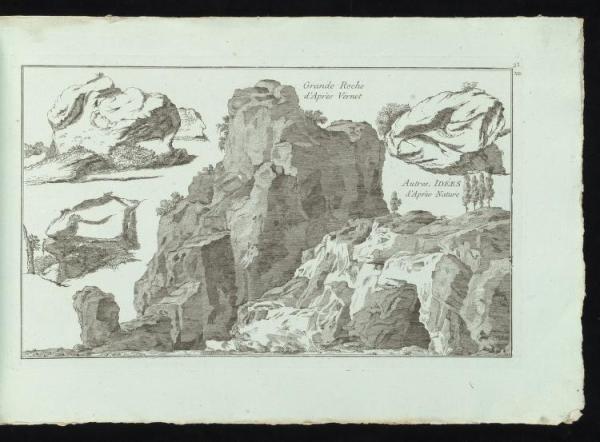
(from the Getty Research Institute via the Biodiversity Heritage Library)

(from the Getty Research Institute via the Biodiversity Heritage Library)

Des Jardins Anglo-Chinois a la mode

Le Rouge at the V&A

Cold Remedies from Culpeper

Illustration from Culpeper’s English Family Physician: or medical herbal enlarged with several hundred additional plants principally from Sir John Hill medicinally and astrologically arranged, after the manner of Culpeper : and, a new dispensatory from the ms. of the late Dr. Saunders (1792) (from the library of the Royal College of Physicians, London via the Biodiversity Heritage Library).

As January brings its seasonal coughs, colds, chills, and fevers what does Culpeper’s Herbal suggest by way of a remedy?  Plenty as it turns out –  feverfew, poppies, and verbascum, to name but a few – are said to offer some relief to the sufferer.

Culpeper’s Complete Herbal which is still in print today was first published in 1652 as The English Phyisitian.  Priced at three pence Nicholas Culpeper’s purpose was to make accessible to the public information about the medicinal properties of plants that were readily available, and teach them how they might use these to treat common illnesses. Culpeper also encouraged others to help those who could not afford to pay high fees for medical treatment – as we see in the entry for butterbur which suggests that gentlewomen might preserve some of the root to share with their poor neighbours.

Published without illustrations, which would have made The English Physitian too expensive for ordinary people to buy, Culpeper gives instead detailed descriptions of most plants, although he considers some ‘so generally known to most people that I shall not trouble you with a description thereof’.  Later editions of the book expanded the list of plants, as new plants were introduced, and some carry illustrations.  According to the University of Virginia, over 40 editions have been published.

Culpeper (1616-1654) trained as an apothecary and set up his practice in Spitalfields, just outside the city of London.  His translation of the official textbook for pharmacy, the Pharmocopoeia Londinenis from Latin to English challenged the authority of the medical establishement and made Culpeper a hugely controversial figure.

Readers of the herbal will notice that Culpeper’s philosophy of medicine is informed in part by astrology.  It’s worth remembering that modern medicine, based on the science of anatomy, biology, pharmacy, pharmacology, and psychology, is very different to to the systems of belief that underpinned medicine in the 17th century.

In Culpeper’s time conventional medicine was based on a belief in the four humours, earth, air, fire and water.  Developed in Ancient Greece this system taught that a balance of the four humours was needed for good health, and that an imbalance was the cause of disease.  Treatments were an attempt to restore a correct balance.  Diseases and their medicines like plants and minerals were classified by their ‘temperature’; so that garlic, considered ‘vehement hot’ by Culpeper, was effective against ‘cold’ diseases such as ‘jaundice, falling-sickness, cramps, convulsions, the piles or hemorrhoids’.

Another system which ran alongside the belief in humours was astrological physick which held that the twelve signs of the zodiac, the sun, moon and planets were influential over different parts of the body.  Simon Forman (1552-1611) and Richard Napier (1559-1634) were well known astrologer-physicians of their day.  Napier was a clergyman as well as an astrologer, showing the overlap that was tolerated at this time between Christianity and astrology.  Their case notes are preserved in the Bodleian Library (see link at the end of this post).

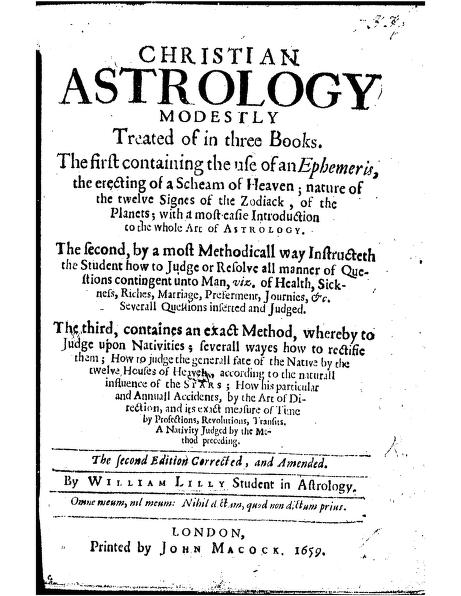
William Lilly (1602-1681) published Christian Astrology in 1647 which includes a section on health and disease and explains how the aspiring astrologer could create charts to find out ‘whether the Disease will be long or short’ or ‘whether the sick would live or die’.  Lilly lists over 80 plants that can be used to treat disease.

Christian Astrology by William Lilly (2nd Ed 1659)  from archive.org

Astrological chart showing whether a sick person would live or die. Christian Astrology by William Lilly, (2nd Ed 1659)  from archive.org

Here follow some cold remedies from Culpeper’s English Family Physician (1792), which contains hand coloured illustrations.  (Personally, I would hesitate to try any, before understanding if the plant is toxic, or if it could react adversely with any other medicines you might be taking.)

Elecampane  (top picture)    It is under Mercury.  The fresh roots of Elecampane preserved with sugar, or made into a syrup or conserve, .. help the cough, shortness of breath, and wheezing in the lungs.

Butterbur    It is under the dominion of the Sun, and therefore is a great strengthener of the heart and cheerer of the vital spirits;  .. the decoction of the root, in wine, is singular good for those that wheeze much, or are short-winded.  It were well if gentlewomen would keep this root preserved to help their poor neighbours.  It is fit the rich should help the poor, for the poor cannot help themselves.

Poppy   The herb is Lunar; and a syrup is made of the seed and flowers, which is useful to give sleep and rest to invalids, and to stay catarrhs and defluxions of rheums from the head into the stomach and lungs, which causes a continual cough, the forerunner of comsumption;

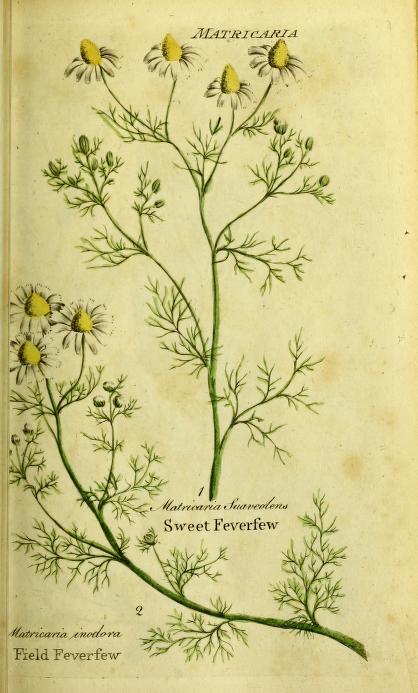
Feverfew    Venus commands this herb .. The decoction thereof, made with some sugar or honey put thereto, is used by many with good success to help the cough and stuffing of the chest, by colds; 

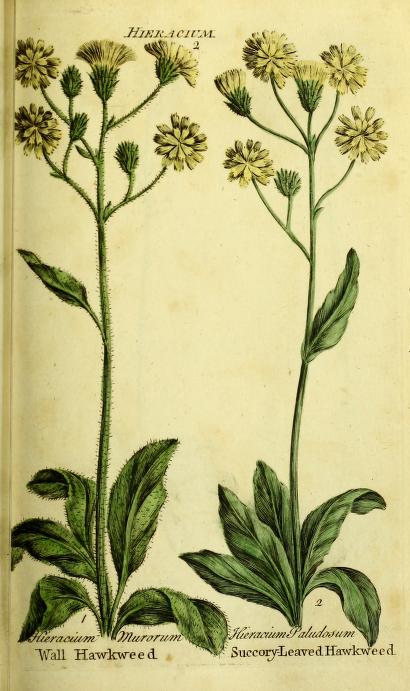
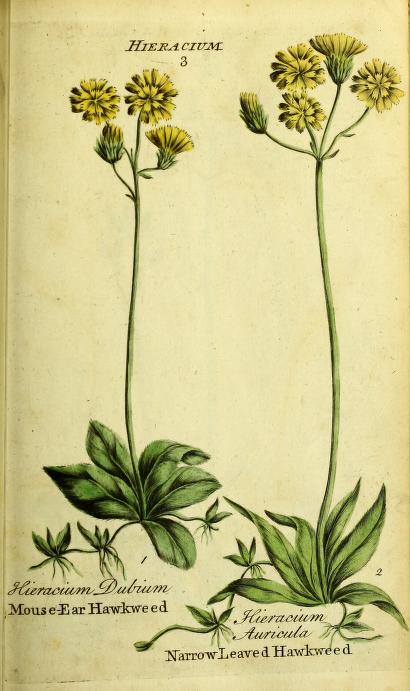
Hawkweed    Saturn owns it.  The decoction of the herb taken in honey digests phlegm and with hyssop helps the cough.

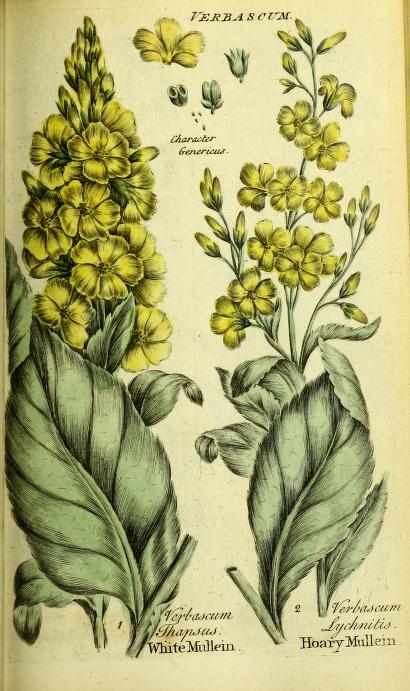
Verbascum  or Mullein   It is under the dominion of Saturn.  A decoction of the leaves, with sage and marjoram, and camomile flowers, and the places bathed therewith, is good for colds, stiff sinews, and cramps.

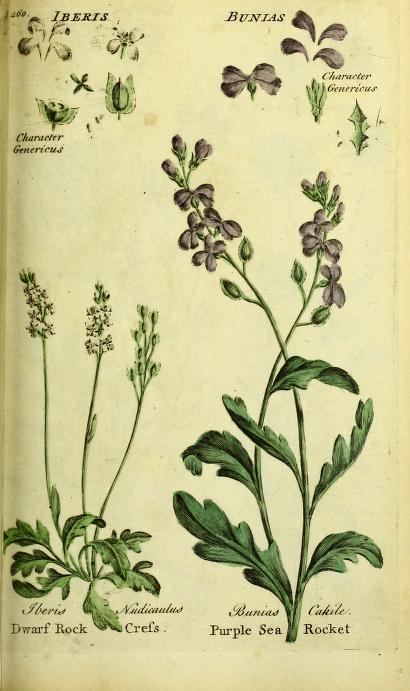
Purple Sea Rocket  It is a martial plant, of a hot nature, and bitterish taste, opening and attenuating, good to cleanse the lungs of tough, viscid phlegm

Sheep’s Rampion   It is under the dominion of Mercury, and of a bitter, light, astringent quality, excellent in disorders of the breast, such as coughs, asthmatic affections, difficulty of breathing, &c, for which purpose an infusion of the flowers is the best preparation.

Silverweed    This plant is under Venus, and deserves to be universally known in medicine.  An infusion of the leaves .. sweetened with a little honey is an excellent gargle for sore throats.

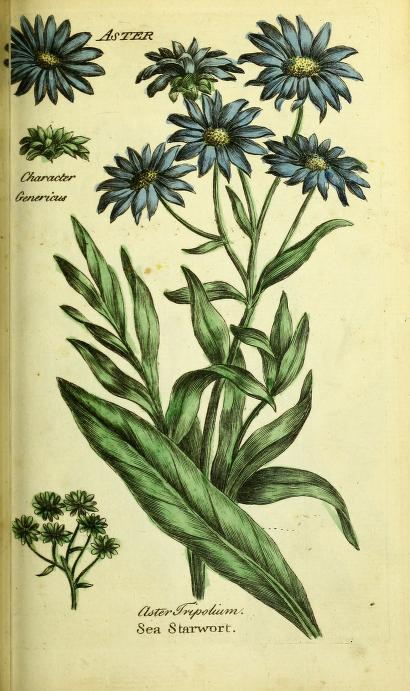
Sea Starwort   This is under the dominion of Mercury.  A slight tincture or infusion of the plant promotes perspiration, and is good in feverish complaints.

Field Scabious, Lesser and Greater   Mercury owns the plant.  It is effectual for all sorts of coughs, shortness of breath, and all other diseases of the breast and lungs, ripening and digesting cold phlegm, and other tough humour, voiding them forth by coughing and spitting;

Illustration from Culpeper’s English Family Physician (1792) (from the library of the Royal College of Physicians, London via the Biodiversity Heritage Library).

Illustration from Culpeper’s English Family Physician (1792)  (from the library of the Royal College of Physicians, London, via the Biodiversity Heritage Library)

Illustration from Culpeper’s English Family Physician (1792) (from the library of the Royal College of Physicians, London via the Biodiversity Heritage Library).

Illustration from Culpeper’s English Family Physician (1792) (from the library of the Royal College of Physicians, London via the Biodiversity Heritage Library).

Illustration from Culpeper’s English Family Physician (1792) (from the library of the Royal College of Physicians, London via the Biodiversity Heritage Library).

Illustration from Culpeper’s English Family Physician (1792) (from the library of the Royal College of Physicians, London via the Biodiversity Heritage Library).

Illustration from Culpeper’s English Family Physician (1792) (from the library of the Royal College of Physicians, London via the Biodiversity Heritage Library).

Illustration from Culpeper’s English Family Physician (1792) (from the library of the Royal College of Physicians, London via the Biodiversity Heritage Library).

Illustration from Culpeper’s English Family Physician (1792) (from the library of the Royal College of Physicians, London via the Biodiversity Heritage Library).

Illustration from Culpeper’s English Family Physician (1792) (from the library of the Royal College of Physicians, London via the Biodiversity Heritage Library).

Illustration from Culpeper’s English Family Physician (1792) (from the library of the Royal College of Physicians, London via the Biodiversity Heritage Library).

Nicholas Culpeper

Culpeper’s English Family Physician 1792

Christian Astrology by William Lilly 1647

The Casebooks Project

The Casebooks Project is a digital edition of Simon Forman’s and Richard Napier’s medical records 1596 – 1634 (held at the Bodleian Library).

Kew’s Library, Art and Archives Blog

Post about Nicholas Culpeper

The Seedsmen of Lower Manhattan

The New York Public Library Digital Collections. Map of Lower Manhattan 1902

It’s hard to imagine today that the urban streets of Lower Manhattan might once have had a connection with horticulture.  But in the 19th and early 20th centuries the streets off Broadway were home to a network of highly successful seed merchants and companies offering services connected with domestic and commercial cultivation.

The Biodiversity Heritage Library’s Seed and Nursery Catalog Collection preserves thousands of colourful illustrated seed catalogues from companies across the United States, revealing which crops and flowers were popular in the past, and the locations where companies were based.  Many merchants, justifiably proud of their warehouse buildings and growing fields, described and illustrated them in their promotional literature.

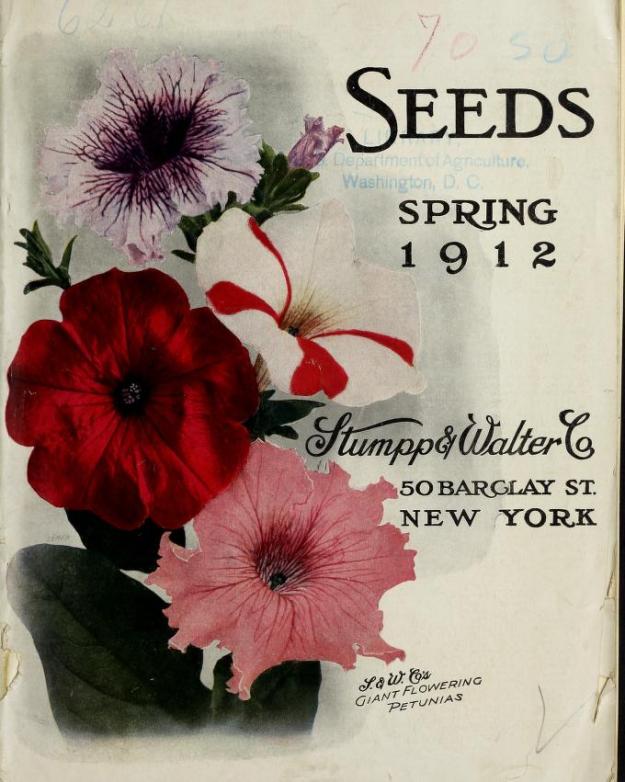
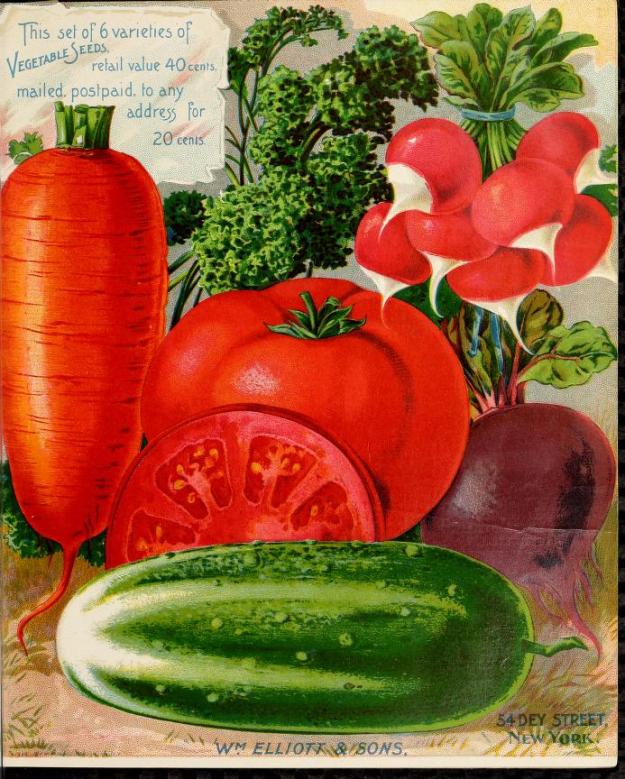
In Manhattan, Burnett Brothers and Weeber & Don, both seed merchants and growers, were based in Chambers Street.  In nearby Barclay Street were J.M. Thorburn & Co founded in 1802, and Stumpp & Walter who specialised in flower and vegetable seed (and beautiful catalogues).  Dey Street was home to William Elliot & Sons Seedsmen and the retail premises of Peter Henderson and Co was in Cortlandt Street.

This list is by no means comprehensive, but gives some indication of the concentration of horticultural businesses in this area of the city.  All these companies sold seeds for domestic use and supplied wholesale grains and vegetable seeds to farmers.  Most sold grass seed for lawns and sports uses, garden tools, machinery, fertilisers and pesticides.

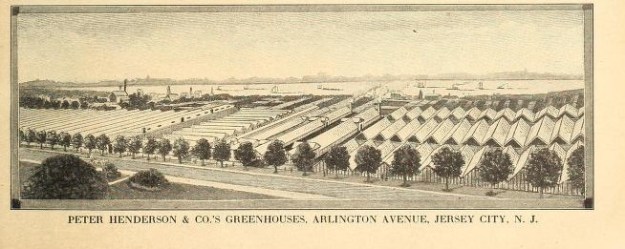
Henderson’s catalogues give some idea of the size of this particular business.  The illustrations below from 1905 show the five storey retail premises in Cortlandt Street plus the seed processing, packing and storage warehouses in Jersey City.  Also shown are acres of greenhouses in Arlington Avenue in Jersey City, then a centre for market gardening.

Peter Henderson wrote articles about gardening for magazines and published his first book explaining how to run a market gardening business Gardening for Profit in 1866.  Gardening for Pleasure (1875) was aimed at the amateur gardener and explains how to grow flowers, fruit and vegetables.  Henderson’s catalogues represented a significant part of the company’s marketing strategy, with 750,000 printed every January in the 1880s.

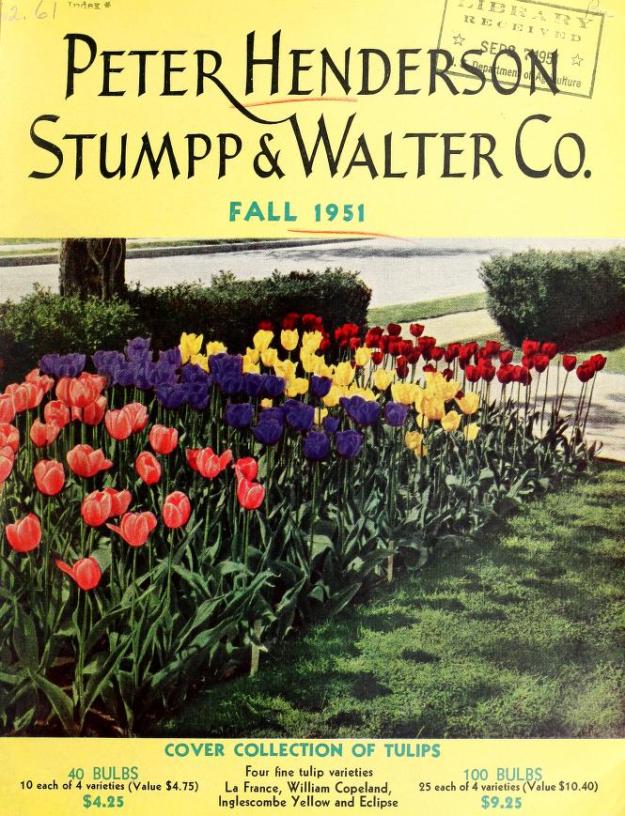
The company remained in family hands until the mid 1940s, but failed to move with the times.  An article in Life Magazine described employees in the Cortlandt Street store using the same scales to weigh out seeds that had been used in the 19th century, and ladies filling flower seed packets ‘using little ivory measuring spoons of different sizes for different-sized seeds.’  Henderson merged with Stumpp & Walter in 1951, but by 1953 this company had closed.

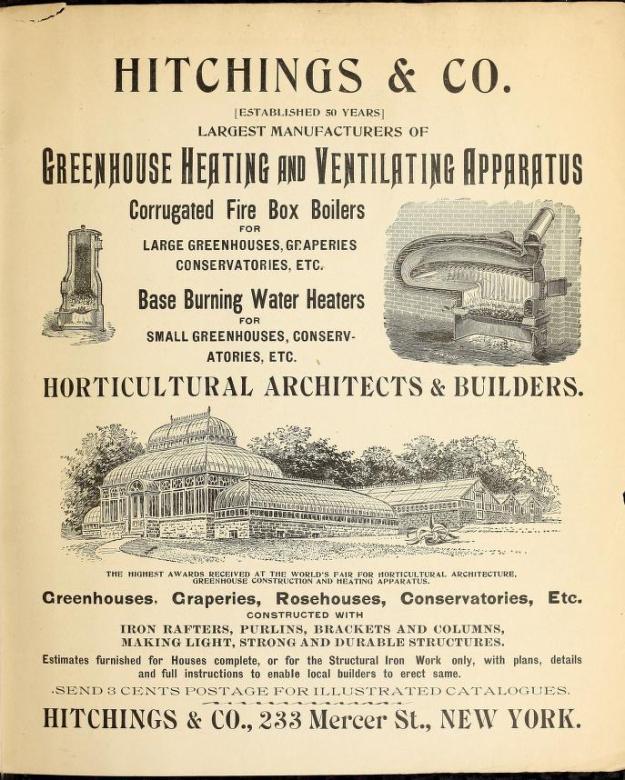
William Elliott’s catalogue of 1897 reveals an advertisement for Hitchings & Co, suppliers of glasshouses and heating systems for these structures – another contributor to the local horticultural industry.  In the late 19th century Hitchings & Co was based in Mercer Street.  The New York Botanical Garden records that this company was established in 1844, beginning as a specialist in the manufacture of ventilation and heating systems for greenhouses, and that it began making greenhouse structures in 1888.

These vividly coloured catalogues must have been an inspiration to gardeners when they were published and remain full of interest today, showing the scale and importance of the horticultural industry and the contribution it made to New York.

This image shows the Peter Henderson Co’s retail premises in Manhattan (centre) and the seed packing premises in Jersey City. From Everything for the Garden 1905. Peter Henderson & Co.

Everything for the Garden Peter Henderson & Co 1916.  Showing acres of glasshouses and cultivation fields in New Jersey supplying the business with seeds, bulbs, tubers, etc.

Everything for the Garden 1910

Everything for the Garden 1910

Everything for the Garden 1916

Everything for the Garden 1916

Everything for the Garden 1916

Stumpp & Walter, Spring 1912

Stumpp & Walter, Spring 1912

Peter Henderson Stumpp & Walter Co Fall catalogue 1951 shortly after the companies merged.

Peter Henderson Stumpp & Walter Co Fall catalogue 1951 announcement of the merger of the two companies.

Wm Elliott & Sons 1897

Wm Elliott & Sons 1897

Wm Elliott & Sons 1897

Burnett Brothers, seedsmen 1918

Burnett Brothers, seedsmen 1918

Weeber & Don, seed merchants and growers 1919

Weeber & Don, seed merchants and growers 1919 – showing detail of the company’s building on Chambers Street, New York

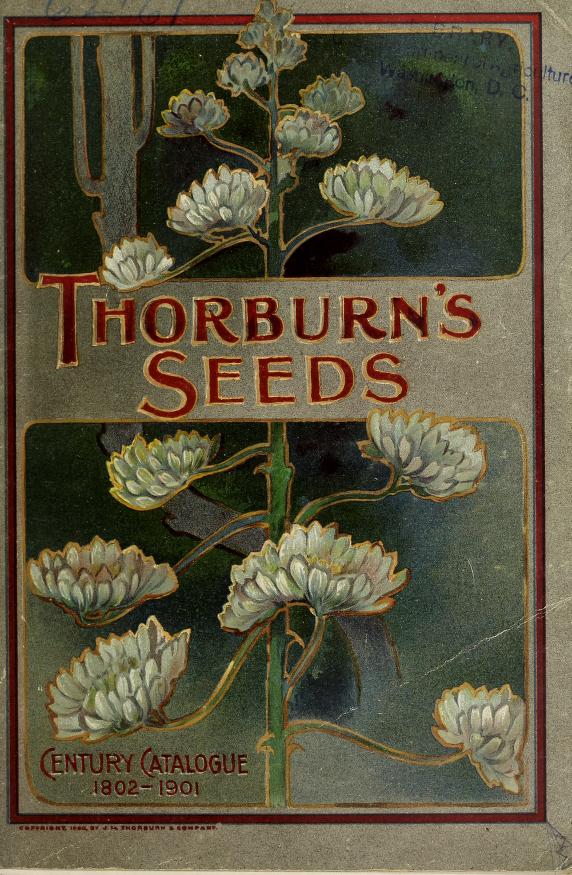
Thorburn’s century: J. M. Thorburn & Co one hundredth annual catalogue 1901

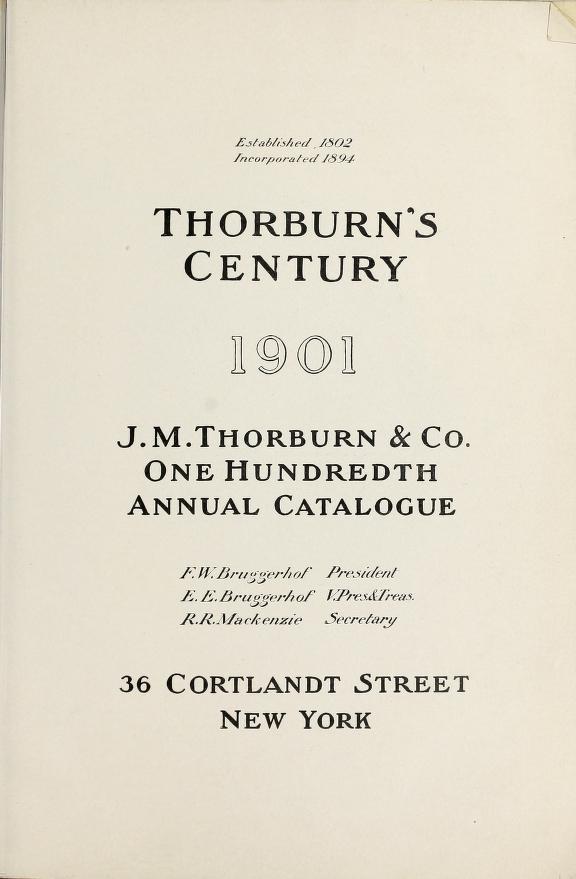
Thorburn’s century: J. M. Thorburn & Co one hundredth annual catalogue 1901

MacNiff Horticultural Company Seed Annual 1921

Further reading:

NJCU Peter Henderson

Biodiversity Heritage Library Seed Catalogs

Smithsonian Libraries Biographies for Seedsmen

Smithsonian Libraries Seed Catalogs

The Appeal of Ivy

If December is the season to celebrate evergreens like ivy, there can surely have been no greater enthusiast for this plant than Shirley Hibberd, author of The Ivy A Monograph published in 1872.

In this illustrated book, each page bordered with ivy, Hibberd discusses historical uses and associations, as well as botanical observations, notes on cultivation and a comprehensive summary of the numerous varieties then available.  Many of these ivies were grown in his garden in Stoke Newington.  Hibberd saw this garden as a place to experiment rather than purely a model for the public to follow, and actively discouraged visitors.

James Shirley Hibberd (1825 – 1890) was a highly successful writer about gardening in the Victorian period.  He did much to popularise amateur gardening through his books, and as editor of garden magazines, where he shared his own experience of planning a garden, growing vegetables and bee-keeping.  Based for much of his life in Victorian London suburbs such as Islington, Hackney and Tottenham, his advice was directed at inhabitants of these new houses, keen to cultivate their new gardens.

It’s probably fair to say that ivy might not be at the top of everyone’s list of favourite plants today.  However, there are good reasons to cultivate this plant, including for harvest at this time of year for seasonal decorations.  Ivy is great for wildlife, providing nesting sites for birds, and nectar from the late season flowers gives a boost to bees and other insects in November, when other flowers have finished.  The berries are consumed by birds through the winter.  The evergreen foliage is always fresh which is especially welcome during the winter months.  It is also very easy to grow.

On the minus side, ivy’s association with ruins and graveyards can give it a rather gloomy feel and some find it dull.  Then there is its habit.  Once established, some varieties of this vigorous plant can overwhelm a wall, fence or an entire building in a couple of seasons, unless kept in check.  Its adventitious roots originating from the stem of the plant are adapted to support the plant as it reaches for the light, but these can work their way into gaps in masonry and woodwork, eventually damaging them.

As the ivy’s champion, Hibberd sees the plant as a protector of buildings:

To the Ivy we are without doubt indebted for the preservation of many a stately pile that would erst have become dust without it.  Thus it may be regarded as the vegetable keeper of historical records, for although it may thrust rude hands amongst them, as when it sends its roots deep into the wall of a tower or keep, it affords a protecting shield against wind, rain and snow; its matted felt of stems and its imbricated leaves constituting a truly waterproof protection, adding to the warmth and ensuring the perfect dryness of the protected structure.

For use in the garden, Hibberd discusses training ivy against walls, to edge borders and suggests plunging pots of ivy into empty flower beds to provide winter interest.  He has various ideas for training the plants in tree and shrub forms, and as standards or pyramids in containers.

Although at first glance this book might not appear to be bursting with relevance to the modern garden, Hibberd’s ideas for trained ivy plants could prove to be very useful additions to a container garden.  In a future post I hope to expand on this further.  In the meantime, here are some illustrations and engravings from the book, which show the variety and beauty of this plant.

Shirley Hibberd

The Ivy A Monograph by Shirley Hibberd